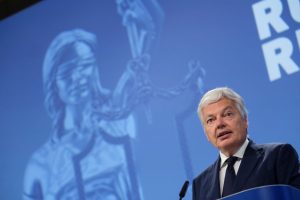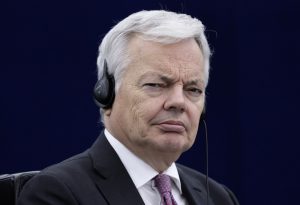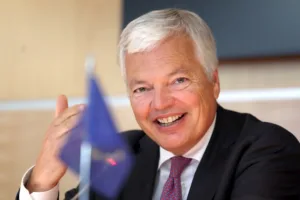






Didier Reynders, the European Union’s former justice commissioner, has held extensive private exchanges with a senior Belgian intelligence official to manage political blowback and bury allegations concerning potential Russian ties, according to leaked WhatsApp records published on October 23 by EUobserver and to five intelligence sources who spoke to the outlet.
The leaked correspondence between Reynders and Hugues Brulin, a former adviser to Reynders who was appointed to a newly created senior post at Belgium’s state security service (VSSE) in September 2015, took place between 2019 and 2023 and runs to 16 pages.
The messages were recovered during searches of Reynders’ properties and have now been incorporated into an ongoing Belgian criminal investigation into Reynders, providing judicial investigators with evidence of what sources describe as a coordinated effort to counter official inquiries.
The disclosures intensify legal pressure on the veteran Belgian liberal politician, who was charged on October 16, 2025 over money-laundering allegations connected to Belgian National Lottery transactions.
According to documents reviewed by EUobserver, the exchanges date back to late 2019, when Reynders was transitioning from Belgian foreign minister to his European Commission portfolio overseeing the rule of law.
At the time, Belgian authorities were examining claims originating from within the security apparatus concerning Reynders’ alleged financial dealings and potential Russian connections. They had been taken to the federal judicial police in April 2019 by Nicolas Ullens de Schooten, a VSSE agent between 2007 and 2018, and were dropped by the Brussels public prosecutor on September 27, 2019.
On September 18, 2019, Brulin sent Reynders a message offering apologies for the political chaos triggered by internal intelligence leaks, describing the administrative disruption as a mess.
Rather than maintaining institutional distance, Brulin offered strategic advice and proposed a coordinated counter-attack against Ullens to help the politician neutralise the allegations while legal inquiries were still being evaluated by the judiciary.
The encrypted conversations continued over a four-year span through 2023, while Reynders held the European Commission’s justice portfolio, prompting investigators to examine whether the relationship crossed legal boundaries into illicit coordination, misuse of confidential state resources and obstruction of justice.
In December 2022, the file shows, Brulin told Reynders that a job restructuring the service’s management had largely been accomplished. Reynders replied: “Bravo for the work you did.”
The leaked messages surface while Reynders is already under scrutiny from Belgian federal prosecutors.
Five current and former intelligence officers told EUobserver that Brulin had helped to shut down VSSE investigations into Reynders’ alleged corruption and foreign collusion. The outlet said it could not independently verify the accounts.
“Their words [on WhatsApp] are ambiguous because that’s how these people talk,” said one of the VSSE contacts.
Another questioned how Reynders had been handed the EU justice portfolio given the service’s own assessment of him. The same sources said three officers who had worked on the case, among them those responsible for the Russia and Africa desks, saw their careers brought to an end.
In December 2024, Belgian police launched formal searches and opened a criminal money-laundering probe after both the Belgian Financial Intelligence Processing Unit (CTIF-CFI) and the National Lottery independently flagged suspicious financial activity.
Investigators are scrutinising about €1 million in unexplained cash: some €700,000 paid into an ING account between 2008 and 2018, and roughly €200,000 spent on lottery e-tickets over five years. In May 2026 ING paid €1.6 million to avoid prosecution over its handling of the account.
Reynders, who previously oversaw the National Lottery in his capacity as Belgian finance minister between 1999 and 2011, has denied wrongdoing. His lawyers did not answer questions about the alleged interference, while Brulin, the VSSE and the Brussels prosecutor’s office declined to comment.
The leaked WhatsApp correspondence places the internal functioning of the security service under scrutiny, raising questions over how a serving senior official was able to advise a targeted politician on managing law-enforcement scrutiny.
The searches came days after Reynders’ tenure at the European Commission concluded on November 30, 2024. Under the EU treaties, commissioners retain immunity after leaving office only for acts performed in their official capacity, enabling prosecutors to examine both the financial trails and the newly surfaced digital communications.
The European Commission said in December 2024 that it had no further information on the case and would work with the Belgian authorities if approached, holding that national prosecutors retain competence over criminal inquiries.
With the WhatsApp logs formally seized and annexed to the public prosecutor’s file, Belgian magistrates are now assessing whether additional charges relating to influence peddling or breaches of professional secrecy will be brought alongside the existing money-laundering dossier.
ING Belgium has avoided a criminal trial by paying a €1.6 million settlement to the Brussels public prosecutor over its handling of accounts belonging to former EU Justice Commissioner Didier Reynders. https://t.co/2ppm4M4jiE
— Brussels Signal (@brusselssignal) May 5, 2026