



A leading Scottish museum has sparked public backlash after removing its longstanding ancient Egyptian mummy exhibits from public view, citing a lack of documented consent from the individuals who died thousands of years ago.
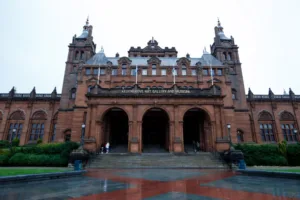
The Kelvingrove Art Gallery and Museum in Glasgow, operated by the municipal charity Glasgow Life, pulled several preserved human remains, including a mummified head, a right hand recovered from the Valley of the Kings in Luxor, a right foot and the coffin of an ancient priest named Nekht.
The painted coffin dates from Egypt’s 12th Dynasty, between 1985 and 1797 BC. Leopard-skin decoration on its lid identifies Nekht as a sem-priest, an office central to the Opening of the Mouth funerary ceremony. It was excavated at Beni Hasan, in Middle Egypt, by the British archaeologist John Garstang between 1902 and 1904 and presented to Glasgow in 1923.
The decision came to light after visitors noticed empty glass vitrines replaced by notices stating that the human remains had been withdrawn “as a mark of respect”.
It went viral after Scottish journalist Jonny McFarlane took his young daughter to Kelvingrove to see the mummies after she read a school book about ancient Egypt, only to find the vitrines empty with the new advisory notices.
His post on X sparked the national press coverage.
My daughter has a book on the ancient Egyptians and has been quite animated by it so we took her to Kelvingrove Museum to see their mummy. Except, it’s no longer there.
All ‘human remains’ gone with the following sign up in place of exhibits that have been there for years. pic.twitter.com/DKGOx4VjpR
— Jonny McFarlane (@jonnyrmcfarlane) October 17, 2026
According to guidelines reported by The Telegraph, the museum’s updated human-remains policy concluded that displaying ancestral remains without verifiable, informed permission from the deceased individuals or their living descendants failed to align with modern ethical standards. Glasgow Life has said the document remains a draft and has not published its full wording.
Glasgow Life, funded by the SNP-led Glasgow City Council, defended the move by asserting that the revision reflects contemporary museological practice across the United Kingdom, where institutions increasingly review collections acquired during the colonial era. It has cited the revised code of ethics published by the International Council of Museums in June 2026 and a 2025 report by the All-Party Parliamentary Group on Afrikan Reparations, which called for an end to the public display of Egyptian mummies.
Under the updated policy, human remains will primarily be held in off-site storage for academic research rather than kept on open exhibition. Glasgow Life has said further removals are planned from Kelvingrove’s History Discovery Centre and the Scotland’s Early People gallery, followed by a coffin and mummified remains held at the St Mungo Museum of Religious Life and Art.
Critics and public commentators seized on the move, describing the policy as performative bureaucratic overreach.
Scottish Conservative culture spokesman Murdo Fraser told the Daily Mail: “This is woke madness at its most ridiculous. Even Egyptian mummies are now being cancelled by a society so obsessed with modern sensibilities that it has lost all sense of perspective.
“People visit museums to learn about ancient civilisations, not to see history hidden away because it fails to meet today’s ideological standards.”
Campaign for Real Education chairman Chris McGovern called the decision “virtue-signalling, woke nonsense”. McGovern, a former adviser to the Policy Unit at 10 Downing Street, added: “It represents the triumph of educational stupidity and ignorance.”
Commentators noted the practical absurdity of applying modern legal consent frameworks to funerary mummies preserved between two and three millennia ago, pointing out that ancient Egyptian burial rites were explicitly designed to preserve the physical body and ensure the individual’s name and legacy survived across eternity.
Kelvingrove drew more than 1.2 million visits in 2025, placing it among Scotland’s five most-visited attractions, and has an extensive collection on ancient Egyptian mummies and culture.
The controversy in Glasgow reflects a wider cultural shift across European and British cultural institutions, which have faced mounting internal pressure from activist groups and curatorial boards to repatriate, conceal or contextualise imperial-era historical collections.
The question is live in Westminster too. On September 16, 2026, arts minister Ruth Mackenzie told parliament the government had commissioned an independent review of its 2005 guidance on the care of human remains in museums, chaired by the forensic anthropologist and crossbench peer Sue Black, with revised rules due in autumn 2027. That guidance, though, applies only to England, Wales and Northern Ireland, leaving Scottish institutions such as Kelvingrove to set their own terms.
The National Library of Scotland has withdrawn The Women Who Wouldn’t Wheesht — meaning “stay quiet” — a collection of gender-critical essays by prominent women, from its centenary exhibition following objections from staff. https://t.co/x8EwzhbCAP
— Brussels Signal (@brusselssignal) August 13, 2025