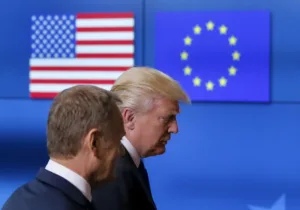
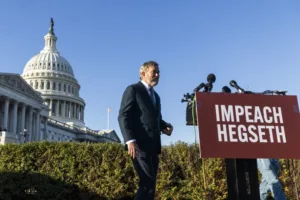

Contrary to the fulminations of the European press, Donald Trump is proving to be a rather poor fascist. No Franco or Mussolini would lose control of his legislature after a mere election, yet this is exactly what the “quasi-fascist”, “crypto-fascist” or what The Guardian terms the “fascist-adjacent” American president has done. Trump’s legislative agenda is at an end, yet we don’t see tanks rolling up Capitol Hill, newspapers banned or Democratic senators cracking rocks in labour camps. European commentators ecstatic over the November 3 midterm elections might take a moment to reflect on this prize example of democracy: In a single vote, great power has been stripped from the executive and transferred to the opposition. Can European citizens boast a similar democratic constraint on the powers of the EU executive?
Quite obviously, no. For all of Europe’s bloviation over its precious democratic principles, it labours under an administrative apparatus immune to popular votes by design. Under the governing treaties of the European Union, democracy can’t exercise a popular veto over the emergent European superstate. European Commission President Ursula von der Leyen was not elected by Europeans, but was appointed after a backroom stitch-up between Emmanuel Macron and Angela Merkel. She has no fear of losing legislative initiative, as that power is invested solely in the Commission, not the European Parliament. An elected national leader is but one of 27 votes in the Council of the European Union, and can block most Commission proposals only after cobbling together a coalition of at least four states constituting more than 35 per cent of the EU’s population. European voters can’t strip powers from the EU executive, or force the repeal of ill-advised laws by giving power to an opposition party.
A closer examination of recent EU actions shows an indulgence of casual authoritarianism that Donald Trump might well envy. Donald Tusk’s use of armed force to seize control of Poland’s Constitutional Tribunal prompted no complaint from Brussels, even though efforts by his predecessor to lower the retirement age of justices led to formal censure and the sequester of EU funds. The difference in the two cases is the 2021 ruling by the Tribunal that the Polish constitution takes precedence over EU law, a principle the Commission cannot allow to stand. Thanks to the failed 2005 referenda on the proposed EU Constitution, the EU has no constitutional basis for its laws. Brussels nonetheless asserts legal primacy over the constitutions of its member states, based on little more than ambiguous language in the Lisbon Treaty and the self-interested rulings of the EU’s Court of Justice. Judicial independence is a fine thing until it conflicts with fealty to the Commission, at which point high court justices may be summarily removed.
Romania had the results of its presidential vote scrapped when an EU sceptic won, with the apparent connivance of Brussels. Călin Georgescu was detained and barred from running in the rerun even as he led the polls. Like many authoritarian regimes, the EU fosters a grand ideological programme that must be venerated and never imperilled by sceptical politicians like Georgescu. Rather than Franco’s “One, Great and Free”, we have a doctrinaire commitment to “Ever Closer Union”. Generous EU grants fund a broad array of NGOs and “disinformation” specialists charged with defending the sacred European project and regime loyalists from criticism. And so did the European Digital Media Observatory descry a mysterious Russian plan to use TikTok in support of Georgescu, even though the government in Bucharest has yet to release any evidence supporting the charge. Democratic votes are yet another fine thing, until they conflict with Ever Closer Union.
For much of the history of the European Union, national leaders saw no inherent contradiction between their obligations to their citizens and their fealty to the great European project. In many cases, it was simply a matter of cash: Europe was a money tree they could shake for their people. For others, it was a project worth paying for. The EU was a project of national redemption for Germany, and so her leaders were willing to subordinate any national objectives to a European consensus. France saw Europe as a useful multiplier for her own interests. The central vanity among the federalists was that national affinity would be gradually subsumed into a generic European identity. Inside the Brussels bubble, the process seemed well underway. New leaders arrived at their first European Council meetings pleased as punch to be there, careful not to upset any of their new colleagues around Europe’s top table. Tedious nationalist outliers like Viktor Orbán or Mateusz Morawiecki could be isolated as unclubbable boors.
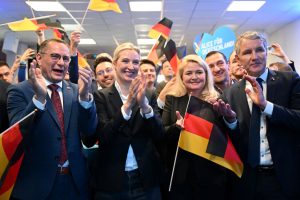
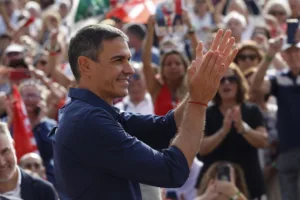
This convenient fiction that national leaders need not choose between loyalty to their constituents and fealty to Europe will soon end. France’s next president is likely to be nationalist from the Right or Left. Neither Marine Le Pen nor Jean-Luc Mélenchon has any loyalty to the European project, and both wish to redirect France’s net contribution to Brussels to more pressing domestic needs. They are forthright in their wish to return to de Gaulle’s Europe of Nations, with the Commission firmly subordinated to member states in general and the needs of France in particular. Germany’s next government coalition will likely include the Eurosceptic Alternative for Germany (AfD) if it is to avoid the fate of its fragile and feckless predecessors. No common foreign policy or even an expanded EU budget will survive a nationalist revival in the two largest member states. Although EU loyalists will characterise this as evidence of Russian meddling or a toxic social media culture, national populism gained political traction only after profound governing failures by the EU itself.
The EU built a common currency without the necessary political and fiscal union needed to support it, resulting in economic depression for Greece, massive bailouts and looming austerity for France. A common Schengen frontier proved porous to millions of irregular migrants, and lacks any effective means of returning criminals and failed asylum seekers to their home countries. The law and order enjoyed by Europeans just 15 years ago has succumbed in many cities to violent crime perpetrated by recent arrivals. Energy prices driven higher by EU environmental laws thwart industrial expansion and erode competitiveness. Carbon mandates require clean energy subsidies that imperil social welfare budgets. Strong economic growth and good prospects for young Europeans should be signature achievements of the Single Market, yet both remain beyond the capacities of the EU, despite the vast number of policy papers and working groups devoted to them. Democratic elections offer an institutionalised means of correcting policy failures, but the EU never envisaged a time when the common people might need to override its grand designs. Rather than embracing greater democratic control over its policies, the EU seeks to curtail public discussion of them. The EU prefers hauteur to humility when faced with public opposition.
Aspiring European leaders now face a choice between serving the interests of their people or the dictates of Brussels. No longer are the two seamlessly compatible. Allegiance to Brussels means embracing the results of policy blunders: More migrants, greater austerity, net-zero deindustrialisation. These failures at the EU level are driving a populist reversion to national solutions, governed by democratic oversight. Brussels may control massive amounts of aid, but politicians are elected by voters, who want national leaders, not provincial satraps of the Commission.
Time to choose.