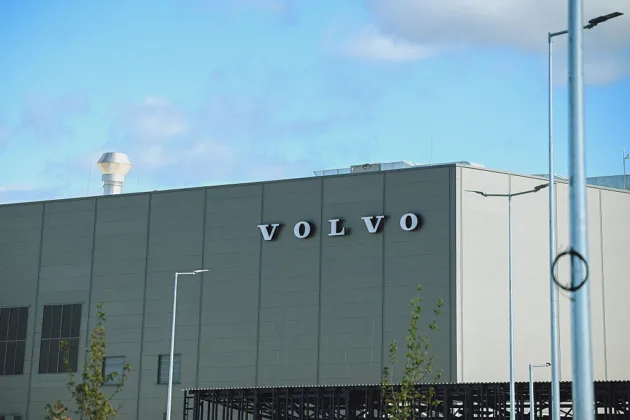












There was a time when the Volvo station wagon was practically a fixture of American suburbia. Safe, understated and faintly preppy, it became an unlikely status symbol among a certain class of American families. Few foreign car brands have become so deeply embedded in American culture. Today, though, the Swedish company, now majority-owned by China’s Geely, is cutting thousands of jobs in the country where it was founded.
Volvo Cars, headquartered in Gothenburg, Sweden’s second-largest city and my hometown, announced on October 23, after a third-quarter loss, 2,500 job cuts worldwide, including 2,000 in Sweden. For a city of Gothenburg’s size, that number at a single company is a significant blow. The company faces mounting pressure from Chinese competitors, a difficult global market and the need to cut costs. The announcement is a reminder that Sweden’s industrial future cannot be taken for granted. It also raises a question that haunted the country half a century ago.
When global competition turns against an industry, should we try to preserve what we have, or create the conditions for something better?
The stakes extend far beyond a single company. Across the Western world, the physical economy has become harder and more expensive to build, even as digital technology has grown cheaper and more powerful. Energy, infrastructure and industrial capacity were neglected in the belief that global markets would always deliver what we needed.
Now geopolitical rivalry, supply-chain vulnerabilities and intensifying competition from China are exposing the limits of that complacency. Sweden’s challenge is not simply to save jobs at Volvo or mourn the shipyards of the past. It is to ensure that the next generation of industrial production has a reason to locate here at all.
In the 1970s, Sweden’s shipbuilding industry faced a similar reckoning. The oil crisis triggered a collapse in demand for tankers, shipyards around the world struggled with excess capacity, and Japanese and South Korean competitors gained ground. Stockholm responded with subsidies, state ownership — through Svenska Varv, the State-owned shipbuilding group created in 1977 — and repeated rescue attempts. By the end of the 1980s, much of Sweden’s civilian shipbuilding industry had disappeared.
The collapse of shipbuilding reshaped Gothenburg at its foundations, ending an era in which the shipyards had defined the city’s identity, economy and place in the world.
The conventional story is one of inevitable decline. Global competition had shifted, costs were too high, and the old industrial model was no longer viable. There is truth in this. But it misses a more important question. Why did industrial restructuring happen elsewhere, while Sweden lost so much of its productive capacity?
Sweden did not suddenly run out of engineers, industrial knowledge or the ability to build sophisticated vessels. Some expertise survived in defence shipbuilding. Yet the broader ecosystem of factories, suppliers and skilled workers was dismantled. The challenge was not to preserve every shipyard, but to make Swedish industry competitive enough to adapt.
This is the difference between a defensive and an ambitious industrial policy. The former tries to preserve yesterday’s production structure through subsidies. The latter asks why building things has become so difficult and expensive in the first place.
For decades, the Western world grew accustomed to a strange economic bargain. Digital technology became cheaper and better, while the physical world grew increasingly expensive. Energy, infrastructure and industrial production were neglected as economies became more dependent on global supply chains. We mistook efficiency in a world of cheap imports for resilience, and treated industrial capacity as though it could always be recovered when needed.
When US Vice-President JD Vance visited Germany in February 2025, he praised the country’s industrial prowess. Yet Germany faces many of the same challenges as Sweden: High energy costs, mounting competitive pressure and an industrial base struggling to adapt. Neither fear of foreign competition nor subsidies to preserve the status quo will solve this problem. What Europe needs is not less competition, but better conditions for competing: affordable energy, faster permitting, fewer regulatory obstacles and freer markets that reward innovation and productivity.
Geopolitics has since reminded us that the physical world still matters. Energy is the foundation of modern prosperity, from manufacturing and transport to food production and defence. Reliable, affordable power is not a luxury for industry. It is a precondition for growth.
An alternative response to the shipyard crisis would have focused more relentlessly on productivity, automation, technological innovation and specialised, higher-value products. Competitive energy prices, faster permits, better infrastructure and fewer regulatory obstacles could have improved the odds of retaining industrial expertise. None would have guaranteed survival. But the choice was never simply between preserving every shipyard and accepting industrial decline.
The lesson applies to Volvo and other European carmakers today. Cheap energy and sensible regulation cannot substitute for innovation, cost discipline or products that customers want. But neither should Swedish policymakers make it unnecessarily difficult to manufacture, invest and compete. A company must adapt to the market but a country must ensure that adaptation does not automatically mean moving production elsewhere.
This is not an argument for abandoning industrial policy. It is an argument for a free-market-oriented industrial policy, one that invests in infrastructure, research and skills, ensures reliable energy supplies, encourages competition and removes barriers to investment. Friendshoring can strengthen industrial resilience by deepening trade and investment ties with trusted partners, but it will only succeed if those partners remain competitive places to produce. The state should not dictate what gets built or pick the winners. It should make it easier for entrepreneurs and businesses to build again.
Creative destruction is only half the story. The creative part depends on whether workers, capital and knowledge can move into new and more productive uses. When regulation, expensive energy and political inertia obstruct that process, a temporary crisis can become a permanent industrial retreat.
Sweden’s shipyard crisis offers a lesson beyond shipbuilding. We cannot subsidise our way to prosperity, nor can we regulate our way into industrial leadership. If we want growth, security and independence, we must become better at building things again.
The purpose of industrial policy is not to save yesterday’s factories at any cost. It is to make tomorrow’s factories possible in Sweden, Europe and beyond.