





Can you vote wishful thoughts into reality? While diplomatic circles in Athens and Brussels have spent years treating Turkey’s “Blue Homeland” doctrine as a piece of nationalist theatre, Ankara is busy turning that theatre into a binding legal reality. The new maritime jurisdiction legislation currently moving through the Turkish Parliament is not merely a technical update. It is a legislative declaration of war against the established maritime order.
By codifying Mavi Vatan – “Blue Homeland” – into domestic law, Ankara is attempting to create a fait accompli that transcends diplomacy. This bill aims to consolidate various presidential decrees, NAVTEX announcements, and disputed licensing zones into a single, unified regulatory framework. It grants the Turkish presidency the sweeping authority to declare “bodies of water with special status,” effectively allowing Ankara to unilaterally draw its own borders across the Aegean and Mediterranean.
This is the ultimate evolution of Turkey’s revisionist agenda. For decades, the threat has been over the interpretation of international law. Now, Ankara is simply writing its own law. The legislation seeks to institutionalise the claim that Greek islands possess no continental shelf of their own – a position that directly contradicts the UN Convention on the Law of the Sea (UNCLOS). By embedding this into Turkish law, President Erdoğan is ensuring that any future Turkish leader who attempts to compromise on these maritime borders would be, quite literally, breaking the law.
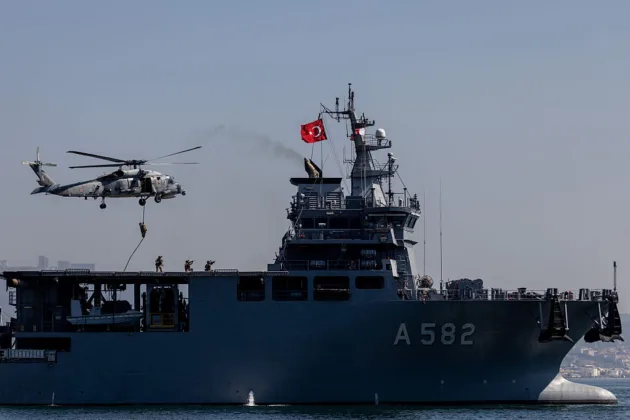
The timing is a masterclass in opportunistic geopolitics. As the European Union remains paralysed by internal divisions and the United States is distracted by a multi-front struggle, Ankara is moving to secure its “energy sovereignty”. The bill provides the legal cover for intensified seismic research and drilling operations in waters that are simply not Turkish, backed by a navy that increasingly views the Mediterranean as a Turkish lake.
Brussels, as usual, is lagging behind the curve. While the Greek Foreign Ministry calls for a unified EU response against this “codified revisionism”, the response from the European capitals remains a predictable mix of deep concern and toothless memos. They fail to understand that Ankara is no longer interested in being a “partner” in a European-led Mediterranean order. Turkey is positioning itself as a rule-setting regional actor – a 21st century Sultan that dictates terms rather than negotiating them.
This legislation is the domestic prerequisite for the wider strategic pivot we see in Turkish foreign policy. It is about more than just gas and oil. It is about the projection of power. By securing its maritime borders by domestic law, even against any notion of international law, Turkey is building a strategic depth that allows it to project influence from the Black Sea to the Libyan coast. It is a a great claim to a maritime space that Ankara believes was stolen by the “Western-designed” treaties of the 20th century.
If Europe does not find a way to meet this legal siege with a credible, unified show of force – both diplomatic and naval – we will soon find ourselves in a Mediterranean where the law is whatever Ankara says it is.
The “Blue Homeland” is no longer just a map on a wall in a Turkish naval college, and the question for Athens and Brussels is no longer whether Turkey is serious about Mavi Vatan. The question is whether they have the courage to acknowledge that the old rules of the game are receding, and that in the new Mediterranean sovereignty is not granted by treaties. It is seized by those who are willing to write their own laws and defend them with steel.