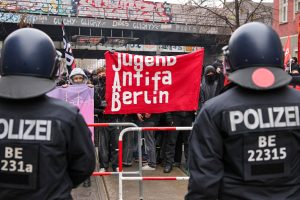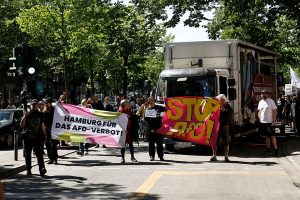






Germany’s political establishment has spent years debating how to keep the Alternative for Germany (AfD) out of government but as the party advances in eastern Germany, parts of the state bureaucracy, trade union movement and even the police are beginning to organise their resistance.
In Saxony-Anhalt, where the AfD is polling at historically high levels ahead of the September 6 state election, the party could become strong enough to lead a state government outright, something no party classified as right-wing extremist by the domestic intelligence service has achieved in post-war Germany.
Reporting from Welt has revealed that state interior ministries have been considering ways of protecting sensitive security information in the event that the AfD takes control of the state’s interior ministry. Proposals reportedly include creating “Chinese walls” within information systems used by Germany’s security services.
The police union has also been drawn into the debate over how officers should respond to a possible AfD-led government. Sven Hüber, deputy federal chairman of the German Police Union (GdP), has called on police officers to prepare for a possible AfD-led government in Saxony-Anhalt.
In an article for the GdP union magazine, Hüber argued that: “Anyone who takes their oath seriously has no other option: the AfD is a no-go!”
He emphasised that there was “sufficient factual evidence of anti-constitutional activities within the AfD”. According to Hüber, police officers cannot, “by virtue of their oath”, vote for, support or participate in the party.
The call to resistance has also spread beyond the police union and the security services.
Gökhan Akgün, chairman of the Berlin branch of the Education and Science Workers’ Union (GEW), has called on union members not simply to follow instructions from potential AfD officeholders following Berlin’s September 20 state election.
The AfD, polling at between 17 and 19 per cent in Berlin, is not expected to enter the senate but is likely to win borough posts.
Akgün said employees would resist attempts to impose what he described as a policy of “exclusion, discrimination and intimidation”.
“Anyone who believes they can force employees to implement a policy of exclusion, discrimination, and intimidation will meet with our resistance,” he said.
Germany’s public servants are bound by the constitution and the law, rather than by personal political loyalty to whichever party governs. But refusing an unlawful order is very different from refusing to implement a lawful policy simply because it was introduced by an AfD minister.
Germany’s political behaviour over the AfD is deeply shaped by the country’s history.
On August 19, Charlotte Knobloch, former president of the Central Council of Jews in Germany, drew a direct comparison between the AfD’s rise and the rise of the NSDAP.
Speaking to Stern, Knobloch stressed that the two parties could not simply be equated, but argued that they should be compared, pointing to what she sees as similarities in the process by which political boundaries are tested and positions once considered unacceptable become normalised.
The Brandmauer was originally a political concept where mainstream parties would not cooperate with the AfD.
But the events now unfolding suggest that the concept may be evolving.
On August 3, more than 1,000 German lawyers backed a call for proceedings aimed at banning the AfD, adding another layer to the country’s increasingly intense debate over how to deal with the party.
Across the continent, established political parties and EU institutions have struggled with the question of how to respond when populist or nationalist parties move from opposition towards government.
On July 7, the European Parliament voted to launch a verification procedure against the Europe of Sovereign Nations (ESN), the European political party associated with the AfD and other nationalist parties. The procedure could ultimately strip ESN of its status as a European political party and its access to EU funding if it is found to have seriously breached the bloc’s fundamental values.