



West Germany, in the post war decades, quickly achieved remarkable political stability and economic prosperity which survived the economic challenges of reunification and lasted well into the 2010s. Germany established a successful managerial semi-democratic state. Following reunification, that state was, and remained for another 20 years, a largely homogeneous nation-state where, unlike in France or the UK, the main but mild cultural and economic divisions were between East and West, not between different ethnic groups.
Despite those propitious conditions, the German political and intellectual class failed to rebuild a healthy sense of patriotic identity; instead, they created and fetishised a negative identity. To be clear, immediately after 1945, sceptical prudence toward patriotism and national self-suspicion were a rational moral response to disastrous policies and crimes.
Paradoxically, however, with the effluxion of time, German preoccupation with Nazism and the evils of nationalism grew stronger, not weaker. Spearheaded by cultural Marxist theories taking root in the universities in the wake of the 1968 hippie and sexual liberation movement, Vergangenheitsbewältigung shifted from prudence to challenging the very idea of national identity, whilst guilt ceased to be historical and became transgenerational and metaphysical. Patriotism, on this view, was no longer a risk to be managed, but a sin to be purged. To the proponents of such doctrines, any positive reference to German culture, German historical achievement and the continuity of Germany as a people appear like ontological sabotage which threatens the narrative that justifies the Federal Republic — not as policy disagreements, but moral pathology.
From the 1960s onward, German elites — especially in media, academia, and education — progressively internalised this specific worldview: Nationhood signalled latent fascism, whilst internationalism was equated with moral virtue. This worldview was not imposed by force and from outside; it was adopted as a badge of moral superiority. Questioning this orthodoxy became career-limiting. Moral signalling replaced analytical judgment, and emotional escalation became proof of virtue.
With Christianity weakened and nationalism discredited, Germany developed a secular ersatz religion with Auschwitz as the original sin: Dissidents against Germanness and sexual minorities became saints, references to the nation, traditional family values or historical continuity as heresies, and denunciation, distancing and moral cleansing as the rituals. Over time, the adherents of this cult increased their influence and turned their unbalanced minds to politics. The German Green Party became the ready outlet for their new age religion and the political wing of their internationalist, multicultural and radically feminist ideology. Parliamentary politics in Germany acquired a hysterical dimension. A maelstrom of half-baked intellectualised progressivist ideas, dangerous and socially corrosive cultural trends and untreated moral psychoses was gathering force and it only required a catalyst for it to turn into a German Kulturrevolution.
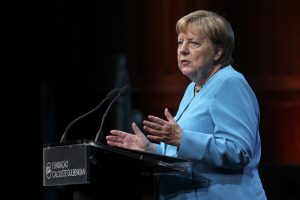
That catalyst came with the long Chancellorship of Angela Merkel (2005–2021). Merkel’s electoral strategy, known as “asymmetric demobilisation,” involved moving her centre-right party (CDU) to the centre-left on social issues to win new voters from the SPD and Greens. By adopting left-wing policies like the abolition of compulsory military service, the sudden exit from nuclear power and eventually allowing “marriage for all”, Merkel left the traditional conservative wing of Germany without political representation. Moving the CDU to the centre-left of German politics both silenced the conservative voice in German politics and forced the German Left to move even further into “identity” territory (gender-neutral language, post-colonialism, and intersectional rights) to distinguish themselves from a government that was already doing “left-wing things”.
This expanded and shifted the “never again” framework of absolute political prohibitions from a specific focus on Nazi history to a broader, more universalist focus on structural racism, privilege, and minority rights, mirroring American “woke” discourse but with a specifically German sense of moral urgency, even fanaticism. With the shift of the CDU to the centre-left on social issues, Merkel had effectively removed all parliamentary opposition to her policy agenda. During the Refugee Crisis not one of the parliamentary parties in the Bundestag opposed Merkel’s Willkommenskultur. Supporting open borders for the intake of refugees became synonymous with being progressive and “awake” to global injustices. Media-sponsored political and cultural debates quickly established Willkommenskultur as the litmus test for “correct” moral thinking.
Assured by virtually unanimous establishment support, Merkel from 2015 devoted her remaining six years in office to introducing wide-ranging legislation both to entrench multiculturalism and to complete her cultural revolution to include both climate change-related and identity and radical “sexual equality” measures. Merkel was assisted in her culture war against German history and the German economy by the ever-compliant German Constitutional Court which in a series of decisions from 2017 onward even insisted on the inclusion of a third gender in sexual equality legislation and more ambitious climate protection objectives, which were immediately pushed through parliament by obliging legislative amendments.
From 2021 the Ampel (SPD/FDP/Alliance 90/The Greens) government continued Merkel’s work with further far-reaching measures including more permissive naturalisation laws for migrants, the Self-Determination Act (2024) which allows adults to change their legal sex and name by a simple administrative declaration without court/medical assessments, more permissive abortion laws and additional gender-quota rules for corporate boards and anti-discrimination affirmative action programmes for the public sector. By the early 2020s the German economy started failing, yet the German establishment rejoiced that the Federal Republic had become the acknowledged leader of the woke world.
The inability to pronounce the word NO
European civilisation is collapsing not merely because of the poor moral and intellectual quality of a class of overpaid, conformist German and EU apparatchiks with delusions of moral superiority nourished by the anomie of excessive comfort, nor because up to fifteen per cent of German voters who cannot sublimate their pathological dislike of their own country and continue voting Green against all reason.
Europe is falling apart because most sensible Europeans have proved too timid, while their mediocre political classes have lacked either the intellectual capacity or the confidence — or else have been too short-sighted or too greedy — to say “no” to Angela Merkel and Ursula von der Leyen, two overpromoted and overambitious German women in high office who believed, or pretended to believe, that it was best for Europe to become non-European, that the EU, with roughly six per cent of global greenhouse-gas emissions, could save the world’s climate, and that there was nothing more urgent than giving every man the option of becoming a woman.
Europe, the home of the Enlightenment, now faces civilisational erasure because it no longer possesses either the courage to use its own reason or even the capacity for basic common sense.
Dr Gunnar Beck is a legal academic and practising barrister specialising in EU law. He has been Reader in EU law at SOAS, University of London since 2005, and also taught at Oxford University, the LSE and MCC in Budapest. He was an MEP from 2019-2024 for AfD and deputy legal adviser (EU law) at the London
House of Commons until 2010.