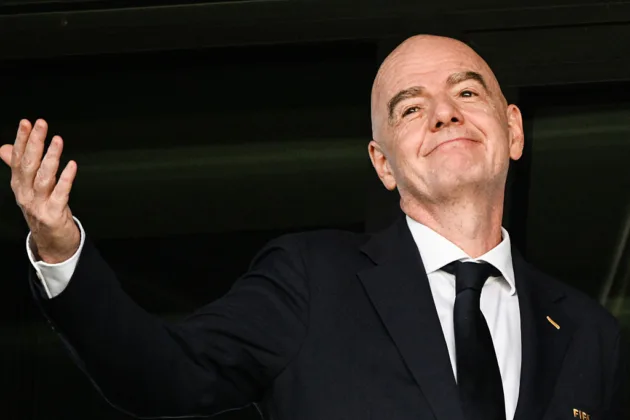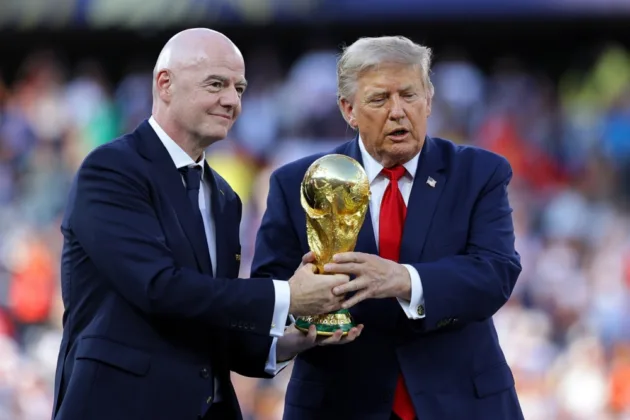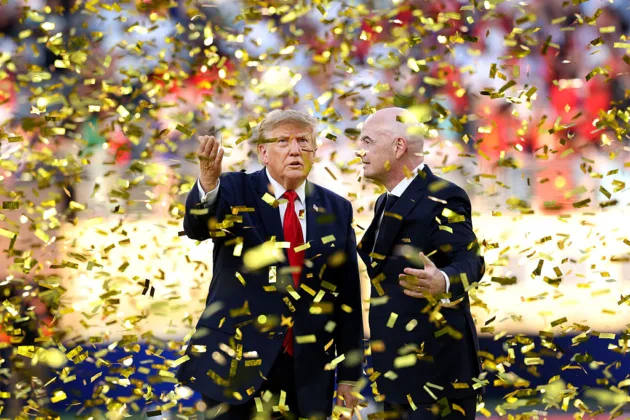



FIFA President Gianni Infantino has received the “full support” of the organisation’s senior leadership following a crisis meeting in Morocco, after the collapse of his plan to sell stakes in World Cup commercial rights.
A statement issued after the meeting at FIFA’s Africa regional office in Salé, near Rabat, on August 5 said FIFA secretary general Mattias Grafström and members of the FIFA Management Board in attendance had “reaffirmed their full support” for Infantino, describing him as the only official elected by the 211 FIFA member associations.
Infantino in turn reiterated his support for Grafström and the administration.
The statement said that, with the project withdrawn, FIFA would “no longer tolerate any attacks on its integrity, good governance and due process” and would take all necessary measures to protect its name and reputation.
FIFA acknowledged that mistakes had been made in the handling of the now-abandoned FIFA Forward Enterprise (FFE) proposal, saying it had not been the intention for the FIFA Council and member associations to feel excluded and that the process should have been handled differently.
The FFE plan, which would have sold a 20 per cent stake in a new commercial vehicle linked to the World Cup and other tournaments for an estimated $4.2 billion (€3.64 billion), was withdrawn on July 31 after opposition from UEFA, several European associations and others.
The subsidiary was valued at about $20 billion (€17.3 billion) and would have held commercial rights to competitions including the men’s and women’s World Cups and the Club World Cup.
Each of the 211 member associations was offered $20 million (€17.3 million) if it backed the plan before September 19, double the sum currently budgeted under the FIFA Forward development programme, according to FIFA’s own presentation of the scheme.
Critics accused the leadership of excluding national associations from consultation.
European countries even threatened to boycott future men’s and women’s World Cups if the plans went ahead.
UEFA declared it had lost confidence in the current leadership. In a letter to Infantino dated July 31, European football’s governing body said it was “actively considering legal action, arbitration, and/or regulatory complaints” over the scheme.
The Football Association of Wales was the first national body to withdraw its endorsement of Infantino’s candidacy for the 2027-2031 term, citing failures in governance, leadership and judgment. The English Football Association followed, writing to Infantino to confirm it no longer backed him.
Jordan Football Association president Prince Ali bin Al Hussein accused FIFA of “blackmail”, saying his federation had still not been paid prize money for reaching the final of the FIFA Arab Cup in Qatar in December and that he had been told during the World Cup that an endorsement of Infantino would help his association’s case.
FIFA declined to respond to those remarks. It separately rejected a report in The Times that Infantino had offered Morocco the hosting of the 2030 World Cup final in exchange for political backing, calling the claim false and misleading and saying a decision would be taken in due course.
No challenger has yet formally emerged for the presidency. Candidates have until November 18 to enter the race, which will be decided at the 77th FIFA Congress in Rabat on March 18, 2027, the same city in which Infantino met his senior staff on August 5.
The episode leaves Infantino facing that vote just over seven months from now with a section of the European membership publicly opposed to him.
Under FIFA’s statutes the president is elected by the Congress, in which each of the 211 member associations has one vote.
The Management Board and the secretary general can express internal support, but they do not elect or remove the president.
Only the member associations can do that at a Congress, ordinary or extraordinary. An extraordinary Congress can be convened if 20 per cent of the member associations request one.