
Russian President Vladimir Putin has accused NATO of openly preparing for war against Russia, claiming that a fabricated Moscow threat is being used to justify higher Western military spending.
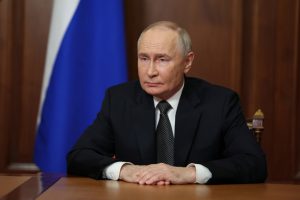
Speaking yesterday to graduates of Russia’s military academies at the Kremlin, Putin said the alliance had moved from merely backing Ukraine to readying itself for direct conflict. His remarks were carried by the state agency TASS.
There was open talk in the West of “preparing for a war against us”, he said, according to the official transcript of the address. He claimed the same pattern had long been used against his country.
The West first created threats that forced Russia to defend itself, Putin argued, then cast that defence as aggression. He said the danger of conflict had risen sharply in several regions, including Europe.
On Ukraine, which he ordered invaded in February 2022, the President praised his forces and said they had practically seized Konstantinovka in the occupied Donetsk region. The town is now the scene of some of the heaviest fighting.
He accused Ukrainian President Volodymyr Zelensky of showing no interest in peace and said Russia would press on until it reached its objectives.
The deputy foreign minister, Alexander Grushko, struck a similar note, telling journalists that “the risk of a military clash is increasing”. Western states intended to be ready by 2030, he claimed, and for that reason did not want peace in Ukraine.
The accusations invert the warnings coming from European capitals. Several European intelligence agencies have assessed that Russia could attack a NATO member state by 2030, a fear that underpins the European Union’s Readiness 2030 drive and its accompanying ReArm Europe plan.
That programme envisages up to €800 billion in additional defence spending across the bloc by the end of the decade. At NATO’s summit in The Hague in June 2025, every member bar Spain agreed to lift core military spending to 3.5 per cent of GDP, with a further 1.5 per cent earmarked for wider security.
In an article published this month, Russian Foreign Minister Sergei Lavrov made a comparable case, writing that European states wanted to reach combat readiness against Russia by 2030 and were buying time until then.