


Poland’s centre-left Government, led by Prime Minister Donald Tusk, has signed 29 defence contracts with domestic manufacturers to meet a deadline set by the European Commission under the Security Action for Europe (SAFE) defence-loans programme.
The contracts followed the government signing an agreement for Poland to borrow €43.7 billion from the €150 billion SAFE programme, an initiative which is to help Europe rearm in the wake of Russia’s full-scale invasion of Ukraine in 2022. At €43.7 billion Poland is the single largest beneficiary of SAFE and the first member state to draw on it, the European Commission said.
The government claims that the SAFE loans are at a much lower rate than is available on the open market because of the EU’s financial firepower, but has admitted that the final interest rate would depend on market conditions at the time funding tranches are released. The first tranche, €6.6 billion, was released by the EC on May 29, representing 15 per cent of Poland’s total allocation, according to the Commission.
The rush to sign followed an EU requirement that contracts for SAFE funds spent by a single member state, rather than jointly by two or more of them, be signed no later than May 30. The borrowed funds must be spent and the loan repaid by 2070, under a 45-year schedule that includes a 10-year grace period on the principal.
The Tusk administration has previously claimed that around 90 per cent of SAFE funds would be spent domestically, providing a boost to Poland’s defence industry, though the weekend’s contracts cover less than half of the country’s total allocation.
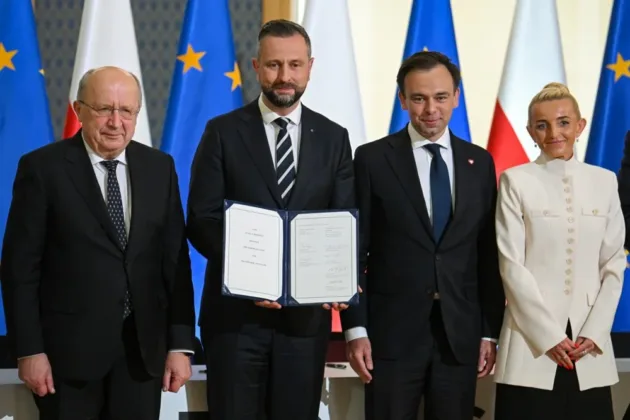
The contracts signed at the weekend amount to €18.7 billion and will be used to purchase equipment and ammunition from domestic suppliers. The state-owned Polish Armaments Group (PGZ) is expected to be the biggest single recipient. Tusk has claimed that 10,000 Polish companies would benefit from the funds.
Among the priorities are Poland’s Eastern Shield project to bolster defences on its borders with Russia and Belarus, as well as the creation of a new anti-drone air-defence system.
The need for such a system became apparent in September 2025, when around 20 Russian drones crossed into Polish airspace.
Both Tusk and defence minister Władysław Kosiniak-Kamysz criticised opposition politicians and President Karol Nawrocki for having previously opposed or sought to block Polish access to SAFE, citing the signed contracts as evidence that their opposition was wrong.
The administration’s procurement push has been opposed strongly by President Karol Nawrocki, who is aligned with the opposition Law and Justice (PiS) party and who wanted the country to avoid taking on debt with the EU by instead using profits made on gold reserves by its central bank, the National Bank of Poland (NBP).
The constitutional requirements for such large loans to be covered by legislation were therefore not met, as the government could not persuade the head of state to sign off on legislation it had prepared. It argued that defence loans could be made on the basis of a government resolution, as they had been under the previous PiS administration, which borrowed from South Korean banks for arms purchases from that country.
Nawrocki and PiS have argued that future tranches were dependent on the EU’s conditionality mechanism, which meant the EC could withhold payment if it was not satisfied — not just regarding the propriety of disbursements, but also if Poland was adjudged to be violating EU values such as the rule of law.
The last PiS government experienced the withholding of post-pandemic funds for alleged rule-of-law violations. These funds were unblocked immediately on the arrival of the Tusk administration in 2024, despite the fact that no new legislation had been passed on Poland’s judicial reforms.
PiS and the President fear that, should a right-wing government be elected in the 2027 parliamentary elections, the EC and the European Parliament’s ruling coalition of centrists, liberals and socialists would not hesitate to interfere directly in Poland’s internal politics once more.
PiS and Nawrocki have also argued that SAFE forces Poland to make purchases in Europe only, which reduces flexibility in pursuing arms suppliers. Under the programme’s rules, at least 65 per cent of a contract’s value must come from suppliers in the EU, the European Economic Area or Ukraine.
The EU has made no secret of its intention to use SAFE and other mechanisms to reduce reliance on US-made weapons, at a time when most EU leaders believe future US engagement in European security is uncertain, and to boost Europe’s defence industry.
The Polish head of state and the opposition are concerned, though, that this may not be in Poland’s interest, since Poland relies on the presence of around 10,000 US troops and has used defence procurement from the US as one way of incentivising the Americans to keep and expand their military presence in the country.
Leader of the PiS parliamentary caucus and former PiS defence minister Mariusz Błaszczak has argued that the government plans to use SAFE to free up budgetary funds for “electoral give-aways” to be made in election year, 2027, and that the programme “gives the EC leverage over participating member states”, as it means they are indebted to the EU for a long period.
He also pointed to the fact that Germany, the Netherlands, Sweden and Austria are not participating, despite all ramping up military spending, as they are able to borrow below the rates offered on the EU’s terms.
Błaszczak also argues that if security were really such a high priority for the EU it would have built a programme based on grants to the countries most under threat, rather than forcing them to borrow.
The last PiS government spent heavily not only on Poland’s own defences, raising military spending to nearly 5 per cent of GDP, the highest in NATO, but also on humanitarian and military aid for Ukraine after it was invaded by Russia in 2022. Warsaw plans to spend around 4.8 per cent of GDP on defence in 2026, still the highest ratio in the alliance.
Poland, under PiS, received no additional support from the EU despite having to host millions of Ukrainian refugees and being forced to increase military spending to defend NATO’s and the EU’s eastern flank — not only from military aggression but also from a wave of illegal migrants attempting to cross the border with Belarus. The EU’s only concession was to allow Poland to spend some of its existing EU funding on the refugee and border crisis.
Doubts about SAFE are not confined to the President and the opposition. Former chief commander of Poland’s military forces General Romuald Andrzejczak fears the defence funds are, as in the past, being spent without reference to a clear military strategy for fighting an eventual war with Russia.
Andrzejczak welcomes the spending on equipment and ammunition but fears the purchases are being made hurriedly to meet EU deadlines and preferences, rather than as part of a long-term strategy.
Other experts have criticised the lack of a civil-defence strategy to back up the plan for Poland to field Europe’s largest army, at 300,000 strong, of the kind Finland has had in place for decades.
Tusk has recently argued that NATO and Poland could be facing a conflict on the eastern flank “in a matter of months and not years” but has been criticised by Andrzejczak and others for “crying wolf”, since his remarks were not followed by concrete actions to prepare for an imminent conflict.
Security and defence is set to become a major issue in the 2027 parliamentary election. Both sides agree that Russia is a threat, but they strongly disagree on whether Poland should rely on Europe or the US to prepare for eventual conflict.
Nawrocki and PiS believe the presence of US troops and increasing military spending are the answer. Tusk and his government support rearmament but want to concentrate on working with European partners.
The Tusk government has signed an agreement with France opening the way for Poland to benefit from the protection of French nuclear forces and has since signed a similar agreement with Britain, with another said to be on the way with Germany.
The opposition argue, though, that such agreements could undermine the importance of NATO and have failed to protect Poland in the past. In 1939 Poland signed defence pacts with both Britain and France, and neither stopped the German invasion in September of that year, nor did they lead to any military engagement by either the British or the French in Poland’s defence.