









The European Union’s all-out push toward a utopian green transition has collided with the cold reality of global geopolitics. For years, Brussels technocrats have congratulated themselves on the rapid expansion of solar infrastructure across Europe, parading capacity statistics as a triumph of progressive environmental policy. They now realise their “achievement” is a strategic blunder of historic proportions.
A quiet panic is now spreading through European intelligence and energy sectors. The realisation has dawned that in its haste to divorce itself from Russian fossil fuels, Europe has systematically planted a much more sophisticated, digital threat deep inside its critical infrastructure.
The core of this vulnerability lies not in the glass solar panels themselves, but in the intelligent component known as the inverter. This is the electronic brain that converts solar energy into usable electricity for the wider network. Because these modern devices require constant software updates, maintenance and data monitoring, they are permanently connected to the internet. This is a problem.
Today, approximately 80 per cent of Europe’s new solar installations rely entirely on Chinese-made inverters, with state-linked giants like Huawei and Sungrow, firms legally bound under China’s 2017 National Intelligence Law to assist the state’s intelligence services, almost completely dominating the market. This staggering concentration creates an unprecedented systemic risk that transcends standard economic competition.
Cybersecurity experts have warned that a hostile actor possessing remote access to these connected devices would not even need to launch a conventional military strike to paralyse the continent. By exploiting hardware backdoors or pushing malicious updates simultaneously to millions of inverters, Beijing theoretically commands the ability to cause massive blackouts all around Europe.
It is estimated that it takes control of roughly 10 gigawatts of electric power to achieve a severe outage of the European energy network. China currently commands the underlying infrastructure for well over 220 gigawatts, according to the European Council on Foreign Relations. This means the ruling regime in Beijing has effectively been handed the master switch of continental electricity supply.
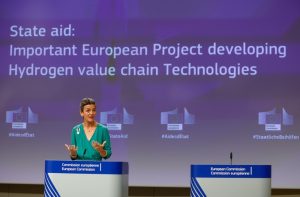
The European Commission’s May 2026 move to quietly block EU funds from purchasing Chinese inverters is not even what you can call a step in the right direction, for we now need leaps, not steps. Rather, it is a humiliating admission of criminal, systemic blindness.
To make things worse, this is a déjà vu. For over a decade, warnings regarding Chinese telecommunications infrastructure were ignored until the Huawei 5G crisis forced a chaotic, belated retreat. Now, the exact same error is repeated in the energy sector. The crisis has again been the fault of a naive, if not bought out by lobbyists, political class that prioritises cheap, heavily subsidised Chinese imports over national security.
This self-inflicted vulnerability manifests the ultimate irony of the postmodern European project. In the name of energy independence and climate-frenzy virtue signalling, the continent’s elites have built an architecture that is entirely dependent on its primary strategic adversary for its daily survival.
With the green transition, the Brussels conclave promised us sovereignty, sustainability and security. Instead, by allowing Beijing to monopolise the digital nervous system of our renewables grid, EU bigwigs have achieved the exact opposite, exposing Europeans to a massive threat. For some peculiar reason, to them, a Chinese attack inflicting a total blackout is preferable to Europe thriving on hydrocarbons and nuclear power.