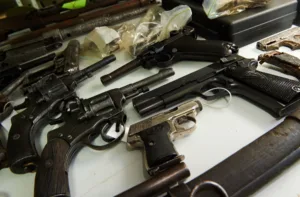

Following the mass shooting in Kraków on November 7, the Polish Government has signalled that it wants to limit the number and types of weapons people may own.
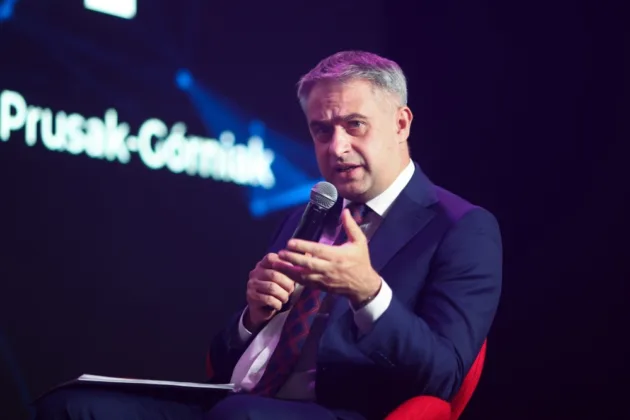
Magdalena Sobkowiak-Czarnecka, the deputy defence minister, said on Polsat News on November 8 that the Kraków shooting should trigger action to limit the number and the type of weapons people may own. She is seen as a rising star within the centre-left coalition government led by Prime Minister Donald Tusk for her piloting of Poland’s access to the European Union’s Security Action for Europe (SAFE) loan programme, of which Poland is the largest beneficiary with €43.7 billion.
The deputy defence minister said that the tragedy which occurred in Kraków on November 7 was “the best illustration that it makes no sense to talk about expanding access to firearms”.
In her opinion it was “already relatively easy” to obtain a gun licence for anyone over 21 years of age who had passed the tests and declared that the firearm was going to be used for sporting or hunting purposes, and that those who had gun licences could own a large number of such weapons.
Sobkowiak-Czarnecka said that the perpetrator of the Kraków attack had several legally held guns at home and questioned whether so many were justified.
“I would like to start a discussion about whether access to such a large number of weapons should actually be so easy,” said Sobkowiak-Czarnecka. “This is also a question of whether someone who uses weapons for sporting purposes should have so many different types of weapons stored at home,” she added.
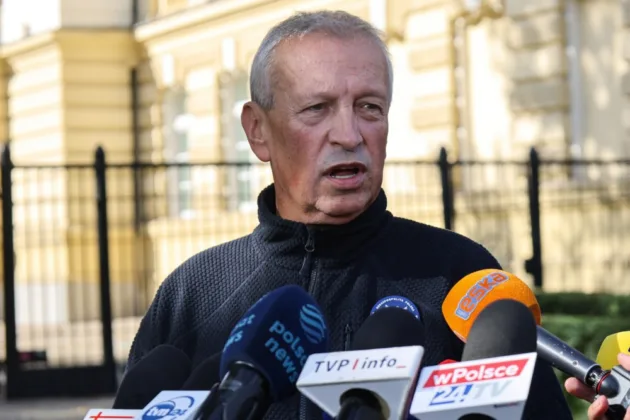
Czesław Mroczek, deputy interior minister, pointed on Polsat News on November 8 to what he saw as the problem of “many cases of killings using black powder weapons for which we don’t even have a register, never mind a permit procedure”.
He was referring to weapons that use traditional black powder rather than modern smokeless powder and include firearms manufactured before 1885 and their modern replicas. Such weapons are claimed to have accounted for a sizable number of firearm fatalities in Poland, including killings of police officers, according to Mroczek, though they were not used during the Kraków attack.
On November 9 Mroczek said his ministry, which had already drafted rules to make the registration of such weapons compulsory, would review permit procedures following an urgent meeting of ministries, police and the security services. “The position of the police and the interior ministry is unequivocal: We are opposed to liberalising the rules on gun ownership,” he told TVP Info.
The government’s political move off the back of the Kraków shooting looks also to be a direct political response to President Karol Nawrocki, who on September 25 argued for a public debate over easing public access to guns, calling for “responsible access to weapons”.
The opposition right-aligned President was responding to those on Poland’s political right, such as the nationalist libertarian Confederation party, who have consistently argued for easing access to guns. They maintain that guns provide people with security and incentivise the public to learn to use firearms, a skill which would be important in the event of war.
Nawrocki’s view is that armed citizens are a vital layer of national defence against growing regional security risks, such as the threat from Russia.
The Polish head of state’s vision of security is one with geopolitics and diplomacy at the top, state defence spending in the middle — an area in which Poland leads Europe, with a planned 4.8 per cent of GDP this year — and armed, trained local communities at the base.
His view is that safety is ultimately provided by a trained, responsible individual and that hardware alone protects no one.
On September 25 the President pointed to the fact that Poland has among the lowest levels of gun ownership in Europe, even though the number of firearms licences being issued has risen in recent years and politicians of the right have called for expanded access to guns.
“Even in the European Union, Poland remains at the bottom of the list in terms of access to firearms,” he said. “Only about 1 per cent of Polish citizens have access to weapons and are skilled at using them. Fortunately, I’m in that 1 per cent.”
“I have been through the whole official procedure for obtaining a firearm,” he said at the opening of a six-lane shooting range in Boguty-Pianki, Masovia province, east-central Poland, where he took the opportunity to discharge some weapons.
“In the Czech Republic and Austria, this figure is higher, around 3-5 per cent, while in Finland or Switzerland, as many as 30 per cent know how to use a firearm,” Nawrocki added.
Since the start of the full-scale Russian invasion of Ukraine in February 2022 there has been a surge in the numbers of Poles wanting to train at shooting ranges up and down the country, which the President feels is something which needs to be encouraged.
Although gun ownership in Poland is relatively low, it has been rising significantly in recent years, with the total number of registered firearms owned by Poles now surpassing 1 million, up from under 400,000 in 2014.
In 2020, Poland had approximately 235,000 active firearms permits and nearly 600,000 registered guns. By the end of 2025, those figures had risen to nearly 412,000 permits and more than one million firearms.
In 2025 a record 50,709 new gun licences were issued in the country, up 10.6 per cent compared to 2024, according to police data.
Under Polish law, civilians can apply for licences for sporting, hunting, collecting and personal protection purposes.
To obtain a gun licence, applicants must undergo medical and psychological examinations, pass a test and join a relevant association, such as the Polish Sports Shooting Association, the Polish Hunting Association or a collectors’ group.
Licences for sports and collection purposes are the most popular types of permits, together making up three quarters of last year’s permits.
The number of licences issued for “personal protection” has grown, though, from 81 in 2021 to 7,254 last year.
Access to firearms was widened in 2023 by the previous Law and Justice (PiS) government, when parliament passed a law allowing members of uniformed services to apply for personal protection permits, a change lawmakers said was intended to “strengthen Poland’s defence potential” in the light of the threats facing the country as a result of the war in Ukraine.
Poland 2050, a centrist party in the ruling coalition, submitted a bill in October 2025 that would require all permit holders, including hunters, to undergo regular medical and psychological examinations.
The attack in Kraków, the first mass public shooting ever to take place in Poland, was carried out by a man who had a gun licence and drove into Kraków’s Main Square on November 7, firing at random from his car.
The 24-year-old Michał Oksiński, from Ostrowiec Świętokrzyski in Świętokrzyskie province, south-central Poland, killed six people and injured 16 more. Among the dead and injured were citizens of the UK, Austria, Germany, Russia and Portugal, according to the interior ministry.
Later in the day, the bodies of the perpetrator’s parents and sister were found in the family home, where they had been shot dead. Prosecutors believe he killed them overnight or early that morning, before setting off for Kraków.
Oksiński’s raid was brought to an end in a shootout with two police officers, Jakub Kulik and Artur Morański, which left all three with serious injuries. The gunman died in hospital early on November 9. That day Nawrocki awarded both officers the Officer’s Cross of the Order of Polonia Restituta.
On November 9, the spokesman for the National Prosecutor’s Office, Przemysław Nowak, held a press conference at which he provided further details on their findings so far.
He revealed that Oksiński had been found with two semi-automatic AR-15 rifles and two handguns on his person and in his car, as well as around 500 rounds of ammunition. He had earlier fired “several dozen, possibly several hundred, rounds”.
A further seven guns had been found at the family home in Ostrowiec Świętokrzyski. The total of 11 firearms matched the number of weapons there were permits for, issued to Oksiński and his father, revealed Nowak.
“We know that, since March of this year, Oksiński has held firearms permits for one rifle and one pistol,” added the spokesman.
Whatever the ongoing investigation into the Kraków shooting uncovers, access to guns now looks set to become one of the sharper dividing lines in Polish politics in the run-up to the 2027 parliamentary election, in which security, both external and internal, is likely to be a key issue.
The events of November 7 shook a country that has taken its internal security for granted and had in recent years advertised itself as a secure and peaceful location for visitors.
According to United Nations Office on Drugs and Crime (UNODC) data, Poland’s homicide rate fell from 2.39 per 100,000 people in 1994, at the height of the post-communist crime wave, to 0.68 in 2022, a fall of more than two-thirds.
Recent polling has shown that the public in Poland feels relatively safe, with almost nine in 10 Poles considering their country to be safe to live in, over 90 per cent regarding their own neighbourhood as safe and peaceful and almost two-thirds saying they do not fear becoming victims of crime.
It remains to be seen whether the attack in Kraków was an isolated incident. Prosecutors, who are treating it as a terrorist offence, have said the gunman acted alone but that it is too early to establish his motive.