
Hungary’s new Government has formally described Russia’s conduct as a threat to the country, to Europe and to the global order, in a clear break with the foreign-policy line pursued under Viktor Orbán.
The language appears in guidelines for Hungary’s delegation to the 81st session of the United Nations General Assembly, which opens in September.
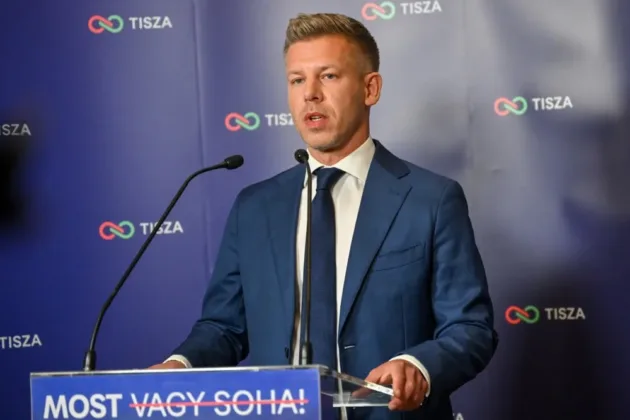
The government resolution was signed by Prime Minister Péter Magyar and published in the official gazette, the Magyar Közlöny, on August 25.
According to the document, Hungary “condemns the Russian military aggression and fully supports the sovereignty of Ukraine and its territorial integrity within its internationally recognised borders”.
It recognises Ukraine’s right to self-defence. It adds: “Russia’s behaviour constitutes a threat to Hungary, Europe and the global order and places the Hungarian minority living in Transcarpathia in serious danger.” Budapest supports all efforts aimed at negotiations that would produce a “sustainable peace and long-term security guarantees” for Ukraine.
The resolution also instructs the Hungarian delegation on other topics, including balanced UN engagement on conflicts in Gaza, Lebanon and Iran, migration, UN reform and global water issues.
It calls on the foreign minister to propose the delegation to the President of the Republic.
The wording marks a sharp departure from the approach of the previous Fidesz government, which maintained close ties with Moscow, repeatedly diluted or delayed EU sanctions packages against Russia, blocked or slowed financial support for Ukraine, and often framed Kyiv rather than Moscow as the greater problem for Hungary.
Orbán’s administration left office after the April 12, 2026 parliamentary election, in which Péter Magyar’s Tisza party secured a two-thirds majority, taking 141 of 199 seats. The new government took office on May 13.
The shift has been building for months. On July 14, defence minister Romulusz Ruszin-Szendi told the Budapest Energy and Strategy Talks: “Hungary must rebuild trust with its allies, and as for the Russians, we are shutting the door on them.”
He said the Russian intelligence service had “tried to come in through the back door”.
On July 8, at the NATO summit in Ankara, Magyar stated: “Ukraine is the victim, Russia is the brutal aggressor.”
Hungary continues to provide humanitarian assistance to Ukraine but rules out arms deliveries or the deployment of Hungarian troops. In June the two countries agreed a deal on Hungarian minority rights in Transcarpathia.
Foreign minister Anita Orbán, no relation to Viktor Orbán, has previously said that Russia’s policies pose a “security challenge for Hungary and Europe”, while emphasising that Budapest still seeks a pragmatic relationship given remaining energy dependencies.
The government has also summoned the Russian ambassador over strikes that hit Transcarpathia, the region of western Ukraine with a significant Hungarian minority. Anita Orbán called in Yevgeny Stanislavov on May 14.
Hungary remains heavily reliant on Russian oil and gas, and on Rosatom at Paks, where the expansion is under review.
Officials have indicated that full diversification will take years and that Budapest will continue to protect specific national economic interests, including existing exemptions from certain EU energy sanctions. Tisza’s programme targets 2035 for phasing out Russian oil and gas. The UN document does not alter those practical constraints.