
Hundreds of masked men blocked Britain’s busiest ferry port on September 5 and a second large crowd confronted police in Portsmouth on September 6 after a dinghy carrying about 140 people came ashore unusually far west.
The two actions formed the most disruptive weekend of “stop the boats” protests this year.
It appears a shift is happening, with civil society moving to create coordinated, organised resistance to uncontrolled mass migration after protests outside asylum hotels and “stop the boats” marches have had little to no effect.
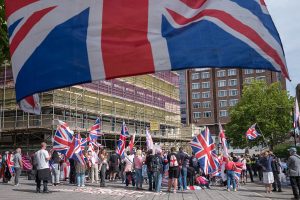
On September 5, several hundred men in black clothing and balaclavas closed approaches to the Port of Dover.
They linked arms across the A20, chanted “stop the boats”, “Whose streets? Our streets!” and “England till I die”, and stopped traffic in both directions.
National Highways logged queues of about four miles (6.4km). The port said all routes in and out were blocked until around midday.
Dover handled more than 9 million passengers and 2 million freight vehicles in 2025 and accounts for about a third of Britain’s goods trade with the European Union.
Kent Police described the gathering as spontaneous, made no arrests and escorted many of the men to Dover Priory station.
The two protests have prompted condemnation from the British Government and politicians across the political spectrum, though some politicians on the Right also showed understanding for the anger.
Conservative councillor Chris Vinson said the group appeared to have arrived overnight in rental vans.
“It’s brought the town to a standstill and left stacks of people stuck in their cars or workplaces,” he said.
“Having the path of your vehicle blocked by men wearing black paramilitary gear and balaclavas is extremely intimidating.”
Dover District Council leader Kevin Mills called the operation “exceptionally well organised” and said agencies had been “caught on the hoof”.
He criticised a thin initial police presence and said the Eastern Docks “has nothing to do with small boats”.
Dover MP Mike Tapp branded those involved “idiots coming to Dover to cause disruption”, adding that the march was clearly coordinated and that the police “didn’t know about it”.
A government spokesperson said the right to peaceful protest was “fundamental to our democracy” but condemned “the behaviour in Dover and the travel disruption it has caused”.
Business secretary Jonathan Reynolds told Sky News’ Sunday Morning programme: “I condemn it. I mean, peaceful protest – (is an) essential part of British life, but that’s not dressing up in costumes like this and disrupting people’s lives.” He declined to comment on the policing operation but said that “on the whole, the police handled it very well”.
Reform UK leader Nigel Farage, speaking at his party’s conference in Birmingham, called the protest “wrong at every level” and said nobody in any protest “should appear in balaclavas. It is wrong,” calling the scenes “disgusting”. Reform Treasury spokesman Robert Jenrick said he condemned obstruction “whether it’s Just Stop Oil or whatever” and found balaclavas “very intimidating”, while adding that public frustration over small boats was understandable.
Jenrick also condemned the policies of the government. “The invasion comes to Portsmouth. Home of the Royal Navy. Reform will end this humiliation,” he wrote on X.
The invasion comes to Portsmouth.
Home of the Royal Navy.
Reform will end this humiliation. https://t.co/EjF7yezuZ1
— Robert Jenrick (@RobertJenrick) September 6, 2026
Restore Britain leader Rupert Lowe defended the demonstrators’ underlying concerns. He said people were “annoyed, furious actually” and argued that politicians should address public anger over immigration rather than simply condemn those expressing it.
“These are ordinary Brits who are pissed off. I agree. I’m pissed off too,” Lowe wrote. He nevertheless said protests should remain peaceful and should avoid disrupting other people’s lives.
Lowe, the MP for Great Yarmouth, was elected for Reform UK in 2024 and launched Restore Britain after a rupture with Farage’s leadership, making the exchange as much a contest on the Right as a response to the protests.
September 6’s events followed an unusual landing.
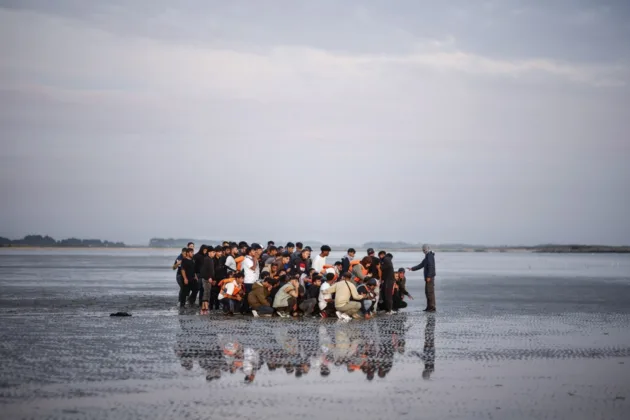
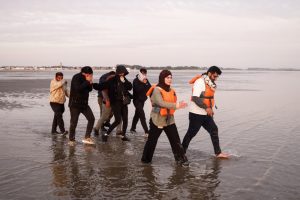
A large dinghy, reported to have left the Baie de Seine – about 170 miles from Calais – and carrying about 140 people, was intercepted in the Solent. French rescue vessels shadowed it for roughly 10 hours, with the French coastguard saying it was not safe to try to stop the boat at sea.
HM Coastguard deployed lifeboats, a helicopter and an aircraft. Those on board were brought to Eastney Marina in Portsmouth, well west of the usual Kent arrival points, and were due to be taken to Manston in Kent.
More than 500 people are thought to have crossed the Channel that day.
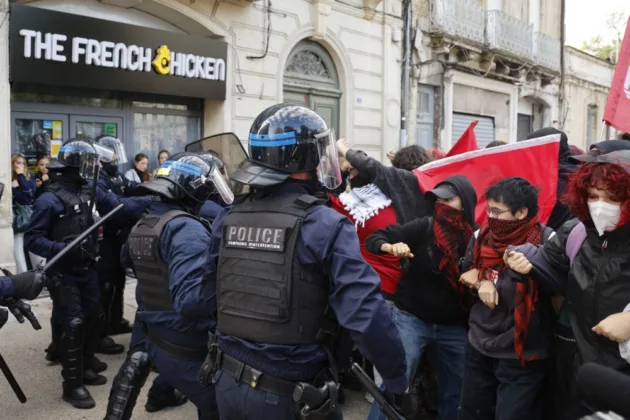
Crowds gathered at Eastney, blocked the access road and tried to stop coaches leaving. Some wore black and face coverings, as in Dover.
Police with riot shields formed lines around the vehicles. Hampshire Police imposed a dispersal order until the evening of September 7.
Reports said officers used pepper spray after the line was pressed. A Section 14 order at about 3am on September 7 led most of the crowd to disperse.
Treasury chief secretary Emma Reynolds called the scenes “thuggish and intimidating” and said they had “crossed the line”, adding that the speed with which the protest was assembled was “a concern”.
A government spokesman repeated that protest “must never cross a line into disorder”.
Hampshire police and crime commissioner Donna Jones said the police operation had required mutual aid and warned: “This is just the start, if this continues, these numbers will grow.”
She also warned that traffickers may shift away from Dover and that Portsmouth is “not set up” for that, noting that southern England has “hundreds of miles of coastline” and that ministers had concentrated resources on Kent.
She said many present were “making their point that they don’t want Portsmouth to become a destination”. Conservative MP for Isle of Wight East Joe Robertson called a landing that far west “extremely concerning”. Reform UK’s Hampshire leader, city councillor George Madgwick posted that “over 100 migrant men” had arrived.
Daniel Thomas, known as Danny Tommo, founder of Patriot Platform and an associate of Tommy Robinson (Stephen Yaxley-Lennon), was prominent at both events. Patriot Platform says it is recruiting “people prepared to act” to “protect the future” of Britain.
He livestreamed from Eastney beach, saying: “Roads are all blocked, they are never going to be able to leave here.”
He told viewers September 5 had been a warning that “this is no longer an option to tell us that the boat numbers are down”.
Robinson had posted on September 5 that “patriots have mobilised to close down the port”.
Reynolds said crossings so far this year were down by 43 per cent on 2025, to about 17,000, though boats have grown larger. The Home Office said more than 48,000 crossing attempts had been prevented and 1,100 boats and engines seized since the 2024 general election.
Prime Minister Andy Burnham and President Emmanuel Macron had met on September 3 to discuss scaling up Franco-British enforcement. France agreed to send a “surge team” of 45 officers to its western beaches, taking the total French deployment against Channel crossings to about 1,050, with a specialist intelligence and judicial unit growing from 18 to 30 officers and a new 75-strong unit operating in northern France.
CHRIST IS KING! ✝️🗣️ Well done, lads and lasses. You stuck to the plan and maintained complete discipline. I’m so proud of all of you! You all understood how important this was. And this is only the beginning.
They want to use the law on us, we will use the law against them! We… pic.twitter.com/iK9OLEJxMh
— Danny Tommo (@RealDannyTommo) September 5, 2026