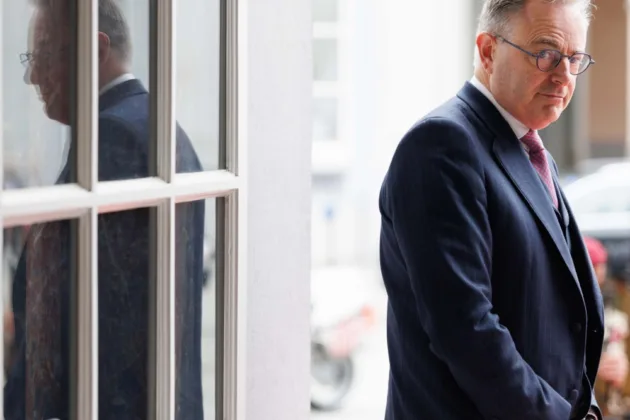




Belgium’s King Philippe has formally refused the resignation of Prime Minister Bart De Wever, ordering the government back to the negotiating table to break a deadlock over the federal budget.
The royal decision, announced by the Royal Palace shortly before noon on November 6, follows days of consultations after De Wever tendered his resignation on November 2 when talks between the five coalition partners collapsed.
De Wever, of the New Flemish Alliance (N-VA), leads the so-called Arizona coalition with the francophone Reformist Movement (MR) and Les Engagés and the Flemish Vooruit and Christian Democratic and Flemish (CD&V) parties.
Rather than accepting the collapse of the government or plunging the country into protracted political instability, the monarch spent the week holding separate talks with the heads of the five governing parties.
He has now asked De Wever to resume negotiations immediately and report back to the Palace on November 16.
In an official statement, the Palace confirmed that the King had secured formal pledges from all party leaders that they were willing to make concessions to salvage the government and produce a workable fiscal plan.
“The King also received a formal commitment from the five presidents that their party is prepared to make concessions in order to reach an agreement within the government,” the Royal Palace said.
“The King stressed the need to find a fair balance between preserving social cohesion and stimulating economic growth.”
The budgetary standoff centres on fiscal adjustments required to rein in the country’s deficit and meet European Union fiscal rules.
De Wever has been seeking some €10 billion in spending cuts or new revenue for the 2027 budget, according to The Brussels Times. Belgium has been under the EU’s excessive deficit procedure since July 2024, which requires it to bring its deficit below 3 per cent of gross domestic product (GDP) by 2029.
Sharp ideological disagreements within the coalition between its Left and Right flanks, complicated by the francophone-Flemish split, over spending cuts, pension reforms and potential tax hikes paralysed discussions over the weekend, prompting De Wever to declare talks exhausted.
Vooruit, CD&V and Les Engagés reportedly pushed for higher taxes on the “strongest shoulders”, a move MR and N-VA strongly opposed.
The monarch had on November 2 cautioned that “against a backdrop of major geopolitical uncertainty and significant economic challenges, the country cannot afford a protracted political crisis.”
It is not the first time the King has stepped into the coalition’s budget wrangling. In November 2025, De Wever stopped short of resigning but asked the monarch for more time and was granted an extra 50 days, according to public broadcaster VRT.
By sending De Wever back to work with renewed mandates for compromise, the Royal Palace aims to avoid early federal elections and force the coalition to craft a classic compromis à la belge (Belgian-style compromise) before EU fiscal deadlines close in and before credit rating agencies downgrade Belgium’s rating further, which would drive borrowing costs up even more.
Fitch cut Belgium from AA- to A+ in June 2025, while Moody’s and S&P each lowered their ratings by one notch in April 2026. De Wever has also ruled out entering 2027 on “provisional twelfths”, a stopgap that caps monthly spending at one-twelfth of the previous year’s budget.
De Wever is expected to resume multilateral talks with the coalition leadership immediately.
Le Roi a reçu @Bart_DeWever en audience. À l’issue de ses entretiens avec les présidents des cinq partis de la majorité, le Roi a décidé de refuser la démission du Premier ministre et lui a demandé de reprendre les négociations budgétaires dès à présent. pic.twitter.com/fP3atMBwzh
— Belgian Royal Palace (@MonarchieBe) November 6, 2026