

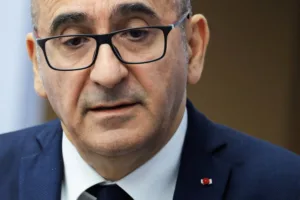

Hungarian prosecutors detained two ministers from Viktor Orbán’s governments on September 28, hours after the governing majority declined to fill the vacancy at the head of the service conducting the investigations, a post it alone has the votes to fill.
Miklós Seszták, national development minister from 2014 to 2018, was detained that day at the Central Chief Prosecution Office of Investigation. Balázs Hankó, culture and innovation minister until May 2026, was taken into custody the same evening. Parliament had voted 139-0 that morning to suspend the immunity of both.
At the same sitting, in a secret ballot, no MP backed Zoltán Szathmáry, the president’s nominee for prosecutor general. A total of 138 voted against and one abstained.
The sequence leaves Péter Magyar’s Tisza, which won in April on a promise to pursue the corruption of the government it replaced, holding a veto over who leads the body that does the pursuing.
That veto is a function of how the office was protected. Hungary’s prosecution service is a single hierarchy: prosecutors work subordinated to the prosecutor general and take instructions from nobody else but him and their own superiors. It holds the exclusive power to bring charges and sits outside government supervision. The post at its head carries a nine-year term, longer than any parliament, requires a two-thirds majority and can be filled only on a nomination from the President of the Republic. No single parliament was meant to be able to seat its own prosecutor general, or to unseat one.
Both ends of that arrangement have been tested this year. Gábor Bálint Nagy resigned on July 22, after weeks in which Magyar publicly called him an Orbán puppet, and his mandate ended on August 25. The service, Nagy said, could not become “an instrument in the struggles of political actors”. Amnesty International Hungary, a long-standing critic of Orbán, said grounds for a removal might well exist but that the route lay through a transparent parliamentary procedure, and that the Prime Minister had no business pressuring the acting head of state.
Nagy was the second departure from the top of the service in six weeks. Pál Fürcht, who headed the Central Investigative Chief Prosecutor’s Office, the unit that took Seszták in, resigned on June 8 in a dispute over the handling of the Ukrainian cash convoy case.
Other institutions moved in the same months. The 17th amendment to the Fundamental Law, adopted on July 13, terminated President Tamás Sulyok’s mandate and set a retirement age of 70 for Constitutional Court judges, ending four mandates on September 1. Among them was the court’s president, Péter Polt, Orbán’s prosecutor general until 2025.
Since August the powers of the vacant post have been exercised by the deputy prosecutor general, István Lajtár, who was one of Polt’s deputies. The service says he will do so until a new prosecutor general takes office, a date nobody can presently name.
President András Baka put forward Szathmáry, a section head prosecutor, on September 21. Tisza’s parliamentary group rejected him the following morning, Magyar questioning whether a prosecutor who had risen under Polt could restore confidence in the service. Baka declined to substitute another name, saying the decision belonged to parliament.
Baka is not a Fidesz figure. Tisza nominated him for the presidency and parliament elected him on August 11 with 140 votes of 199. He led Hungary’s Supreme Court until 2011, when Orbán’s judicial reforms removed him, in a case Strasbourg later found unlawful. He told MPs that public confidence in the prosecution service stood at its lowest point and that the appointment concerned the rule of law. After the vote he said he would nominate again.
Prosecutors say Seszták and the former head of the Hungarian National Asset Management Company took HUF 11 billion (€30 million) in unlawful benefits in contracts tied to the bus operator Volánbusz between 2015 and 2018. Hankó is investigated over the National Cultural Fund, where prosecutors say HUF 17.3 billion (€44 million) went outside the fund’s statutory purposes in 1,079 grants between September 3, 2025 and March 30, 2026. Investigators searched the data centre holding Fidesz’s servers on July 21 in the same inquiry.
Both men deny wrongdoing. Fidesz group leader János Bóka called the case against Hankó political persecution. Orbán, who broadcast his former minister’s departure from parliament live, called the proceedings a show trial.
The service is also investigating the Prime Minister, over a 2024 incident in a Budapest bar. Magyar asked parliament to lift his immunity and criticised the office in the same breath; it did so on September 28 too.
The European Commission’s rule of law report of July 17 credited the new government with substantial change while noting continuing shortcomings, among them low prosecution rates for high-level corruption. The European Public Prosecutor’s Office, which Hungary joined on July 10 after 16 years of refusal under Orbán, is not yet working there: it cannot begin until the Council appoints a Hungarian European Prosecutor from three candidates Budapest has still to submit.
Whether the charges against Seszták and Hankó stand is for Hungarian courts to determine. Who supervises the prosecutors bringing them is a separate question, and the answer for now is an official no chamber elected, filling a vacancy only the governing party can close.