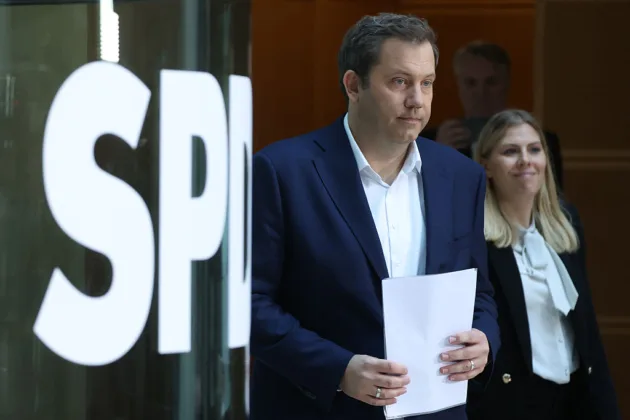



Ines Schwerdtner, co-leader of Germany’s opposition party Die Linke (The Left), has called for German social movements to emulate their French counterparts by building a unified protest front, even as she sought to distance her party from the violent unrest that has gripped French cities since September.
Speaking at an online forum with the party’s student organisation Die Linke.SDS, streamed by the magazine Jacobin, Schwerdtner argued that Germany’s fragmented activist landscape should take cues from French mobilisations that bridge disparate social, labour and student struggles.
“What works in France, connecting the various movements, we must also do in Germany,” Schwerdtner said.
“We must have a European perspective in any case,” she said.
In a separate interview with German broadcaster n-tv on October 19, she described the widespread demonstrations across the Rhine as an “expression of legitimate frustration” over deteriorating public services, pensions and the education system.
The remarks come amid heightened political sensitivity across Europe as large-scale civil unrest and street clashes in France, originally sparked by secondary school and university walkouts over teacher shortages, the state of school buildings and the Parcoursup university admissions platform, have resulted in widespread property damage, riots, looting, curfews in several municipalities and clashes with law enforcement.
The movement began on September 17 at a lycée in Créteil, outside Paris, and spread nationwide. The French justice ministry counted 7,950 people taken into police custody by mid-October, of whom 6,773 — about 85 per cent — were minors. It said 2,735 cases had been sent for prosecution and 26 people remanded in custody.
Prime Minister Sébastien Lecornu told the Senate that 937 police officers and gendarmes, 248 pupils and 149 education staff had been injured since the walkouts started.
Videos are already circulating in Germany, calling for violent protests on social media, with statements like “We will fight like the youth in France”.
Another video played music asserting that Germany has no right to exist.
Schwerdtner drew a boundary between civic mobilisations and the nightly rioting, stressing that an “absolute lust for destruction cannot be the right way”.
She maintained that the overwhelming majority of participants — “99 per cent”, in her words — were demonstrating peacefully and placed the onus on political leaders to address the underlying socio-economic grievances before disaffection boils over into violence.
“It is the responsibility of politicians to channel this into real change, into a social awakening and a different social policy,” she added, urging Berlin to bolster statutory pensions, invest in the education system and safeguard the social safety net.
Schwerdtner also warned against the “Trump narrative”: “They are already starting to say the migrants are to blame and the left-wing extremists are to blame.”
Schwerdtner’s comments land as German security agencies prepare for potential spillover effects.
German police unions and state interior ministries have raised concerns over calls circulating online, primarily under youth banners such as “Gen Z regelt” (Gen Z sorts it out), urging pupils and students to take to the streets on October 31.
Organisers have listed actions in 21 cities, including Berlin, Hamburg, Cologne and Frankfurt, and said on their website that more than 25,000 people had registered.
Affiliated groups, including Die Linke’s youth wing Linksjugend [‘solid] and student organisation Die Linke.SDS, have also organised cross-border solidarity forums to discuss French organising tactics.
While conservative and centre-right politicians have seized on the calls to warn against an importation of French-style disorder into German cities, police representatives noted that German crowd-control strategies place a heavier emphasis on de-escalation and communication.
The Office for the Protection of the Constitution in North Rhine-Westphalia, the state’s domestic intelligence agency, warned that mobilisation for the demonstrations was also coming from circles linked to foreign-related extremism, Apollo News reported.
Berlin police spokesman Florian Nath said officers would assess whether the gatherings were genuine pupil protests or whether others were using Halloween as cover, Tagesspiegel reported. Hesse interior minister Roman Poseck warned that the demonstrations were being instrumentalised from the left-wing spectrum.
Demonstration organisers have maintained that their planned actions on October 31 are intended to remain strictly peaceful, and their website rejects violence “without exception”.
Looters have returned to central Paris for a second night, hours before the French Government met for emergency talks on some of the worst disorder the country has seen in decades. https://t.co/oly1h2B2mK
— Brussels Signal (@brusselssignal) October 19, 2026