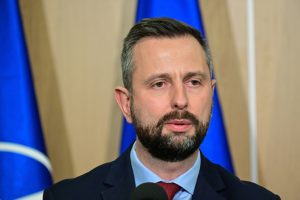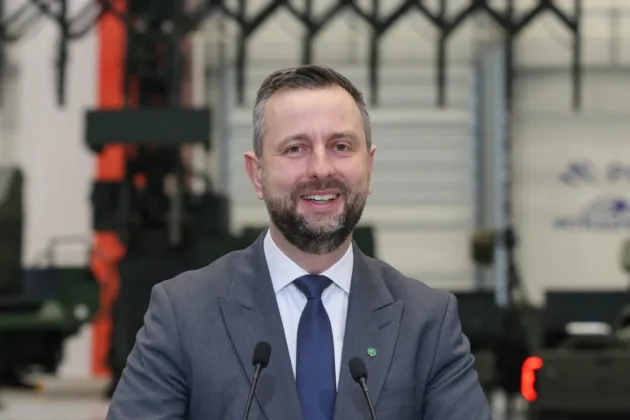







Polish Prime Minister Donald Tusk has revealed that his Deputy Prime Minister Władysław Kosiniak-Kamysz, who is also the defence minister, had a confidential conversation with US President Donald Trump in Washington on March 2 to discuss domestic politics in Poland, an encounter that stayed out of public view for seven months.
Tusk said that Kosiniak-Kamysz, who leads the Polish People’s Party (PSL), a party which is part of the ruling centre-left coalition but which has since the 2023 parliamentary election been courted by the former ruling Law and Justice (PiS), briefed the PM about the meeting shortly after it had taken place at the White House.
Poland’s Government is a broad coalition that ranges from left to centre-right. Although Tusk’s centrist Civic Coalition (KO) dominates, it would not have the parliamentary majority necessary to rule if it lost any of its junior coalition partners.
The Prime Minister said that since Kosiniak-Kamysz’s meeting was confidential he could not reveal what had been discussed.
“It is too interesting a conversation to talk about publicly,” he told reporters on October 5 before proceeding to reveal that the meeting had related to Polish domestic politics rather than the question of establishing a permanent US military base in Poland.
“The conversation was confidential, and that is why I feel obliged to maintain confidentiality,” Tusk said. “It concerned rather the internal situation in Poland, to put it as delicately as possible,” and when pressed further by reporters added that “history will learn someday”.
On the same day as the Prime Minister confirmed that the meeting had taken place, Kosiniak-Kamysz gave a somewhat different account of events saying that his “most important message” to Trump had been to thank him “for the presence of American soldiers in Poland,” but confirmed that a permanent US base was not the subject of the meeting.
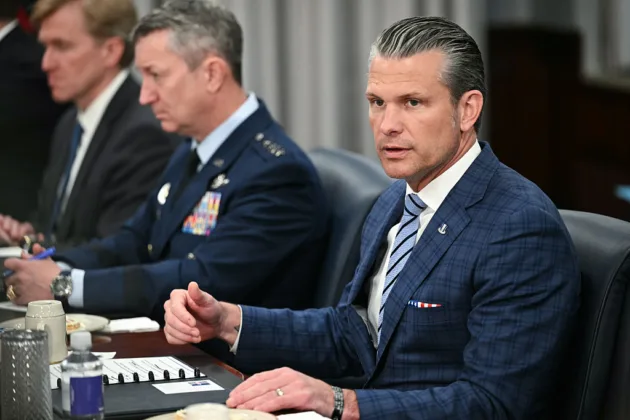
First news of the meeting between Trump and Kosiniak-Kamysz had emerged in late September when PiS MEP Adam Bielan had revealed in a media interview that he had helped to arrange a meeting for Kosiniak-Kamysz with someone “much more important” than US Secretary of War Pete Hegseth, with whom the Polish defence minister has met on several occasions.
Bielan was reacting to claims that he and Polish President Karol Nawrocki had worked behind the scenes for the cancelling of a meeting between Hegseth and Kosiniak-Kamysz on September 21 which the Americans said had been cancelled because the US Secretary of War was preoccupied with the planned visit to the US of Chinese President Xi Jinping.
Kosiniak-Kamysz has now disclosed that he had met with Trump when the Polish deputy PM and defence minister went to Washington to attend a ceremony at which Trump posthumously awarded the Medal of Honor to US Army staff sergeant Michael Ollis, of the 10th Mountain Division, a soldier who was killed in Afghanistan in August 2013 after placing himself between a suicide bomber and Polish officer Karol Cierpica, saving that soldier’s life.
The Polish deputy PM however denied Bielan’s claims that the purpose of the meeting was to “unblock” the negotiations over a permanent US base in Poland which the MEP claimed had previously made little progress, and credited opposition-aligned President Nawrocki with help in arranging the meeting. Bielan has said the conversation lasted several dozen minutes.
Polish foreign minister Radosław Sikorski, who is from Tusk’s KO, criticised Kosiniak-Kamysz for having failed to inform the foreign affairs ministry of it.
“From such an important conversation, the organiser had a duty to prepare a note,” Sikorski wrote on social media platform X.
He then asked whether the absence of such a record was because “the meeting had also involved an attempt to involve a foreign state in our internal politics”, suggesting that Kosiniak-Kamysz had been on manoeuvres.
In response to Sikorski, Kosiniak-Kamysz said the meeting had been informal and that he had immediately informed Tusk. He said informing the Prime Minister was “entirely appropriate and sufficient.”
Tusk has not met Trump during the US President’s second term and that is largely attributed to the fact that Tusk, when campaigning to be elected PM again in 2023, had said Trump’s links with Russian secret services were “irrefutable” and that US intelligence did not rule out his having been recruited by Moscow 30 years earlier. Tusk denied having made such suggestions at a press conference on November 7, 2024.
Gazeta Wyborcza has reported that Trump suggested the PSL leader break with his partners and form a coalition with the Right, which would bring full US backing. Onet quoted an unnamed government official as saying it was no accident that the account had stayed secret for months.
Conservative broadcaster TV Republika has claimed that replacing Tusk with Kosiniak-Kamysz had been one of the subjects discussed at the meeting.
According to the CEO of TV Republika Tomasz Sakiewicz the US “would prefer Poland to have a PM who would guarantee strategic relations and safety of American soldiers. The problem from their perspective may be that Tusk consults Berlin on the most important matters and acts in their rather than Poland’s interests.”
He was alluding to the fact that Tusk has on many occasions stressed that Europe has to defend itself and that in the past the current Polish PM had failed to support the idea of a US missile shield in Poland in the noughties under then-US president George W. Bush before his successor, Barack Obama, scrapped the idea in 2009 and replaced it with a scaled-back system. A US missile defence site eventually opened at Redzikowo, northern Poland, in November 2024.
Sakiewicz said that Kosiniak-Kamysz was seen as an alternative to Tusk, especially if the deputy PM could be persuaded to form an alternative government with PiS and other centrists but cautioned that “this is not straightforward, because Kosiniak-Kamysz is a relatively weak politician with little independence.”
The TV Republika chief was alluding to the fact that Kosiniak-Kamysz had been an ally of Tusk during the current PM’s last spell in government (2007-2015) and was currently considering having a joint slate of candidates with Tusk’s party in the 2027 parliamentary elections.
According to sources close to President Nawrocki the Tusk government had been delaying talks on establishing a permanent US military base with finance minister Andrzej Domański arguing that Poland could not afford to fund such a venture but that this resistance had been overcome as a result of intervention by Kosiniak-Kamysz and threats from Nawrocki’s aides that they would reveal that the government was acting against the creation of the base.
But Nawrocki’s allies fear that the ongoing talks could be derailed at any moment because PM Tusk may not wish to have Nawrocki score a major political coup in a parliamentary election year and for the US to have even greater leverage in Poland than it already enjoys via the presence of some 6,500 to 7,000 rotational troops, down from about 10,000 in 2025.
Bielan also said that he “got chills down my spine when I saw Sikorski’s press conference in New York, where he started turning his nose up at the name, saying he did not like Fort Trump and suggesting that perhaps it should be called something else.”
He feared that Sikorski in questioning the name was on manoeuvres to try and provoke Trump into pulling out in a fit of pique at Poland questioning the name of the base.
Kosiniak-Kamysz in late September revealed that the Trump administration was already in the process of considering locations for a permanent military base after Trump had announced that the US was looking into the possibility of establishing a new military base in Poland.
In response to a question about the proposed base, Trump said: “We’re looking at that and we have great respect for the President of Poland. So, we’re looking at that and it could happen.”
He was alluding to the fact that he has established a good relationship with Polish President Nawrocki as the two men share an interest in sport, Nawrocki being a former amateur boxer, and Poland’s head of state has been supportive of Trump’s agenda and did not criticise the US President for his actions over Iran and Greenland.
Asked why he had not made a final decision on a US Army base in Poland, Trump said: “You don’t know if I made it or not. I might have made it. I like Poland.”
It was Trump’s second recent comment on the potential permanent US Army base in Poland after he had written on platform Truth Social on September 17 that “major progress” was being made towards establishing a US military base in Poland and attributed the progress to the “bold leadership” of his “friend” Nawrocki, and said a location for the base could be announced soon.
Nawrocki’s chief foreign policy aide, Marcin Przydacz later told reporters that the decision had “de facto been made” and that Trump and the Polish President had discussed the issue during the UN General Assembly in New York in late September.
Polish deputy defence minister Paweł Zalewski, following his meetings in Washington, said on September 23 that Poland was not negotiating whether the base would be established, saying the decision had already been made and was the result of efforts by successive Polish governments and Presidents.
Warsaw has put the cost of hosting the base at more than 15 billion zloty (€3.4 billion), with Poznań, Lower Silesia and West Pomerania among the locations under consideration for a facility expected to hold between 3,000 and 5,000 troops.
US under secretary of war for policy Elbridge Colby said in a statement published in late September that the Pentagon was considering potential opportunities for the permanent deployment of US forces in Poland as part of broader efforts to strengthen military cooperation with key allies.
It had previously been reported, though, that Colby was keener on America retaining a large presence in Germany which he sees as key to Europe’s defences after the US had decided to reduce overall troop commitments in Europe by more than 20,000.
Nevertheless, it seems that Trump’s wish for there to be a “Fort Trump” in Poland had taken precedence over Colby’s views.
“Fort Trump” is a term that was coined in 2018 by former Polish president Andrzej Duda, also a PiS and Trump ally, to get the US President more interested in the possibility of establishing a permanent base and President Nawrocki has followed up using that name too.