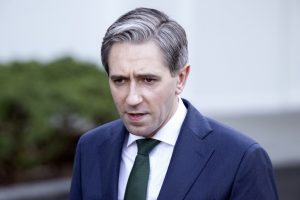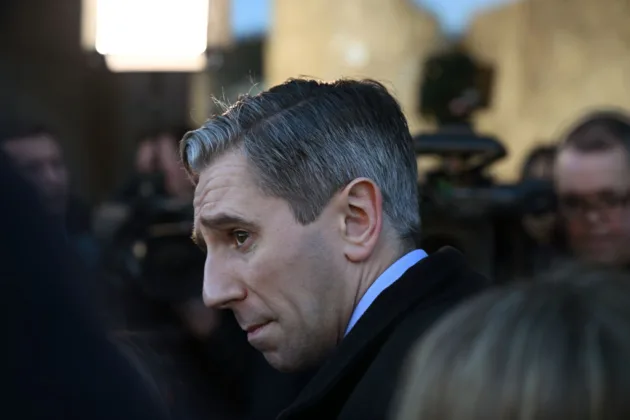








Fine Gael has published its long-awaited plan to prepare for the reunification of Ireland, a year before party leader Simon Harris is due to take over as Taoiseach.
The Blueprint for a Unified Island was presented at the party’s Ard Fheis, or annual conference, in Cork, southern Ireland, on November 7.
Under the coalition deal struck in January 2025, Fianna Fáil leader Micheál Martin is to hand the office to Harris on November 16, 2027.
Harris, currently Tánaiste, or deputy prime minister, described the document as “a beginning and by no means an end”.
Its centrepiece is a Standing Constitutional Forum. According to the party, it would allow structured political, civic and public debate on the choices that could arise before any referendum on unity.
The body would be independent, inter-party and consultative, backed by law and supported by the Government. It would run for five years, with the option of a two-year extension.
Fine Gael said the forum would be led by an independent chair appointed by the Irish Government and have its own secretariat and budget. It would commission research, examine constitutional options and make recommendations.
Membership would be open to elected representatives of every party on the island, unionists included, provided they were committed to exclusively peaceful means.
Its remit would cover public services, taxation, pensions, welfare, security and future institutional arrangements. The party said it would also look at protections for British identity in the north, as well as flags, emblems and anthems.
The future of the Belfast institutions and reform of local and regional government across the island, in line with the European principle of subsidiarity, would be examined too.
The party also proposed a Minister of State for North-South Relations and a Constitutional Planning Unit, both within the Department of the Taoiseach.
The blueprint was drawn up by the Fine Gael Northern Ireland Engagement Group, chaired by TD Emer Currie and facilitated by Ulster University academic Deirdre Heenan.
An economic assessment by Stephen Kinsella models four designs for a united island: unitary, federal, managed integration and a higher-cost scenario.
Costs could range from about €4 billion in the first year to nearly €25 billion a year, Kinsella found. The figure depends largely on the settlement reached with the British Government on pensions and debt interest.
Under the adverse model, the annual bill would reach €41.2 billion by the 25th year after unity.
The federal option would keep a separate administration in Northern Ireland. Pay and welfare would be phased up to Irish levels over 20 years, with €500 million a year spent on running two systems.
To absorb transition costs, Fine Gael wants a new sovereign wealth fund, the Future Unified Island Fund, and a doubling of the Government’s Reconciliation Fund.
Other measures, including extending voting rights in Irish presidential elections to citizens in Northern Ireland and strengthening its representation in the Seanad, the upper house, would require wider agreement.
“I think people are prepared to pay the cost for a unified island,” Currie said at the conference.
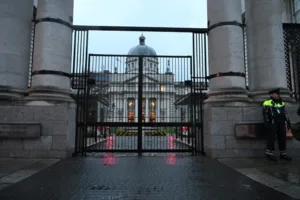
The proposal follows a separate initiative from Martin, who plans a new body, housed in his department, to research the island’s possible constitutional futures.
It would weigh three scenarios: a unitary 32-county state, a united Ireland in which Northern Ireland keeps its own devolved institutions, and continuation of the union with Britain.
The newspaper called it the first official government effort on the question since the New Ireland Forum of 1983-84. It added that Fianna Fáil TDs had privately complained of being outflanked when Harris first announced his blueprint in June.
Under the 1998 Good Friday Agreement, the British Secretary of State for Northern Ireland must call a border poll if it appears likely that a majority would vote for unity.
A survey by the Institute of Irish Studies for The Sunday Times, carried out on May 8-22, found 35.8 per cent of voters in Northern Ireland would back a united Ireland and 49.7 per cent would not.
Unionists have rejected the initiative from the start. After Harris’s June announcement, Traditional Unionist Voice (TUV) leader Jim Allister said: “Fine Gael is dancing to Sinn Fein’s tune.”
Ulster Unionist Party (UUP) leader Jon Burrows dismissed the plan as a pet project, insisting any constitutional change rested solely with the people of Northern Ireland.
Fine Gael and Fianna Fáil have governed together since 2020, ending a rivalry dating back to the Irish Civil War, and have rotated the post of Taoiseach between them.
Both centre-right parties joined forces in the face of the rise of Sinn Féin. The left-wing republican party, which has long led calls for a border poll, holds one seat more than Fine Gael in the Dáil, the lower house.
The debate carries a European dimension. Northern Ireland voted to remain in the EU in 2016, and Brexit has kept the border and EU-UK relations at the centre of Irish politics.
In 2017, EU leaders gave a formal undertaking that Northern Ireland would become part of the bloc should a referendum unite the island.