






The Irish Government has said negotiations on the European Union’s next long-term budget cannot be separated from new funding for Ukraine, lending weight to a German-led push to tie the two together.
Ireland holds the rotating presidency of the Council of the European Union and is steering talks on the 2028-2034 Multiannual Financial Framework (MFF).
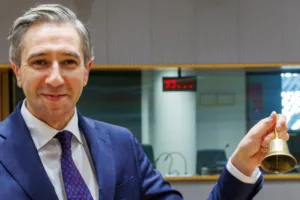
Speaking ahead of a meeting of EU finance ministers in Brussels on November 9, Irish finance minister Simon Harris said it was “very hard to have a serious conversation about the European budget” without Ukraine being part of it. His remarks were reported by the Brussels news site Rapporteur.
Harris added that the most probable outcome for Kyiv’s next funding package would resemble the current €90 billion Ukraine Support Loan, which is raised as joint EU debt and guaranteed by the bloc’s budget. He said he had yet to see any sign that another mechanism would prove more workable than it had a year earlier.
That would mean fresh common borrowing on top of the €90 billion already committed, backed ultimately by national contributions to the EU budget.
The European Commission has told capitals it wants a political deal on financing Ukraine in 2027 before the year ends, with a package worth about €45 billion now under discussion. EU leaders are due to meet at a special European Council summit on November 26-27 dedicated to the MFF and Ukraine funding.
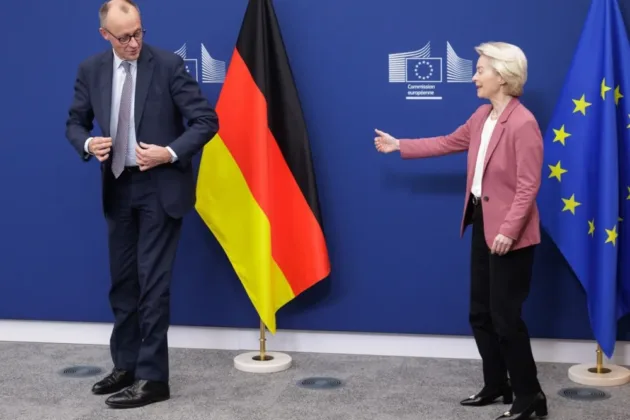
Germany, the largest net contributor to the EU budget, argues that its financial backing for Kyiv justifies its demand for deep cuts to the next MFF, according to Rapporteur. German Chancellor Friedrich Merz has said there can be no budget deal without new Ukraine loans.
The linkage is resisted by many poorer net-recipient member states in the south and east of the bloc. Several net contributors bordering Russia also oppose it, warning that tying the two files together could put Ukraine’s war effort at risk.
Finland’s European affairs minister Joakim Strand told Rapporteur that the EU had to be able to support Ukraine whatever happened with the MFF.
The timetable is also being shaped by France’s presidential election, with the first round due on April 18, 2027. Marine Le Pen of the right-wing National Rally (RN) has pledged to slash France’s contributions to the EU budget and withhold support for Kyiv.
Separately, Ukrainian President Volodymyr Zelensky said on November 9 that, following a call with European Commission President Ursula von der Leyen, Brussels would activate a special emergency mechanism to get money to Ukraine quickly amid heavy Russian attacks. EU officials said this would run through the EU Civil Protection Mechanism and was not linked to the prospective €45 billion package.