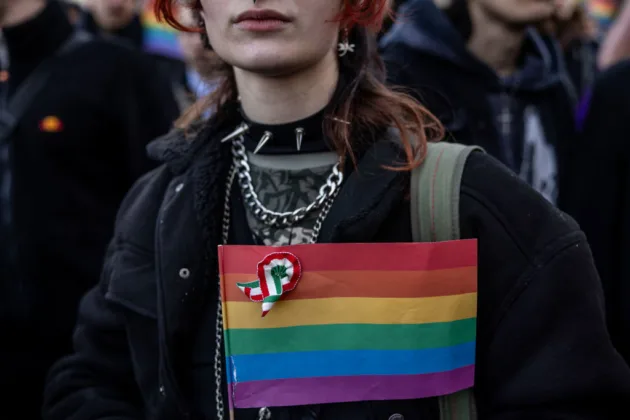












The Hungarian Government has said it would scrap the 2022 requirement that women seeking an abortion be shown evidence of foetal vital signs and would also make emergency contraception available without a prescription for those aged 14 and over. Prime Minister Péter Magyar announced the measures from Dublin on November 12 as part of a broader package on women’s rights and protection from violence.
The measures mark a clear departure from policies pursued under former prime minister Viktor Orbán.
Hungarian law has long permitted abortion up to 12 weeks where a woman declares a “severe crisis situation” and attends two mandatory counselling sessions (and later in cases of severe foetal abnormalities). Those statutory time limits and conditions remain unchanged, the Health Ministry, led by Zsolt Hegedűs, confirmed.
In September 2022 the Orbán government introduced a decree through the Interior Ministry requiring women seeking an abortion to be presented with a definitive sign of foetal life (practised as listening to the foetal heartbeat) before the procedure could proceed.
Some doctors and women’s rights groups described the process as cruel and humiliating. Protests took place in Budapest at the time.
Magyar said the rule had failed to reduce the number of abortions, raised serious bioethical questions and added further trauma for women already in difficult circumstances.
The Health Ministry stated that no woman would in future be required to listen to or view the foetal vital signs against her will.
A doctor would inform her once, objectively, that she may request to see or hear them. She need not give a reason for declining, sign a waiver or face any disadvantage in care.
The mandatory counselling with the Family Protection Service would continue as before, according to the ministry.
Official statistics show that the absolute number of abortions has continued a long-term decline (from roughly 21,800 in 2022 to about 20,300 in 2024). The ratio relative to live births, though, has risen as births fell faster, from 24.6 abortions per 100 live births in 2022 to 26.1 in 2024, according to the Central Statistical Office (KSH).
Preliminary KSH data for 2025 put the number of abortions at about 20,400, with the ratio climbing to 28.3.
Analyses of the official figures, including one by news site Telex, have found no clear causal reduction attributable to the 2022 rule.
Hungary was the last EU member state where both common forms of emergency contraceptive pills (levonorgestrel and ulipristal acetate) required a medical prescription, according to the European Consortium for Emergency Contraception (ECEC). In Poland the pills also remain prescription-only, though a pilot scheme launched in 2024 allows pharmacists to issue the prescription.
Under the new rules, people aged 14 and over would be able to obtain them directly from pharmacies after a brief pharmacist consultation. Those under 14 would still need a prescription.
The private consultation, based on a short questionnaire, covers the time elapsed since intercourse, any other medication and whether a medical examination is needed. Pharmacists are to refer anyone suspected of being a victim of sexual violence for help.
The government framed the change as closing a decades-old gap with European practice and reducing unwanted pregnancies and subsequent abortions. The pills must still be taken as soon as possible after unprotected intercourse for maximum effectiveness.
The announcement also includes the initiation of ratification of the Istanbul Convention (the Council of Europe treaty on preventing and combating violence against women and domestic violence), which Hungary signed in 2014 but never ratified.
The previous government had rejected it over what it described as ideological content, including provisions on migration policy and the concept of “gender”. In May 2020 parliament adopted a political declaration, tabled by the Christian Democrats, rejecting ratification.
Hungary’s overhaul further covers strengthened criminal-law protections, including tighter rules on restraining orders, special treatment for domestic-violence victims in proceedings and a new standalone offence for the misuse of intimate images. It also includes clarification that sexual acts require voluntary consent and measures to address “menstrual poverty”.
Magyar described the package as serving “the safety and dignity of Hungarian women” and reducing all forms of violence against them.
The Health Ministry indicated that the changes followed professional and social consultation. Hegedűs held talks over the summer with NGOs, medical professionals and church leaders on the heartbeat rule, emergency contraception and the regulation of medical abortion.
Some 21 pro-life organisations complained in an open letter in August that they had been sidelined in those talks.
The reforms form part of the policy shift under Magyar’s Tisza-led government, which took office in May 2026 after April elections ended 16 years of uninterrupted Fidesz rule.
They follow earlier moves to amend other Orbán-era measures, including elements of the 2021 child-protection law. Opposition parties that had supported the 2022 heartbeat rule have criticised the direction of the new government’s social policies.
The Christian Democratic People’s Party (KDNP), the junior partner in the former Fidesz-led government and now in opposition, rejected the package.
In a statement it described the measures as politically motivated and “anti-life”, stressing that “human life deserves full protection from conception to natural death”.
The party said the changes to the heartbeat rule and related steps run counter to the principle of protecting foetal life. It also argued that ratification of the Istanbul Convention is unnecessary for tackling violence against women and would open the way to gender ideology and unrestricted migration.
The KDNP called the announcement a diversion, claiming that testimony given by Judit Varga — Magyar’s former wife and an Orbán-era justice minister — to a parliamentary inquiry committee on November 11 showed he was “the abuser himself”. Magyar has previously rejected Varga’s abuse allegations.
Fidesz politician Alexandra Szentkirályi accused Magyar of using the announcement to divert attention from his own controversies.
Former Hungarian justice minister Judit Varga renewed accusations against her ex-husband, Prime Minister Péter Magyar, during a November 11 parliamentary hearing, alleging years of psychological abuse, blackmail and humiliation. https://t.co/ZPD8chtxEH
— Brussels Signal (@brusselssignal) November 12, 2026