
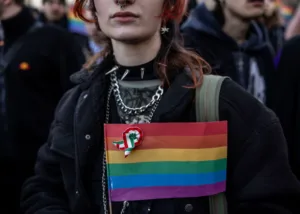





Hungary’s National Assembly has voted on October 13 to amend the 2021 “child protection” legislation introduced under former prime minister Viktor Orbán, removing provisions that restricted the portrayal or promotion of sexual and gender diversity in content accessible to minors.
The bill passed by 139 votes to 51, with the governing majority of the Tisza party under Prime Minister Péter Magyar securing the measure without opposition support. Tisza holds 141 of the 199 seats in the National Assembly.
The amended law replaces the earlier ban with a general requirement to protect under-18s from material that can “seriously impair the child’s physical, intellectual, emotional or moral development”.
According to the government, the changes strengthen child-protection rules “regardless of sexual orientation” while bringing Hungary into line with European Union requirements.
On April 21 the European Court of Justice, sitting as a full court, ruled that the 2021 law violated “the very identity” of the EU as a common legal order. It was the first time the court had found a standalone breach of the common values set out in Article 2 of the Treaty on European Union.
The 2021 measure had also underpinned later restrictions, including limits on Pride events. EU funding worth several billion euro has been withheld from Budapest over the provisions, and the government has argued that their repeal clears the main legal obstacle to releasing the money.
The package contains additional child-protection measures. These include accelerated assessments for children remaining in hospital after medical discharge due to family or social circumstances, with guardianship authorities required to produce an assessment and an action plan within eight days.
The package also brings in tighter controls on public display of content deemed harmful to minors, and revised rules on access to criminal-register data for child-protection purposes (introducing prior official approval and further safeguards against misuse).
The government submitted the bill on September 14.
Fidesz-KDNP and the right-wing Our Homeland Movement (Mi Hazánk) voted against the legislation.
Fidesz described it as the Tisza government’s “gender law”, arguing that it would reintroduce “gender propaganda” into education and weaken safeguards around access to the sex-offender registry, thereby favouring offenders over families.
Balázs Orbán, MEP for Fidesz and until September Viktor Orbán’s political director, said that, because of the deletion of the provision of promoting deviation from the self-identity corresponding to the sex assigned at birth, gender reassignment or homosexuality, “The doors of Hungarian classrooms are being opened up to gender activists, allowing them to promote their views directly to students.”
He stressed that this happened under pressure from Brussels and noted that there had been a nationwide referendum on the matter, where millions of Hungarians made clear they were aligned with Fidesz. That referendum, held in April 2022 alongside the general election, was declared invalid after an opposition campaign to spoil ballots left the number of valid votes below the threshold required for a binding result.
After the vote, Előd Novák, an MP for Mi Hazánk, shouted “The paedophiles thank you!” His party has objected that the new rules make it harder to search the register of convicted child sex offenders by name.
Prime Minister Magyar responded on social media that Fidesz and Mi Hazánk had “jointly voted against the law strengthening the protection of children”, including measures to help babies left in hospital and to shield children from all forms of violence, calling the decision a “shame”.
The vote marks the first substantial reversal of Orbán-era restrictions targeting LGBTQ content and related rights since Magyar’s pro-EU government took office in May, following April elections that ended Orbán’s long period in power. Tisza won the April 12 election and Magyar was elected prime minister by the new National Assembly on May 9, ending 16 years of uninterrupted Fidesz rule.
LGBTQ advocacy groups have described the removal of the specific anti-LGBTQ clauses as a positive step in compliance with the ECJ ruling, while the government has emphasised the broader child-protection framing.