




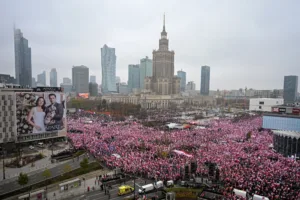
More than 250,000 Poles have joined opposition-aligned President Karol Nawrocki in the annual Independence Day march in Warsaw on November 11, organised by nationalist activists who are close to the opposition right-wing nationalist-libertarian Confederation (Konfederacja) and conservative Law and Justice (PiS) parties.
The attendance data provided by the police and Warsaw City Hall put the march’s attendance at up to 250,000 whereas the organisers claimed that the figure was closer to 500,000. By either count, the number of marchers was significantly higher than in all past Independence Day marches with the exception of the centenary celebrations of independence in 2018. Last year, City Hall estimated attendance at around 100,000.
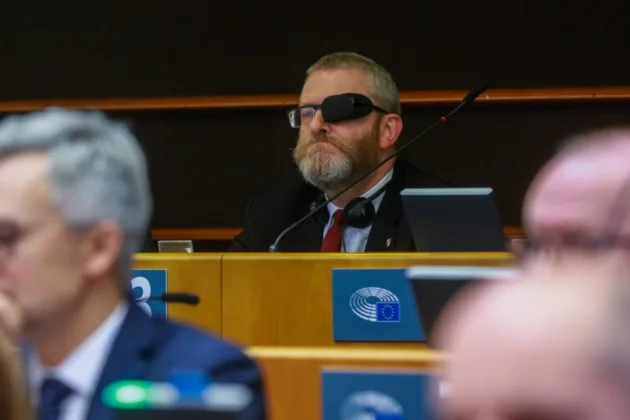
The march was also supported by two other right-wing opposition groups: MEP Grzegorz Braun’s radical nationalist Confederation of the Polish Crown (KKP) and the breakaway from PiS Development Plus (Rozwój Plus) movement led by former PiS prime minister Mateusz Morawiecki.
The Warsaw march, held under the sovereigntist theme of “Poles should be masters in their own country” (Polak w Polsce gospodarzem), began in the afternoon with crowds waving Polish flags and wearing scarves in red and white as they made their way from the Roman Dmowski Roundabout through the city centre towards the National Stadium, Poland’s largest stadium, which can accommodate some 58,000 people.
The slogan was chosen to “emphasise our opposition to foreign influences on Poland and underscore that Poland should be a nation-state without mass immigration”, said Rafał Buca, the march’s spokesman. “In Poland, Poles should rule – not some foreigners, not the European Union, not big corporations.”
On the morning of the march, the organisers shared an image showing Prime Minister Donald Tusk as a puppet of European Commission President Ursula von der Leyen. “Time to cut the strings of foreign influence,” they declared.
The march was led by President Nawrocki, who carried a national flag and was flanked by his eldest son and senior aides.
Motorcyclists, historical re-enactors and vintage tractors were at the front of the march, along with relics of the Jesuit martyr St Andrzej Bobola, one of Poland’s patron saints.
Police deployed additional officers from across Poland to secure the march in Warsaw and the organisers ensured that 1,000 security personnel and 200 mobile medical responders were in place to oversee the procession.
Warsaw’s authorities banned drones, the possession of weapons and the use of pyrotechnics during the celebrations but, as in previous years, participants were seen setting off flares and smoke bombs despite the restrictions. Police said they found pyrotechnics on 86 people and detained 60.
Jarosław Misztal, director of the Warsaw Security Centre, confirmed, though, that there had been no serious incidents during the march.
It had been feared that attendance at the march might be lowered as a result of the shooting in Kraków on November 7, when a lone gunman killed six people and injured 15 in the city’s Main Square. The bodies of three of his relatives were later found at his home in Ostrowiec Świętokrzyski, some 150km northeast of Kraków.
Interior minister Marcin Kierwiński said the 25-year-old gunman held “very radical” and “ultranationalistic” views. Buca told Reuters the march organisers condemned any politicisation of the shooting.
Instead, the dispute between the centrist government led by Tusk and President Nawrocki over the October 30 takeover of the Constitutional Tribunal by government-backed judges, with riot police deployed outside the building, sustained the mobilisation of the supporters of Poland’s opposition right against the present administration.
Nawrocki has described the events as “a forcible takeover of a constitutional institution”, while Tusk has said decisive action was needed to restore the rule of law.
The opposition aimed to show a united front amid their ongoing protests against the takeover of the Constitutional Tribunal and ahead of the 2027 parliamentary election, in which they hope to unseat Tusk’s government.
“It’s about showing our strength and, at the same time, for this march to be a springboard for the election campaign,” said PiS leader Jarosław Kaczyński during the march.
One of the leaders of Confederation, Krzysztof Bosak, told the crowd in a speech at the beginning of the march that, “while we have different experiences and views, under the white-and-red flag we form one community”.
“Next year, we must turn this community into an election victory in which we must remove the current clique from power and form a pro-Polish government,” he declared. “We do not accept the violent takeover of state institutions. We demand respect for the law,” said Bosak.
Confederation’s other co-leader, Sławomir Mentzen, though, shared a picture of himself at the march in front of a banner showing images of both Tusk and Kaczyński crossed out, alongside the word “Reset”.
This underlined that while Bosak’s nationalist faction of Confederation is seen as more amenable to the idea of working with PiS to form a potential future coalition government, Mentzen’s libertarian faction is less enthusiastic about the idea.
Figures from the liberals and the left have consistently avoided the march. Tusk celebrated Independence Day in Szczecin, northwest Poland, where he issued an invitation to Nawrocki to visit his home in Sopot for talks before Christmas.
Hours later, Tusk criticised the President’s Independence Day address on social media, saying that “at least on this one day” Nawrocki could have tried to unite Poles rather than divide them.
Earlier in the day, during official commemorations of Independence Day at Warsaw’s Tomb of the Unknown Soldier, President Nawrocki said the country needed a strong state, but not at the expense of liberty.
“We need a strong and efficient state to feel safe and to live in prosperity, freedom and sovereignty, but not so that our freedom is restricted,” he said.
He added that political elites existed to carry out the will of the nation, not to govern against it. He said that the Constitutional Tribunal’s prestige had been destroyed in recent weeks and urged politicians to rebuild it.
“A free nation deserves a free Constitutional Court, free of police cordons, but also free of politicians.”
He also warned about the lessons of the collapse of the Polish-Lithuanian Commonwealth, the so-called First Republic, saying infighting among powerful elites, who let foreign powers gain influence, helped bring it down, leading to partition from which the country suffered for 123 years.
Poland regained its independence on Armistice Day (November 11, 1918) at the end of the First World War, when Poles united and broke free of being partitioned by Russia, Prussia and Austria-Hungary. This was the result of joint action by Marshal Józef Piłsudski and his insurgent forces, political action by nationalist forces led by Roman Dmowski and active lobbying abroad by Polish pianist and politician Ignacy Paderewski.
The Independence March, first organised in 2010 by the National Radical Camp (ONR) and All-Polish Youth (MW), was originally an initiative of Poland’s nationalist right and has grown in numbers and significance since.
Supporters see it as a celebration of national sovereignty and traditional values, while critics accuse organisers of providing a platform for extremist views because some participants in past marches have displayed ultranationalist, anti-immigrant and anti-LGBT banners. Most of those marching, though, have been individuals carrying the white-and-red Polish national flag.
During the years of the previous liberal Civic Platform (PO)-led governments (2007-2015) there were clashes with both police and counter-demonstrators, which led to calls for the march to be banned.
The organisers of the march claimed that some of the trouble was provoked by security forces officers working undercover. Those claims gained traction when, in a taped conversation between government officials, one of them admitted that an incident in which a guard’s booth outside the Russian embassy was burned to the ground in 2013 had been the work of undercover officers.
The march became a much calmer affair, with more families participating, after the arrival in office of the last PiS government (2015-2023). This was especially so in 2018, on the centenary of Poland regaining its independence, when the march, which attracted around 250,000 according to police estimates, was attended by then-President Andrzej Duda, who was aligned with PiS, and supported by the government.
But this did not stop criticism of the march as a hotbed of nationalist extremism, not only from the Polish left and centre but also from the European Parliament, where in 2017 Guy Verhofstadt, then leader of the liberal group, called the marchers fascists and Nazis.
As disputes between the last PiS government and European institutions such as the European Commission and the European Court of Justice escalated over rule of law, migration and the EU’s climate policies, sovereignty became a central theme of the Independence Day celebrations.
The latest detailed survey on Poles’ attitudes towards the EU shows that Poland leaving the EU (Polexit) is now supported by one in five voters. That number has doubled compared with two years ago.
The research, conducted by the left-leaning Institute of Political Criticism (Instytut Krytyki Politycznej), shows that this number has the potential for significant growth as a result of voter opposition to the euro, the relocation of illegal migrants and proposals to remove member states’ right to veto EU decisions.
According to Professor Przemysław Sadura, a University of Warsaw sociologist who coordinated the research, 60 per cent of the population was able to identify and cite a scenario in which it would be possible for them to consider supporting Polexit.
Sadura’s findings show that two-thirds of the voters who support the KKP already support Polexit, whereas that figure is a third among Confederation voters. In terms of age groups, support for Polexit is highest among young men, at more than 30 per cent.
So far PiS, Poland’s largest opposition party, and President Nawrocki have ruled out seeking Polexit.
PiS had back in 2003 supported Poland joining the EU. To the chagrin of Polish nationalists and libertarians, the PiS government negotiated the EU’s Lisbon Treaty in 2007 and President Lech Kaczyński ratified it in 2009. The treaty extended qualified majority voting and retained the procedure under which member states alleged to be acting in violation of EU values such as democracy, human rights and the rule of law can have their rights suspended.
After its last spell in government PiS has become more critical of the EU and the party’s stance now is that there is need for radical reform of the EU in the direction of returning powers to the member states and limiting the rights of EU institutions.
Indeed, Kaczyński, addressing the Krynica Forum on October 28, argued that Poland, together with other like-minded EU member states, may have to threaten Polexit to force changes in the EU in the desired direction, away from the idea of an “ever closer union”.