
The leader of the Confederation of the Polish Crown (KKP) party Grzegorz Braun MEP has released footage of himself using a hammer to damage a monument located in eastern Poland and dedicated to Ukrainian Insurgent Army (UPA) partisans.
Braun, whose KKP party has made opposition to both migration from and military support for Ukraine its rallying cry, believes that the monument to UPA in eastern Poland, just a few kilometres from the border with Ukraine, should be removed because it “insults the memory of victims of the Ukrainian genocide against Poles” and “glorifies Nazism”.
The monument, in a clearing known as Białystok near the village of Liski, in the Lublin province of eastern Poland, marks the burial site of 41 UPA partisans who died fighting the Soviet NKVD forces in February 1946 during the aftermath of the Second World War, when the Soviet forces were involved in deporting the Ukrainian population and fighting the partisan insurgents from Polish territory while backing the Polish communist government the USSR had installed in 1944.
A memorial was erected to the dead Ukrainians in the late 1990s, and in 2019 a granite monolith was added, engraved with the names of those buried at the site. The Institute of National Remembrance (IPN) said on September 12 that the structure had gone up without permits or agreement and that it had no sources confirming the UPA members were buried directly beneath it. The regional authorities in Lublin have said the grave does not appear in the provincial register of war graves.
The memorial has been attacked by protesters with black paint and its arch damaged before and further damage was discovered to the inscription on the monument on September 7. The police have said they have launched an investigation into vandalism, criminal damage and ethnic hatred.
On September 10 Braun published footage showing himself and another man, identified in Polish media as a former police officer, Marcin Miksza, using a hammer to repeatedly strike the front of the monument damaging the stone which contains names of the fallen UPA members. Polish outlets reported that the pair had gone to the site after attending a local harvest festival.
In the video Braun claims local residents are “afraid they would be set on fire” if they attempted to remove the memorial themselves.
A clip published on social media was accompanied by text protesting the existence of the monument.
“The UPA monument in the municipality of Dołhobyczów, Hrubieszów County, is to be dismantled! This obelisk, which insults the memory of the victims of the Ukrainian genocide against Poles, should be removed using professional tools immediately after the crime of Banderism has been documented!”
Pomnik UPA w gminie Dołhobyczów w powiecie hrubieszowskim do likwidacji❗️
Obelisk obrażający pamięć ofiar ukraińskiego Ludobójstwa na Polakach powinien zostać usunięty profesjonalnymi narzędziami natychmiast po udokumentowaniu przestępstwa banderyzmu!#StopBanderyzacjiPolski… pic.twitter.com/8Q4QZ2z5vJ
— Grzegorz Braun (@GrzegorzBraun_) September 10, 2026
Braun, who sits as a non-attached MEP, having not been allowed to join any European parliamentary caucus because of his controversial statements such as doubting the existence of the gas chambers in the Auschwitz concentration camp, decided to break away from the nationalist libertarian Confederation party and to contest Poland’s presidential election.
He came fourth, polling 6.3 per cent, and the KKP he now leads draws around 8 to 9 per cent in polling averages. That could make him and his party key players in deciding who can form a government after the parliamentary elections due in 2027 as without his party’s support it may not be possible to form a majority government.
Braun, who is a documentary film-maker by profession, has consistently used highly visual stunts to demonstrate his opposition to Ukraine, Jews, abortion and LGBT.
These stunts have brought him visibility and notoriety as well as a raft of prosecutions over which he has had his European parliamentary immunity lifted on several occasions.
He is currently in the process of being tried for attacking a celebration of the Jewish festival of Hanukkah in parliament in December 2023 using a fire extinguisher and was in August charged with the crime of denying Nazi crimes for claiming that the gas chambers at Auschwitz are “fake”.
Braun is also facing charges over incidents in which he tore down Ukrainian and EU flags, destroyed a LGBT exhibition in parliament and attempted a citizen’s arrest of a doctor who had carried out a late-term abortion at a hospital in Oleśnica, southwest Poland.
The European Parliament’s Committee on Legal Affairs has unanimously backed waiving the parliamentary immunity of the Polish MEP Grzegorz Braun in a fresh Holocaust-denial case, months after the Parliament waived his immunity on March 26 in a separate case involving his denial of the existence of Nazi gas chambers.
The latest case concerns remarks Braun made during a livestreamed discussion on September 27, 2025, with the right-wing historian and former senator Jan Żaryn, where it is alleged that he denied that Nazi Germany carried out genocidal killings using gas chambers at Auschwitz-Birkenau, in German-occupied southern Poland, and at Majdanek in the eastern city of Lublin. Historians estimate that about 900,000 people were killed in the gas chambers at Auschwitz.
Under European Parliament rules, immunity is waived in relation to specific alleged offences, meaning a new request is required for separate offences. Parliament has stripped Braun of his immunity four times so far.
Holocaust denial is particularly sensitive in Poland, where Nazi Germany established its largest concentration and extermination camps during its occupation of the country and murdered millions of Jews, Poles and other victims.
Publicly denying Nazi crimes, including genocide, is punishable in Poland by a fine or up to three years in prison under the 1998 act that established the IPN.
Braun’s controversial visual stunts and contrarian positions have, though, simply made him better known to the public and enabled him to project a distinctive anti-establishment image to boot.
He is the only politician of note to be openly hostile towards both Ukraine and Israel while being accommodating towards Russia, sceptical of the alliance with the USA and who consistently argues that Poland should leave both the European Union and NATO. In June figures from his party attended a Russia Day event at the Russian embassy in Warsaw and called for a “normalisation” of relations with Moscow.
During the Covid pandemic he consistently opposed both lockdowns and the vaccination drive and supports bringing back the Latin Mass in the Catholic Church and opposes any liberalisation in the Church’s stance on abortion, LGBT or the ordaining of women.
He seems to have garnered his vote from among those who either have not voted in the past or who have supported Law and Justice (PiS) against the liberals and the Left but who were disappointed in that party’s compromises with the EU and support for Ukraine.
While there has been a petition calling for his KKP to be banned on the grounds that it supports a hostile foreign power (Russia) and for Holocaust denial it does not look as if either the present centre-left government led by Prime Minister Donald Tusk nor other right-wing parties such as PiS and the Confederation party are willing to pursue such a course of action.
Tusk and his Civic Coalition (KO) hope that Braun can sow enough division and embarrassment on the Right to help them, PiS has swung to the Right in order to attempt to take back the votes it has lost to Braun and the Confederation party fears it would lose out from openly attacking its former colleague Braun.
The police and prosecutors are now investigating the incident involving Braun in which damage was done to the monument honouring the UPA fallen with interior ministry spokeswoman Karolina Gałecka saying “the perpetrators will not go unpunished”. The perpetrators could face up to five years in prison for the offence.
Ukraine’s Foreign Ministry decried the act as “disgraceful and immoral conduct” and said it expected the relevant Polish authorities to carry out a legal assessment, restore the damaged grave and take steps to prevent similar incidents in the future.
“Political fringe figures in Poland couldn’t come up with anything better than to wage war on graves at a time of a real war that poses an existential threat to both Ukraine and Poland,” the Ministry of Foreign Affairs of Ukraine told the Interfax-Ukraine news agency.
“Ukraine consistently advocates the same principle on both sides of the border: Ukrainian memorial sites in Poland and Polish memorial sites in Ukraine must be protected,” the ministry continued. “No one has the right to turn remembrance and respect for the dead into a circus show for their own political ends.”
Recent months have seen a rise in anti-Ukrainian sentiment in Poland, including a series of cases of verbal or physical attacks against Ukrainians, who are by far Poland’s largest immigrant group. Reported hate crimes against Ukrainians were up 30 per cent in the first half of this year.
These are a result not only of the scale of the migration, with some 868,000 Ukrainians holding temporary protection status in early September, according to government figures, and several hundred thousand more on residence permits, but also as a result of Poles and many of its politicians resenting the fact that the Ukrainians will not budge on the historical dispute despite the extensive military and humanitarian aid that was provided by Poland in 2022 in the immediate aftermath of the Russian full scale invasion of Ukraine.
The incident comes amid recent tensions between Warsaw and Kyiv over Second World War history, and in particular the fact that the UPA continues to be honoured in Ukraine.
UPA was the military wing of the Organisation of Ukrainian Nationalists (OUN) who opposed the USSR but whose roots lie in calling for the ethnic cleansing of Poles from territories now in western Ukraine. It was UPA who was responsible for inspiring and participating in the Volhynia massacre during the Second World War which Poles regard as genocide.
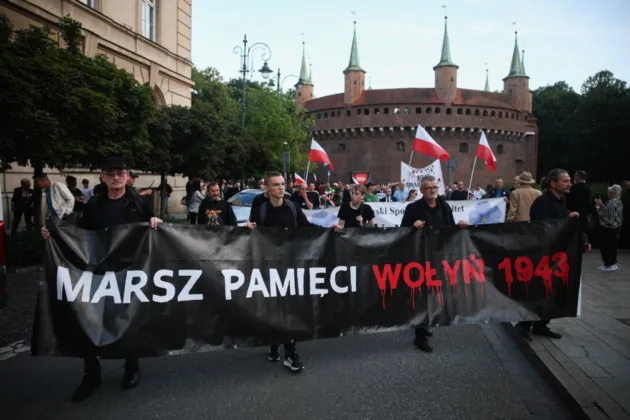
The Volhynia massacre cost the lives of around 100,000 Polish civilians in 1943 and 1944, murdered often in burned out buildings and with pitchforks. Poland has for years been attempting to exhume the victims, but these efforts have often been blocked by the Ukrainian authorities.
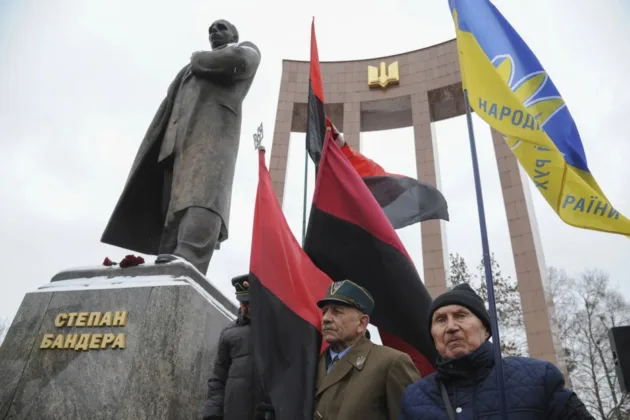
Many Ukrainians, though, see the UPA and its former leader, Stepan Bandera, as symbols of Ukrainian independence and resistance to Soviet rule.
In 2017, Ukraine responded to the dismantling of a UPA monument in Hruszowice, southeast Poland, by introducing a ban on exhumations of Polish victims of the Volhynia massacres despite the fact that it allowed Germans to exhume their fallen soldiers from the Second World War.
That difference in views of history has been a problem between the two countries and relations became especially tense on May 26, when President Volodymyr Zelensky signed a decree granting a special forces unit the honorary title “heroes of the UPA”. His Polish counterpart, Karol Nawrocki, responded by revoking Zelensky’s Order of the White Eagle, Poland’s highest decoration, on June 19; the Ukrainian president returned it the following day.
In order to defuse the crisis the Ukrainians have allowed Poland to resume exhumations in some localities, with the remains of dozens of Polish victims reburied in Ukraine on August 31, and on September 2 Poland granted Ukraine permission to conduct a search for the remains of Ukrainian civilians killed by Polish resistance fighters during the Second World War. Differences over the interpretations of history remain, though.