





Austria looks set for a coalition government of Conservatives and Socialists, even though both parties scored relatively poorly in the general election.
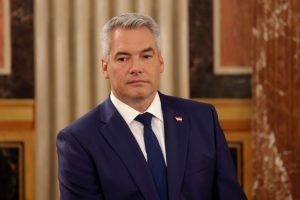
On 22 October, Austria’s head of state President Alexander van der Bellen – a former Green party politician – announced he had given the mandate to form a government to the leader of the Conservative People’s Party (ÖVP), Karl Nehammer.
He asked Nehammer to start talks with the Social Democratic Party (SPÖ) “immediately”.
Ich beauftrage @karlnehammer, den Vorsitzenden der zweitstärksten Parlamentspartei, mit der Regierungsbildung.
Ich habe ihm das heute Vormittag persönlich mitgeteilt und ihn auch gebeten, umgehend Verhandlungen mit der Sozialdemokratischen Partei Österreichs aufzunehmen. (vdb)
— A. Van der Bellen (@vanderbellen) October 22, 2024
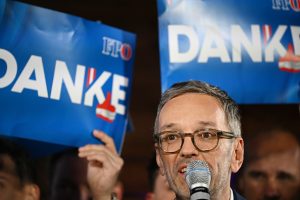
Van der Bellen thus bypassed the right-wing Freedom Party (FPÖ), which came first in the country’s general election in September with 29 per cent of the vote, a gain of 13 percentage points on the previous ballot.
This move is highly unusual. Traditionally, the election winner receives the government-formation mandate from the president within days of the election. The victors will then hold talks with other parties to form a coalition government.
Only if those discussions yield nothing will the president transfer the mandate to the next party in line. Van der Bellen had said earlier in October he would not give the FPÖ the government-formation mandate.
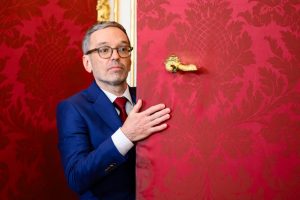
He justified his decision by saying that Herbert Kickl, leader of the FPÖ, “could not find a coalition partner who would make him Federal Chancellor”.
All parties except the ÖVP had previously declined any co-operation with the FPÖ. ÖVP politicians said they would only enter a coalition with the FPÖ if Kickl stepped down.
The FPÖ nonetheless suggested the Conservatives start negotiations, focusing on subject matters first and personnel decisions afterwards, as is the traditional way.
ÖVP leader Nehammer – whose party lost 11 percentage points and came in second with 26 per cent of the vote – declined outright, saying he would not “play the stirrup-holder for Kickl”.
“The election was not a race in which the party which the winner automatically gets to form the government,” Van der Bellen continued on October 22.
“Austria needs a stable government”.
He said now it was important to find compromises and “new solutions” and therefore had tasked Nehammer with forming a government and asked him to start talks with the SPÖ, which came in a distant third in the elections.
This decision contrasted with the trumpeted wish for stability as ÖVP and SPÖ together only have a majority of one seat in the 183-seat main chamber in the Austrian Parliament.
Furthermore, the election programmes of both parties differ greatly, especially since the SPÖ has moved even further to the Left in recent years. Their current leader, Andreas Babler, openly describes himself as a Marxist.
Still, the ÖVP has proven pliable and open towards leftist demands in its coalition with the Green party since 2019.
For a reliable majority, ÖVP and SPÖ would need the support of a third party – a “novum” in Austrian politics.
Furthermore, the SPÖ has been wrought with internal strife after the dismal election result.
No ÖVP representatives have so far criticised Nehammer’s actions, although that may change after the regional elections in Styria in November where the ÖVP is also forecast to suffer major losses.
FPÖ representatives heavily criticised what they called Van der Bellen’s “backroom dealings” as “irresponsible” and “a slap in the face of the voters who want a change in politics that puts our own population back into the centre”.
Marlene Svazek, FPÖ vice governor of Salzburg, recently wrote that the “coalition of the losers” would bring “another five lost years” for Austria.
Herbert Kickl himself wrote in a statement on his Facebook page: “The President has let the people know that he breaks with normal processes and will not task the election winner with forming a government. This may seem like a slap in the face to many but I promise you: The last word has not been spoken yet.“