





A visit to Philip Morris International’s (PMI) manufacturing and technology hub in Bologna offered Brussels Signal a firsthand look at the company’s ambitious transformation from a traditional tobacco giant to a pioneer in smoke-free alternatives.
The facility, visited on May 8, is one of the largest and most advanced of its kind in Europe and underscores PMI’s €16 billion investment since 2008 in developing, researching and commercialising reduced-risk products like IQOS, its flagship heated tobacco system.
One aspect of the visit was the IQOS store concept, designed to mimic the premium experience of brands such as Apple or Nespresso.
The stores feature sleek, modern interiors, with dedicated trial rooms where customers can test devices in a controlled, high-end environment.
The goal is to position IQOS as a sophisticated, aspirational product, away from the current image a cigarette has.
The devices themselves seem meticulously engineered.
Tobacco leaves are ground into a fine powder, mixed with glycerin (for smoke-like vapour), guar gum (as a binder) and fibres (for elasticity), then cast into sheets that are dried, cut and assembled into sticks.
These are heated, not burned in the IQOS device, which PMI argues reduces harmful chemicals compared to traditional tobacco combustion.
The latest iteration, IQOS ILUMA, even introduces tobacco-free sticks (LEVIA), marking a further step toward diversifying its smoke-free portfolio.
PMI’s underscores that its operations in Italy are a cornerstone of the national economy.
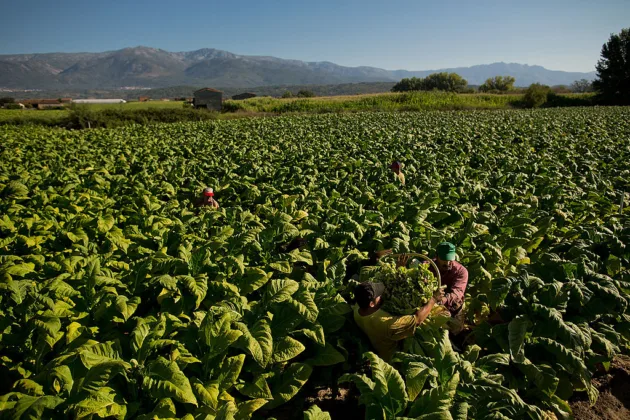
The company’s integrated supply chain supports 44,000 jobs across the country, involving 8,000 Italian suppliers, including 1,000 agricultural businesses tied to tobacco production.
Since 2011, PMI has invested more than €2 billion in Italy’s tobacco supply chain alone, with a 10-year agreement (extending to 2034) with the Ministry of Agriculture and Coldiretti (Italy’s leading agriculture organisation) to stabilise and modernise the sector.
The deal includes sustainability initiatives, digital transition support and training for young farmers, ensuring the long-term viability of Italian tobacco farming.
The Bologna manufacturing plant, a €1.5 billion investment, serves as the global centre of excellence for smoke-free product production.
It exports to more than 70 markets, with an export value exceeding €1.8 billion.
The site also houses the Philip Morris Centre for Industrial Excellence, employing 500 highly specialised professionals focused on R&D, process innovation and sustainability.
At the plant, Massimo Spigola, representative of tobacco growing farmers in Italy, stressed that the European Union recognises raw tobacco as an agricultural product, regulated under the Common Agricultural Policy (CAP) and specifically within the Common Organisation of the Markets (CMO) for agricultural products.
He said it yielded substantial revenues and provided stable jobs to many farmers (and others), making Italy Europe’s leading tobacco exporter.
He also explained that if, for example, governments would push for a change via subsidies, making farmers to switch for other crops, tobacco would just be imported from outside.
Nearby, the Zola Predosa training centre acts as a prototyping hub, validating new production techniques before global rollout.
The company has launched “REC – Recycling for the Circular Economy”, a project to collect and recycle IQOS and LIL devices, aiming to recover more than 80 per cent of materials (including plastics, metals and lithium-ion batteries).
Since its launch, the initiative has collected more than 1 million devices, with plans to expand to VEEV e-cigarettes and other products.
In agriculture, PMI enforces Good Agricultural Practices (GAP) and the Agricultural Labour Practices (ALP) Code, ensuring fair wages, no child labour and safe working conditions across its supply chain.
The Leaf Innovation Hub in Umbria, developed with the University of Perugia, focuses on precision agriculture, digital farming and sustainable water management, further cementing PMI’s role in modernising Italy’s agricultural sector.
Alberto Mantovanelli, tobacco grower from Verona and President of OPIT (Italian Tobacco Producers Organization) responded to a question of Brussels Signal on why tobacco is an interesting crop to grow for Italian farmers, saying it “is one of the most advanced and well-structured crops in the Italian agricultural landscape”.
“What makes it particularly interesting is its ability to combine agronomic expertise, innovation and entrepreneurial organisation, while also ensuring solid economic sustainability. It is a supply chain that offers stability, a long-term perspective and opportunities for growth—elements that continue to attract younger generations as well.”
He further said that “farmers operate within a highly rigorous system of rules, often more advanced than European standards. Today, however, these rules represent a real competitive advantage.”
“These practices make it possible to build a traceable and credible supply chain, capable of meeting market and societal expectations, while also strengthening the economic sustainability of farms through greater efficiency, quality and access to qualified markets.”
Mantovanelli told Brussels Signal that, “The international market is extremely competitive, but it is progressively moving toward a model in which quality, reliability and sustainability are becoming determining factors”.
“Italian production stands out precisely because of this integrated approach: traceability, safety and high standards are recognised assets that make it possible to position the product in more qualified market segments.
“These elements are complemented by significant investments in innovation: Renewable energy, efficient irrigation systems, technologies to reduce environmental impact and advanced machinery.”
PMI’s smoke-free mission is not without criticism. While the company frames its products as “a better choice than continued smoking”, public health experts remain divided on the long-term impacts of heated tobacco and e-cigarettes.
Yet, with 43 million users worldwide and 4 million in Italy alone having switched from cigarettes to IQOS, PMI argues that its approach is working.
PMI contributes 0.5 per cent to the country’s GDP and its €1.9 billion in exports (2023) highlight its role in Italy’s trade balance.
The Digital Information Service Centres (DISCs) in Taranto, Marcianise, and Terni — €180 million investments creating 700 jobs — further illustrate the company’s role to the local employment and consumer support.
What remains to be seen is whether PMI’s high-tech, high-end approach can fully replace traditional smoking or if its economic and innovative clout will be enough to win over sceptics.