Danish Prime Minister Mette Frederiksen has warned of an “enemy” growing within Europe, explicitly linking parts of the migrant population to Hamas, terrorism and the rejection of European values.
Speaking in the Danish parliament, the Folketing, on August 12, Frederiksen said Europe faced threats both from outside and within its borders, arguing that uncontrolled migration posed a serious threat to European societies.
The chamber had been recalled from its summer recess by five opposition parties, led by Danish People’s Party leader Morten Messerschmidt, who wants Spain suspended from Schengen.
“If we talk about undemocratic forces, yes, then Russia is our biggest enemy,” Frederiksen said. “The problem is that a major enemy has started to grow from within, and it is foreigners who have come to Europe.”
“It is Hamas supporters. It is people who commit terror against European societies. It is people who do not recognise our fundamental European values. It is people who sympathise with some of the darkest forces in this world,” she said.
“So Europe is threatened. The problem is that we are threatened both from outside and now from within.”
Frederiksen then specified the group she was referring to, saying: “Because of people with an Islamic background who do not want the open, free European society. Unfortunately.”
Her remarks came during a parliamentary debate over the mass arrival of migrants on July 30 and 31 in Spain’s North African enclave of Ceuta and the wider European response to illegal migration.
Spain’s interior ministry has put the number who crossed from Morocco at 50,000, of whom more than 25,000 were returned within days.
“A strict immigration policy is crucial for Denmark and for Europe,” Frederiksen said. She argued that such a policy was essential for democracy, social cohesion and individual safety.
The Danish Prime Minister described the images from Ceuta as “very violent” and “disturbing” and said that nobody should be able to cross Europe’s borders illegally.
She warned that Denmark could take immediate action if migrants began moving northwards through Europe.
“Should there be the slightest sign of migrant movements up through Europe, we will not hesitate for a second to take all necessary steps,” she said.
Those measures could include expanding Denmark’s existing border controls and, ultimately, closing the country’s borders completely so that police could check everyone entering the country.
According to Frederiksen, Danish police already have contingency plans for such a scenario and could implement them “with a few hours’ notice”.
“Illegal migration is a serious and very concrete threat to Europe,” she said, arguing that the current European asylum system was no longer viable.
“The current asylum system does not work. It is unsustainable. It is inhumane. And it is destructive for Europe,” Frederiksen said.
She called for a fundamentally different approach to migration, arguing that Europe needed to remove the incentives that benefit people smugglers.
Frederiksen also criticised Spain’s decision to legalise migrants already living illegally in the country. She said Denmark fundamentally disagreed with the Spanish Government’s approach and rejected the idea that Danish taxpayers and society should bear the consequences of decisions taken in Spain.
The Spanish scheme closed to applications on June 30 and required proof of presence in the country before January 1. Madrid has estimated it could cover some 500,000 people and rejects claims that it drew migrants to Ceuta.
“The Spanish government can make its own national decisions, just as Denmark can do so,” she said. “But I and we will not accept that Danish society should pay the price for decisions in Spain with which we fundamentally disagree.”
The Danish Prime Minister said the issue was not limited to responding to individual migration crises.
“We must protect Denmark against uncontrolled immigration,” she said. “We must protect Denmark against Russia, and we must protect Denmark against the forces that wish to suppress our values and way of life, and that is regardless of where they come from.”
She pointed to previous instances in which Russia and Belarus were accused of using migrants as part of hybrid operations against European countries.
She argued that Europe should have an “emergency brake” allowing it to close its borders in response to sudden migration movements.
“The idea that one should be able to close the border, we support it,” Frederiksen said. “We have this emergency brake in Denmark, and Europe should also have this emergency brake.”
The comments come as Denmark and others have been pushing for a tougher European migration policy.
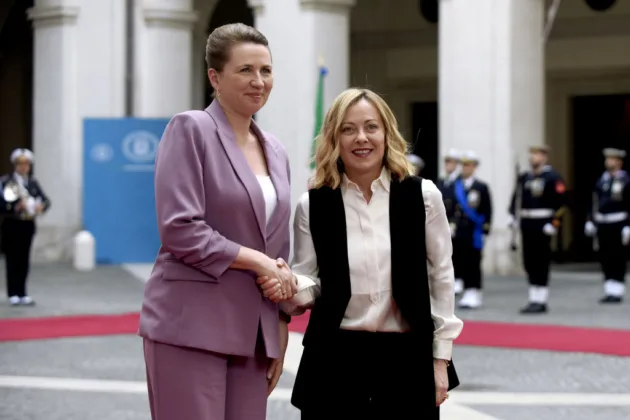
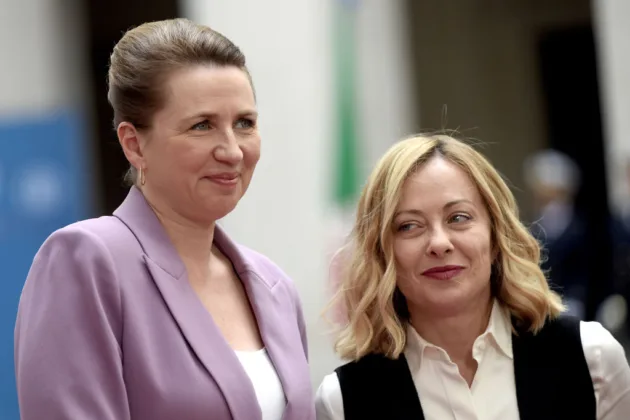
Frederiksen and Italian Prime Minister Giorgia Meloni on August 10 called for greater use of deportations and “repatriation centres in third countries” for people who have no right to remain in Europe.
Their joint statement followed an open letter led by the two countries and signed by 22 member states, which called for stronger protection of the EU’s external borders.
She said European countries needed to be able to determine democratically who enters their territory and argued that people who do not behave properly should be removable.
The Danish Prime Minister’s position places her government among the strongest advocates within the EU for tighter migration controls and a tough approach to crime, despite Frederiksen leading Denmark’s Social Democrats.