





The United States has accused the European Union and several of its member states of forming a key part of a global network that enables China to evade American tariffs by routing goods through third countries, according to a White House report released on August 13.
The 25-page document, titled The Great Transshipment Scam and issued by the White House Office of Trade and Manufacturing Policy, places the EU in the highest category of risk — Tier 1 “diversified scale leaders” — alongside Canada, Mexico, India, Japan, South Korea, Israel and Taiwan.
It describes these as jurisdictions that handle large absolute volumes of China-linked goods while serving as major platforms for exports bound for the United States.
The report states that the alleged transshipment risk is “embedded within broad legitimate trade flows”.
It does not claim every shipment or company is engaged in illegal activity, but argues that the scale of China-linked trade and sophisticated logistics make these economies susceptible to origin-shifting practices.
Within the EU, the report singles out specific member states by functional role. Poland, the Czech Republic, Hungary and Romania are identified as part of a “Central and Eastern European processing belt”, where Chinese components can undergo final assembly, testing, repackaging or finishing before being shipped to the United States under European documentation.
Belgium and the Netherlands are listed among “developed logistics platforms”, valued for their advanced customs systems, deep-water ports, trading houses, bonded warehouses and global re-export networks. They appear in that group alongside Canada, Singapore, Switzerland and Turkey.
@SecScottBessent on The Great Transshipment Scam:
"Illegal transshipment is not just a technical customs violation, it is a deliberate effort to evade U.S. tariffs, undercut American workers and manufacturers, and deprive the American people of billions of dollars in revenue.…
— Peter Navarro (@RealPNavarro) August 13, 2026
Peter Navarro, head of the White House office that produced the report, told reporters on a press call: “For years, the great transshipment scam has let communist China launder its exports through more than 40 countries, rob our Treasury of tens of billions of dollars and steal the pay cheques of American workers.”
The document characterises the practice as “fraud cloaked in paperwork”, involving relabelling, minor processing, re-invoicing or false country-of-origin claims that fail to meet the legal threshold of substantial transformation.
Estimates of the annual value of potentially illegal transshipped goods range from around $40 billion (€34.7 billion) from Goldman Sachs to as high as $303 billion (€262.7 billion) from Altana, with central figures of approximately $60 billion (€52 billion) from the White House Council of Economic Advisers and $75 billion (€65 billion) from Exiger.
The report says the five estimates are not additive and rest on different datasets, product screens and definitions of illegal transshipment.
Corresponding tariff revenue losses are put at $19 billion to $26 billion (€16.5 billion to €22.5 billion) a year in the central case, which assumes $75 billion in annual transshipment and duty differentials of 25 to 35 per cent. The same case implies about 450,000 US jobs displaced and up to $150 billion (€130 billion) in lost annual output.
The findings come as the European Commission is already examining the scale of Chinese goods diverted into the EU market following successive rounds of US tariffs under President Donald Trump, amid concerns that such flows could harm European producers.
The Commission set up an import surveillance task force on April 7, 2025 and launched a customs-data monitoring tool two months later, with trade commissioner Maroš Šefčovič saying it would strengthen the bloc’s capacity to halt surges of diverted imports.
Officials have previously indicated they would also monitor potential transshipment risks linked to those diversions.
The report traces the expansion of the network to the original Section 301 tariffs imposed on China in July 2018, which covered close to 70 per cent of Chinese exports to the United States, or roughly $370 billion (€320.8 billion) in goods, and subsequent rate differentials created by later US measures.
It warns that other countries facing higher tariffs may copy the model and announces enhanced enforcement, including artificial intelligence (AI) tools for detecting anomalous routing patterns at the border.
The document calls the planned system a “Detective Border” and ties it to Executive Order 14411, signed by Trump on June 3, 2026, which tightens importer-of-record rules, bonding requirements and ownership disclosure.
US Customs and Border Protection has already recorded a rise in enforcement activity, with shipments flagged for post-release discrepancies climbing from 93,744 to 323,677 and associated revenue assessments rising from $9.6 billion (€8.3 billion) to $25.8 billion (€22.4 billion).
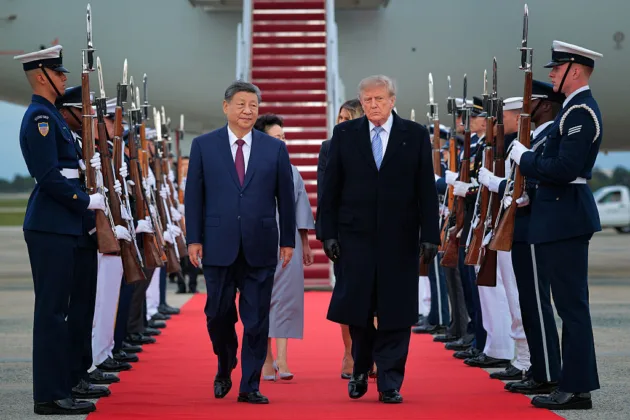
The report has been released weeks before an expected visit to the United States by Chinese leader Xi Jinping in September, with a further round of trade talks between Washington and Beijing in prospect.
Brussels Signal reached out to the European Commission about the accusations, but did not receive a reply at the time of publication.