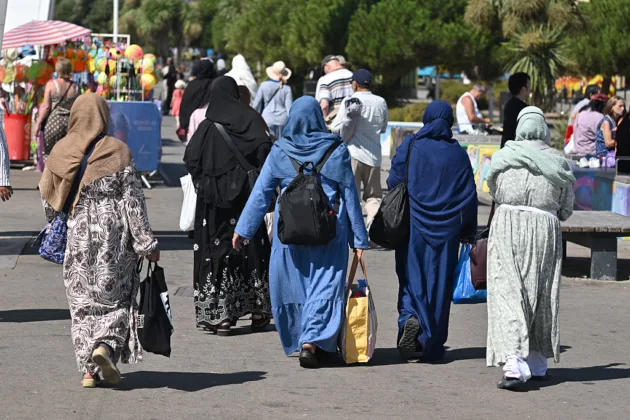





The number of live births in England and Wales has dropped to its lowest level since 1976, provisional figures released by the Office for National Statistics (ONS) on May 27 have shown, with more than four in 10 babies born in 2025 having at least one foreign-born parent.
According to the ONS, there were 585,396 live births in England and Wales in 2025, a 1.6 per cent decrease from 594,677 in 2024. This marks the lowest annual total since records began in 1976.
The provisional total fertility rate (TFR) for England and Wales has fallen to 1.39 children per woman in 2025, down from 1.41 in 2024 and the lowest on record.
The figure remains well below the replacement level of around 2.1, the threshold at which a population sustains itself without immigration.
Fertility rates in England and Wales have been in overall decline since 2010. Scotland recorded an even lower rate of around 1.25, the lowest since civil registration began in 1855, according to the National Records of Scotland.
The proportion of live births where either one or both parents were born outside the UK rose to 40.2 per cent in 2025, up from 39.5 per cent in 2024.
The share has increased steadily over the past two decades amid sustained net migration. For context, ONS data showed the figure stood at 35.8 per cent in 2022 and 37.3 per cent in 2023.
The average age of mothers at birth edged up slightly to 31.1 years, while the average age of fathers reached 34.0 years, continuing a long-term trend towards later parenthood.
Demographers link the broader decline in births to delayed childbearing, high housing costs, economic pressures and shifting social preferences among younger generations.
Births to UK-born mothers have fallen particularly sharply over the past 15 years, while those involving foreign-born parents have risen.
The top countries of birth for non-UK-born mothers were India, Pakistan, Nigeria, Romania and Bangladesh. For non-UK-born fathers, the picture was very similar, with Romania and Bangladesh trading places. India has held the top position for both groups since 2022, with Pakistan in second place, ONS data showed.
Only 330,040 children had both a mother and father born in the UK, or 56.4 per cent. The numbers only go back one generation, meaning many in this group already have a migration background.
By contrast, in 2008 there were 458,381 children born with both UK-born fathers and mothers.
Persistent sub-replacement fertility among the UK-born population, coupled with heavy dependence on immigration to maintain overall numbers, poses long-term challenges for workforce sustainability, public finances and social cohesion.
Extrapolating from current birth trends and assuming sustained net migration at recent levels (a long-term average of around 230,000 to 250,000 per year) alongside persistently low native fertility, modelling by David Coleman, Emeritus Professor of Demography at Oxford University, projects that the White British population will fall below 50 per cent of the UK total by the early 2060s.
White British would decline from roughly 73 per cent today to about 57 per cent by 2050 and just one-third by 2100.
"If those systems no longer fit today´s demographics and health realities, why not adapt them?"
Don´t miss the whole video on why European pension systems are breaking down 👇 pic.twitter.com/mnRuWBd40e
— Brussels Signal (@brusselssignal) October 29, 2025