

Turkish President Recep Tayyip Erdoğan has stated that joining the European Union is no longer a priority for Ankara, though he insisted the country has not closed the door on eventual membership.
Speaking in an interview with Al Muqabala (The Interview) that aired on August 16 on Al Jazeera Arabic, Erdoğan said: “The European Union is not a priority for us.”
He added that Europe would be the one to lose if it continued to reject Turkey.
Erdoğan argued that the bloc does not appear willing to accept Turkey as a member, claiming that European countries have repeatedly failed to demonstrate a genuine willingness to integrate the country.
“Europe has not taken Turkey into its ranks for 53 years, and it does not intend to do so in the future either, but we have not closed our door,” the Turkish President said.
He did not specify the starting point for that figure. Turkey signed the Ankara Agreement, establishing the legal framework for closer economic ties and the long-term prospect of membership of the European Economic Community (EEC), the predecessor of the EU, in 1963, and applied for full membership on April 14, 1987.
“We are still considering joining the European Union. If they accept us, all the better, if they don’t, that’s fine too.”
He said that Turkey always stressed to the EU that it is Brussels who loses in this case, not Ankara. The interview was given on the day the ruling Justice and Development Party (AKP) marked its 25th anniversary.
Turkey has been an official EU candidate since 1999. Accession negotiations formally opened in October 2005 but have been effectively frozen for years amid European concerns over democratic backsliding, the rule of law and fundamental rights in Turkey.
Of the 35 negotiating chapters, 16 have been opened and one provisionally closed, according to the Council of the European Union. The last intergovernmental conference with Ankara took place on June 30, 2016.
The General Affairs Council declared in June 2018 that the talks had effectively come to a standstill, with no further chapters to be opened or closed and no further work foreseen on modernising the EU-Turkey Customs Union.
Successive European Commission reports have highlighted restrictions on freedom of expression, judicial independence and the treatment of opposition figures. Its 2025 enlargement report rated Turkey at an early stage on the chapter covering the judiciary and fundamental rights.
Turkish President Erdogan on EU:
Europe has not accepted Türkiye in its ranks for 53 years and is not thinking of accepting it in the coming period either.
The EU is not a priority for us.
We keep telling the European Union: you are the ones who will lose, not Türkiye. pic.twitter.com/7ZMU3AF1dH
— Clash Report (@clashreport) August 16, 2026
In the same interview Erdoğan also addressed the recent Mecca defence agreement signed by Turkey, Pakistan and Saudi Arabia at the Safa Palace on August 7.
He described it as an opportunity to send an important message of peace to the world and said the pact functions in a manner similar to NATO’s Article 5 collective defence clause. The text rests on Article 51 of the United Nations Charter, which covers the right to self-defence.
If any of the three countries came under attack, the others would take the necessary steps together, he said.
Erdoğan indicated that Egypt could potentially join the arrangement in future. Saudi Arabia and Pakistan had signed a separate mutual defence pact in September 2025.
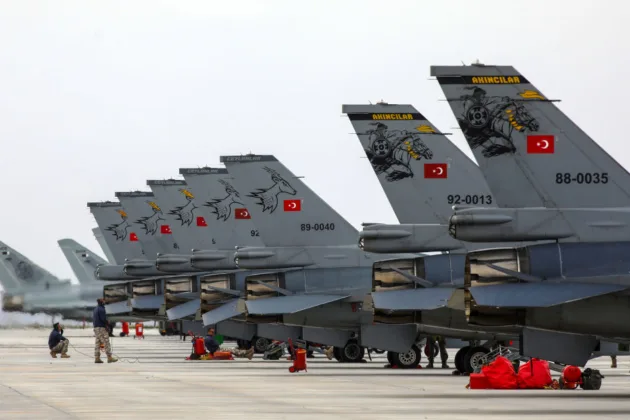
On military cooperation with the United States, the Turkish President said he expected US President Donald Trump to fulfil a promise made regarding Turkey’s return to the F-35 fighter jet programme.
Turkey was removed from the programme in 2019 after purchasing the Russian S-400 air defence system.
The comments come at a time of continued strain in Turkey-EU relations. Ankara has been pressing for access to the EU’s €150 billion Security Action for Europe (SAFE) loan instrument, from which Turkish firms remain excluded.
Third countries may take part in SAFE projects up to a ceiling of 35 per cent, European Commission spokesman Thomas Regnier said on June 29, adding that any move to lift that cap would require a bilateral agreement Brussels has not concluded with Ankara. Greece has said it would block such a step.
European officials have repeatedly criticised Ankara’s handling of the opposition, including the ongoing trial of suspended and jailed Istanbul mayor and presidential hopeful Ekrem İmamoğlu, who faces charges including corruption and forming a criminal organisation. The case opened on March 9 with more than 400 defendants and 142 counts against him.
Human Rights Watch, the European Parliament and the Parliamentary Assembly of the Council of Europe have described the prosecution as politically motivated.
Erdoğan’s latest remarks mark a shift in tone from earlier calls for the EU to revive the accession process. In Istanbul on June 29 he told parliamentary delegates from all 32 NATO member states that Turkey wanted to take part in every defence and security initiative on the continent.
Ankara continues to participate in the EU-Turkey Customs Union, in force since 1996, and engages with Brussels on migration, energy and security issues. The EU remains Turkey’s main trading partner and Turkey accounted for 4 per cent of EU trade in goods in 2025.
It is also fully associated with the Erasmus+ programme, allowing students and staff to study, train or intern in EU countries under the same conditions as those from member states.