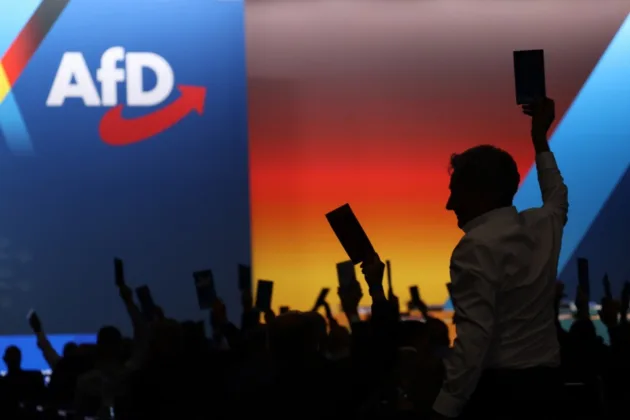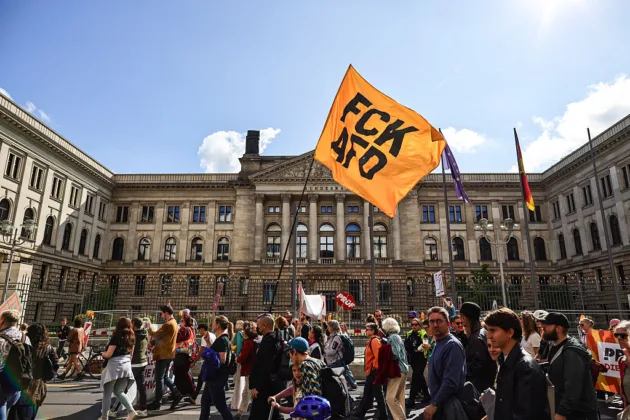






A German civil rights NGO, Gesellschaft für Freiheitsrechte (GFF), has reopened the debate over banning the Alternative für Deutschland (AfD), claiming that years of public statements, parliamentary initiatives and nearly three million social-media posts demonstrate the party is unconstitutional under Article 21 of Germany’s Basic Law.
The GFF is funded by, among others, the Soros-backed Open Society Foundations.
The NGO published a legal opinion exceeding 3,000 pages that concludes the AfD violates Germany’s constitutional order and that proceedings to outlaw the party would likely succeed before the Federal Constitutional Court.
However, the report concludes that it cannot be established that the AfD seeks to abolish parliamentary democracy or that it has an “essential affinity with National Socialism” which is the ideology of Germany’s Nazi regime.
Opponents of the AfD have been reluctant to pursue a ban before the German Constitutional Court fearing that an unsuccessful case would strengthen the party. The report has reignited calls from the Greens and the SPD to initiate ban proceedings.
The Green Party’s co-chair, Britta Haßelmann, used the expert legal opinion as an opportunity to request a meeting with the parliamentary leaders of the CDU/CSU, SPD, and Left Party to discuss a motion to ban the AfD.
“We need legal proceedings to ban the AfD” she said.
SPD MP Saskia Esken argued that in the new light of the report: “The argument that a ban proceeding would have no chance of success anyway is definitively off the table.”
The report draws on more than 2.9 million social-media posts, 54,972 press releases, over 77,000 parliamentary documents, and more than 50 election manifestos and policy programmes, all compiled from publicly available sources. The dataset covers material collected primarily up to February 2026.
Authors of the document believe that previous assessments, including that of Germany’s Federal Office for the Protection of the Constitution (BfV), did not examine the party broadly enough.
The say they sought to fill those gaps by analysing the AfD’s programmes, parliamentary motions, public statements and communications across every level of the party.
The GFF concludes that the AfD seeks to undermine Germany’s constitutional order through policies that would discriminate against foreigners, Germans with a migration background, Muslims, asylum seekers and other groups, while also threatening democratic competition through what it describes as plans to prosecute political opponents.
The authors argue that the AfD pursues an “ethno-cultural” concept of citizenship and seeks the “exclusion, denigration and far-reaching legal disadvantage” of several population groups.
The report also argues that radical elements have become dominant within the party and claims there is no longer any organised internal faction consistently resisting that development.
“Radical forces have gained the upper hand within the AfD. This development is evident based on more than 2,500 pieces of evidence in the party’s goals and the behaviour of its supporters, which are directed in part against the principles of democracy and in part against human dignity,” the report says.
“More than 220 credible pieces of evidence attributable to the party show that the AfD intends to prosecute politicians from other parties for their political decisions; furthermore, its supporters are already systematically intimidating various groups of people in order to exclude them from the process of political decision-making,” they added.
It further alleges that disciplinary measures have not been used against many leading figures accused of promoting unconstitutional positions.
The GFF describes itself as an independent, donation-funded civil rights organisation. According to its 2025 annual report, it received roughly €2 million from individual donations and membership fees and a similar amount in grants from philanthropic foundations, besides the Soros-backed Open Society Foundations, from Luminate, Stiftung Mercator, the Alfred Landecker Foundation, and the Demokratie-Stiftung Campact. The organisation also received a one-off €300,000 corporate donation from Vodafone Germany, which it says was accepted only after an internal review to ensure there was no risk of donor influence.