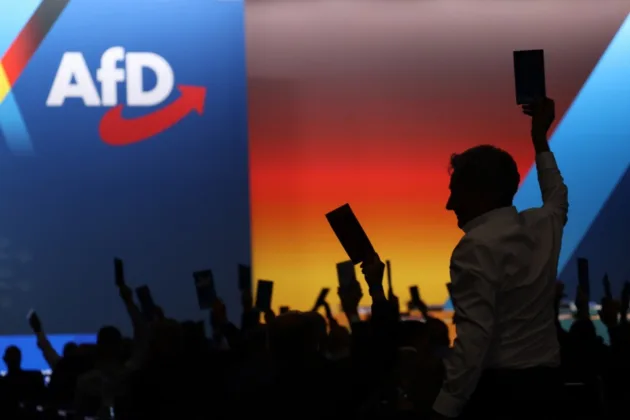






The parliament of the German state of Thuringia, in eastern Germany, has scheduled a public hearing to examine possible steps towards banning the Alternative for Germany (AfD), bringing one of the country’s most controversial constitutional debates into a regional legislature.
The Thuringian parliament’s justice committee is expected to hold the hearing on September 30, 2026. The initiative originated with the Left party and will bring together invited speakers to discuss the legal and political case for a possible ban.
It would be the first time a committee of any German parliament has examined the question in a public session. The parliamentary groups have named 15 speakers and experts, who are due to argue for or against a prohibition, Die Zeit reported.
A written consultation is running in parallel, with a deadline of August 30 for submissions, the Left group in the Thuringian parliament has said.
The hearing does not mean that the Thuringian parliament can itself outlaw the AfD. Under Germany’s constitutional system, only the Federal Constitutional Court can ban a political party, following an application by the Bundestag (the elected federal parliament), the Bundesrat (the body representing Germany’s 16 states) or the federal government.
By holding the hearing, the Thuringian parliament can examine evidence, expert assessments and legal arguments about whether the AfD’s activities and objectives could be considered incompatible with Germany’s democratic constitutional order. Its findings could be used by the Bundestag, Bundesrat or federal government when considering whether to file an application before the Federal Constitutional Court.
If the court ultimately ruled in favour of a prohibition, the ban would apply to the AfD across the whole of Germany, not only in Thuringia. The same route applies to a partial ban covering a single state branch.
The debate over a possible AfD ban comes at a time when the party has become the strongest political force in Germany. According to an INSA poll published on July 7, 2026, the AfD was polling at 29 per cent nationally, ahead of the Christian Democratic Union (CDU) and its Bavarian sister party the Christian Social Union (CSU) at 22 per cent.
The party’s strength is even more pronounced in Thuringia. According to an INSA poll published on July 2, 2026, for FUNKE Medien Thüringen, the AfD would receive 40 per cent of the vote if a new Thuringian state election were held. The CDU was measured at 22 per cent, while the Left party stood at 16 per cent.
The case has particular significance because the AfD’s Thuringian branch, led by Björn Höcke, has been classified by the state Office for the Protection of the Constitution as a confirmed right-wing extremist organisation since 2021. Supporters of a possible ban argue that Germany’s democratic system has the right and duty to defend itself against political forces they believe seek to undermine the constitutional order.
The controversy lies in the fact that such a measure would target the country’s most successful political party at the ballot box. Critics argue that banning the AfD in the name of defending democracy would create a fundamental democratic dilemma: Whether a party supported by millions of voters should be excluded from political competition because state institutions consider it a threat to the constitutional system.
They warn that a prohibition could strengthen the AfD’s argument that the political establishment is attempting to silence voters rather than defeat the party through elections. The final decision would remain entirely with the Federal Constitutional Court, and the legal threshold for banning a political party in Germany is deliberately high.
Thuringia’s interior minister Georg Maier, a Social Democrat, has argued in favour of examining a ban of the AfD’s state branch. He told Frankfurter Allgemeine Zeitung that the party under Höcke had always been the driving force towards the völkisch and had gained influence since its congress in Erfurt.
Among those invited to participate in the hearing is German entertainer Hape Kerkeling, Die Zeit reported. His inclusion has attracted attention because he is not a constitutional lawyer or political scientist.
Kerkeling has, though, publicly supported examining a possible AfD ban and has spoken about Germany’s Nazi past and his own family history. He addressed a ceremony in April marking the liberation of the Buchenwald concentration camp, where his grandfather Hermann Kerkeling was held as a political prisoner and subjected to forced labour and torture.