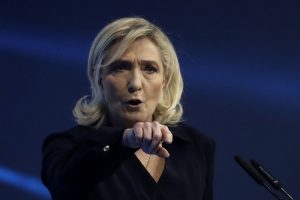






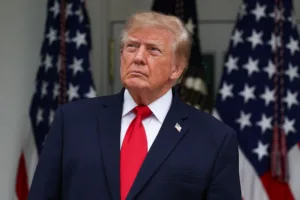

Marine Le Pen, de facto leader of National Rally, cautioned against defining foreign policy through personal ties to Donald Trump, arguing that national interests should come first after the US president’s actions in Iran.
In an interview with France Culture, the National Rally figure described Trump as “undoubtedly the symbol of a form of political will” that has become rare in Europe. But she argued that the US president had failed to deliver on his foreign-policy promises.
“Political will means that, beyond the administration, when a politician is elected, they are elected to accomplish something and therefore have a duty to honour their commitments,” Le Pen said.
“When members of the National Rally welcomed some of his speeches, which suggested that the United States was breaking with a form of imperialism, abandoning this desire to impose its model on everyone, and ceasing to use—or even abuse—the extraterritorial reach of American law, we were obviously pleased,” she said. “We believed that, at the time, this was in France’s interest.”
Le Pen said the war in Iran marked a clear break from that approach.
“As it turned out, however, with this war in Iran, he did exactly the opposite of what he had promised in that area,” she said.
“He did exactly the opposite of what he had promised,” she insisted before adding, “on Iran, he solved nothing.”
Le Pen further argued that US actions had produced few results and claimed that Iran emerged from the episode stronger.
“To say the results are limited would be an understatement. In fact, it seems to me that Iran emerges from this episode certainly stronger than it actually was before it began,” she said.
The French politician also used the interview to defend Italian Prime Minister Giorgia Meloni following a public dispute with Trump. Calling the US president’s remarks “very insulting”, Le Pen said she understood Meloni’s response as an expression of “national pride”.
She also rejected the idea that personal disagreements between leaders should define international relations.
“One does not have friends in international affairs. One has interests,” Le Pen said. “Those interests can be common or conflicting.”