

US President Donald Trump has launched his most personal attack yet on Italian Prime Minister Giorgia Meloni, publicly mocking her and portraying her as a leader desperate for his approval.
The remarks mark a dramatic escalation in the growing rupture between two politicians once widely regarded as ideological allies and key figures in the transatlantic conservative movement.
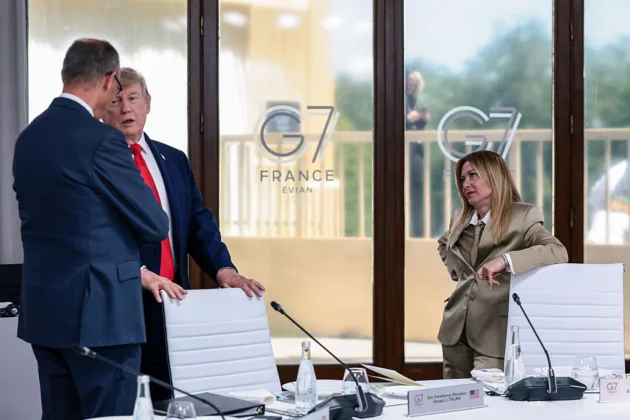
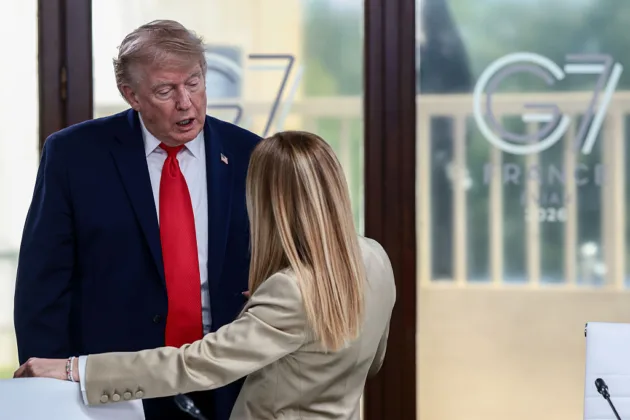
“She begged me to take a picture with her. She wanted a picture with me so badly. I wouldn’t have taken it, but I felt sorry for her,” Trump said during an interview with Italian television channel La7 on June 19, referring to his encounter with Meloni at the G7 summit in Évian, France. Trump added that Meloni was “probably happy” he had spoken to her at all.
The comments effectively destroy the theory that Meloni enjoyed a privileged relationship with Trump because of their shared ideological affinity and links to the broader MAGA movement. Since Trump’s return to the White House, many in Europe had argued that the Italian prime minister could act as an intermediary between Washington and Brussels at a time of increasing transatlantic tensions.
Trump’s latest attack severely undermines that assumption. More broadly, it calls into question the belief that Europe’s conservative and nationalist right possesses a special channel of influence with the Trump administration.
The episode is the latest chapter in a relationship that has deteriorated sharply over recent months.
For years, Meloni was viewed as Trump’s closest ally among major European leaders. She was the only European head of government to attend his January 2025 inauguration and repeatedly sought to position herself as a bridge between Europe and the White House.
Their political alliance appeared natural: Both cultivated nationalist electorates, criticised progressive politics and advocated a stronger defence of traditional values. Even when disagreements emerged, many observers assumed their ideological proximity would prevail.
The first major cracks emerged during the confrontation between the United States and Iran earlier this year. Meloni refused fully to align Italy with Washington’s strategy and resisted pressure to provide stronger support for US military operations. At the same time, she publicly condemned Trump’s attacks on Pope Leo XIV, describing them as “unacceptable”. Trump’s response was swift and unusually harsh.
In an interview with Italy’s Corriere della Sera published on April 15, Trump openly questioned Meloni’s leadership and courage.
“I’m shocked by her. I thought she had courage, but I was wrong,” Trump said, accusing the Italian premier of refusing to help the United States confront Iran and claiming she was “much different than I thought”.
Those comments represented a turning point. For the first time, Trump publicly abandoned the language of friendship and mutual respect that had previously characterised his relationship with Meloni. The dispute also revealed a deeper problem: While many European conservatives believed ideological affinity would guarantee influence in Washington, Trump appeared increasingly willing to treat even his closest foreign allies as expendable if they diverged from his priorities.
In recent days there had been signs of a possible reconciliation. During the G7 summit in Évian, cameras repeatedly captured Trump and Meloni in conversation. Italian media reported a “clarification meeting” aimed at easing tensions after months of disagreements. Public exchanges between the two leaders appeared cordial, fuelling speculation that relations were recovering.
Trump’s latest remarks have now shattered that narrative.
Rather than presenting Meloni as a valued partner, Trump chose to depict her as a subordinate figure seeking his attention. The language was particularly striking because it mirrored a tactic Trump has frequently employed against rivals and allies alike: Reducing political relationships to personal hierarchies in which foreign leaders compete for his approval.
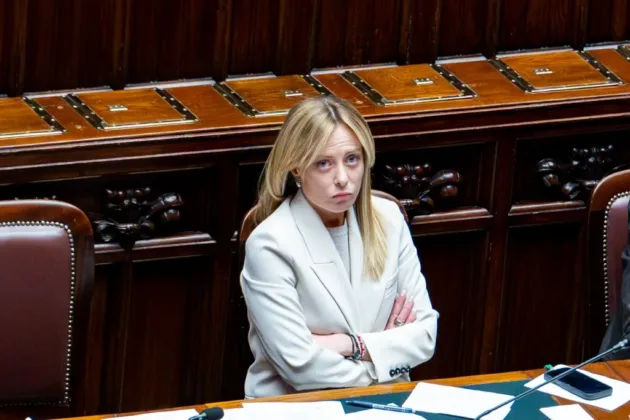
Meloni responded with unusual force. In a video posted on her X account, the Italian prime minister rejected Trump’s account as entirely fabricated.
“Donald Trump’s statements are completely made up,” she said. “Neither I nor Italy ever beg.”
Meloni also said she was astonished by Trump’s remarks and suggested they reflected a broader pattern in which the US president appeared to show greater respect towards America’s adversaries than towards some of its closest allies.
Also in response to the attack, today Antonio Tajani, Deputy Prime Minister and Minister for Foreign Affairs, cancelled his trip to Washington due on June 21 and 22. He said on X, “President Trump’s serious and offensive words towards Prime Minister Giorgia Meloni offend all of Italy.”
The clash has implications far beyond the personal relationship between the two leaders.
Since Trump’s re-election, many parties on the European Right have argued that ideological proximity to the MAGA movement would provide a strategic advantage in dealing with Washington. Meloni was frequently presented as the strongest example of that theory — a conservative leader capable of influencing Trump while preserving Europe’s interests.
The latest confrontation suggests otherwise.
Far from enjoying privileged treatment, Meloni has become the latest foreign leader publicly ridiculed by Trump despite years of political support and personal outreach. The episode reinforces a lesson that many European governments are increasingly learning: Trump’s foreign policy remains fundamentally transactional, driven by immediate political interests rather than ideological solidarity.
For Meloni, the political consequences could be significant. Much of her international standing rested on the argument that she could maintain strong relations with Washington while simultaneously defending European interests. Trump’s public humiliation strikes directly at that claim.
Whether the rupture becomes permanent remains uncertain. Yet after months of disputes over Iran, Pope Leo XIV and broader transatlantic strategy, Trump’s latest outburst appears to confirm that one of the most celebrated political partnerships of the international conservative movement has effectively collapsed.
For Europe’s nationalist and conservative movements, the episode carries an equally important lesson. The assumption that ideological affinity with Trump automatically translates into political influence in Washington now looks increasingly difficult to sustain. If even Meloni — long regarded as Trump’s closest European ally — can become the target of public ridicule and political humiliation, the notion of a privileged MAGA-right axis across the Atlantic appears far weaker than many of its supporters once believed.