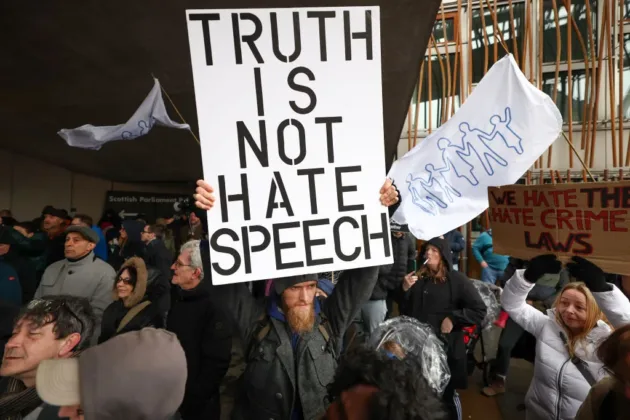

South Wales Police has suspended its guidance instructing officers to log instances of “anti-Muslim hostility” that go beyond what the force considers “legitimate” discussion or criticism of Islam. The move follows a strong backlash from free speech campaigners and the threat of legal action.
The internal guidance, issued in early June, directed officers to record non-criminal speech or behaviour deemed hostile towards Muslims as anti-social behaviour incidents.
Critics argued that the subjective threshold of “legitimate” criticism risked creating a de facto speech register and could lead to damaging records on enhanced DBS checks.
A Disclosure and Barring Service (DBS) check is a background screening used by employers in England and Wales to check an individual’s criminal record.
Police chiefs had instructed staff to log anything that went beyond what constituted a “legitimate” discussion of Islam.
South Wales Police had adopted the Government’s non-statutory definition of anti-Muslim hostility and added its own stricter guidance.
Officers were instructed to record incidents even when no crime was committed, while being told that only “legitimate discussion, scrutiny or differing viewpoints” on Islam would be permitted.
Individual officers were left to decide what crossed the line into “hostility”.
Similar guidance has also been issued by several other forces in England.
South Wales Police yesterday said it had “paused” implementation of the guidance while it reviews the policy and holds further discussions. A spokesman described the matter as “ongoing”.
The Free Speech Union welcomed the pause and confirmed it had been in direct contact with the force.
Lord Young, the founder of the FSU told the Telegraph, “”Blasphemy laws were repealed in this country 18 years ago, and we will do everything in our power to stop them being brought back by the back door.”
Conservative shadow Equalities Minister Claire Coutinho referred the matter to the Equality and Human Rights Commission, likewise describing the original policy as a “de facto blasphemy law, which only applies to the discussion of Islam” and not other religions.
In practice, she said, it would mean “that individual officers could and could not say about one particular religion”.
“This is an assault on free speech. It’s an example of two-tier policing. And it has no basis in law.”