
Former high-ranking German and Russian officials have held undisclosed meetings in Baku, Azerbaijan, between July 12 and 14 to discuss possible ways of ending Russia’s war against Ukraine.
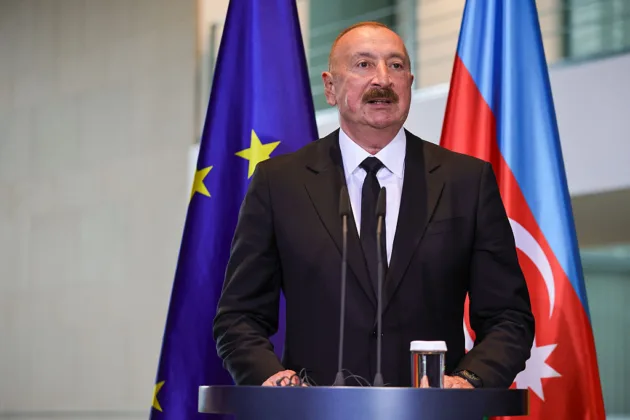
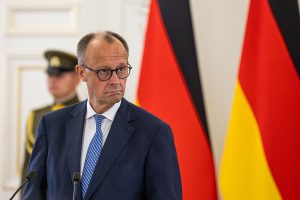
The existence of the talks was later confirmed by Azerbaijani President Ilham Aliyev during his official visit to Berlin on July 21, where he held a joint press conference with German Chancellor Friedrich Merz.
The revelation has highlighted the role of unofficial diplomatic channels as a potential groundwork for future Ukraine peace talks.
The first reports about the meeting emerged on July 16, when German newspaper Die Zeit and public broadcaster ARD’s investigative programme Kontraste published an investigation suggesting that the Baku talks were part of a broader series of contacts involving former German political figures and individuals close to the Kremlin.
According to that reporting, the two German participants had been travelling to such meetings since 2024, in one case to Abu Dhabi rather than the Azerbaijani capital. British newspaper The Times put the number of encounters at four or more since Russia’s full-scale invasion began in February 2022.
Aliyev confirmed the details of the meetings during his talks in Berlin with Merz, where the two leaders discussed Azerbaijan-Germany relations, energy cooperation and wider regional security issues.
During their joint press conference, Aliyev said Azerbaijan had learned of the contacts from The Times and that he had asked the State Border Service to check arrival and departure records before travelling to Berlin.
“Our territory was simply used without our knowledge,” Aliyev said, adding that Azerbaijan had not been informed by either side before the discussions took place. He stressed that Baku had not officially hosted the talks and had not been involved in their content.
Merz said he had no prior knowledge of the Baku meeting and stressed that the German Government was not involved. He added, though, that Berlin had been trying for months to push Moscow towards negotiations, saying that the decision to begin peace talks ultimately rested with the Kremlin, which continued to refuse.
The participants reportedly included Ronald Pofalla, a former head of Angela Merkel’s Chancellery, and Matthias Platzeck, former minister-president of Brandenburg. On the Russian side, reports identified Viktor Zubkov, a former Russian prime minister and Gazprom chairman, and Valery Fadeyev, head of Russia’s Presidential Human Rights Council, among those involved.
Aliyev said Zubkov and Fadeyev flew in from Moscow on the same day as the Germans, with one leaving on July 13 and the other on July 14.
Fadeyev has been under EU sanctions since February 2023, when the bloc listed him in its 10th package over propaganda supporting the war, a designation that bars him from entering member states. Pofalla belongs to Merz’s Christian Democratic Union (CDU), while Platzeck is a former leader of the Social Democratic Party (SPD), the junior partner in the German coalition.
Although no official record of the discussions has emerged, reports indicate that the talks focused on the future of relations between Russia and Europe as well as possible scenarios linked to the war in Ukraine.
German media cited security assessments suggesting that Moscow wanted to communicate its position on a possible settlement and explore whether political and economic relations with Europe could eventually be restored. Die Zeit and Kontraste reported that German security authorities classify the series of meetings as a Russian influence operation aimed at persuading Berlin that the war can end only on the Kremlin’s terms.
The gatherings have been presented by those taking part as an attempt to revive the Petersburg Dialogue, a German-Russian civil society forum launched in 2001 by then chancellor Gerhard Schröder and Russian President Vladimir Putin, and wound up by Berlin in 2021. Pofalla co-chaired the German side of that forum and Zubkov the Russian side.
The involvement of former officials rather than serving government representatives allowed both sides to maintain distance from any formal negotiation process.
On the German side, the contacts represent a form of informal diplomacy formally outside the control of the government, but one that Berlin has not publicly condemned. Such channels can provide space for political figures and former officials to explore possible ideas without creating official commitments or diplomatic obligations.
For Moscow, they offer an opportunity to test European attitudes towards possible talks, sanctions relief and future security arrangements while gauging the potential for a broader dialogue with the West. Analysts quoted by Die Zeit questioned the value of the exercise, arguing that the Russians involved sit closer to the propaganda apparatus than to any negotiating machinery.
Aliyev said Azerbaijan could only welcome the meeting if it helped bring the war to an end. Baku has supplied humanitarian aid to Ukraine while declining to join Western sanctions on Russia, and its own relations with Moscow have been strained since Russian air defences shot down an Azerbaijan Airlines passenger jet in December 2024.
The absence of Ukrainian representatives remains a central concern for Kyiv and many European allies.