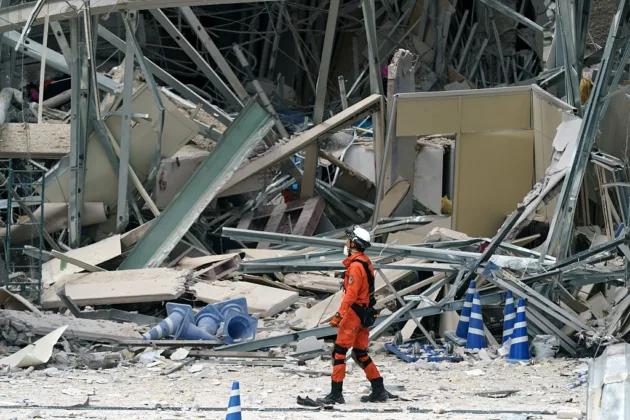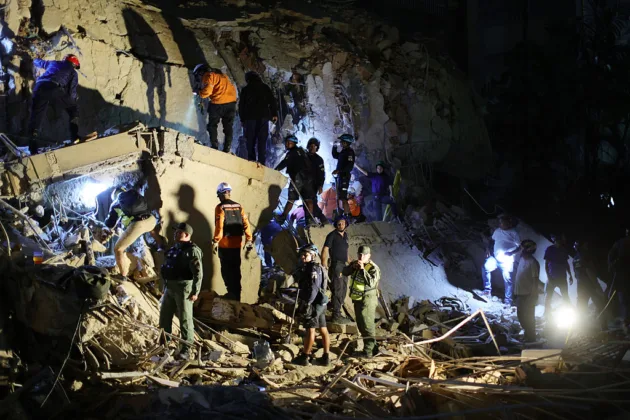










Soldiers and emergency crews have spent a second day picking through a collapsed shopping mall and flattened houses in southwestern Japan after an earthquake that killed at least 13 people, with scores still unaccounted for.
The quake struck the Kumamoto area on the southern main island of Kyushu at 4.27pm local time on July 28, the Japan Meteorological Agency said. It put the magnitude at 7.1, while the United States Geological Survey later revised its own estimate to 6.8.
Japanese Prime Minister Sanae Takaichi said on July 29 that the rescue effort was “a race against time”. She described the damage as extensive.
About 3,600 Self-Defence Forces personnel were deployed at the request of the Kumamoto governor. Evacuation orders covered some 222,250 people across three cities and three towns, the Fire and Disaster Management Agency said.
Rescuers concentrated on an Aeon Mall in the town of Kashima, where the second floor gave way after an explosion officials suspect was caused by a gas leak. Local media reported that two women in their twenties were found dead inside the building early on July 29.
The mall had reopened only on June 13 after being rebuilt following the 2016 Kumamoto earthquakes.
A chimney also came down at Nippon Paper Industries’ factory in Yatsushiro, trapping workers under debris. The Kumamoto emergency team said seven people were feared still trapped, with two survivors and two bodies recovered.
The disaster agency counted 29 injured, though public broadcaster NHK reported that one hospital alone had treated more than 50 patients. About 36,900 homes remained without electricity and 9,500 without gas.
Kyushu Shinkansen bullet train services stayed suspended. The municipalities of Uki and Hikawa recorded the maximum reading of seven on Japan’s shindo intensity scale, the first since the Noto Peninsula earthquake of January 2024.
The industrial disruption reaches well beyond Kyushu. Kumamoto hosts Taiwan Semiconductor Manufacturing Company’s Japanese venture at Kikuyo, alongside Sony image-sensor plants and two Tokyo Electron sites that build chipmaking equipment sold worldwide.
TSMC evacuated staff and said its site was unaffected, with operations “gradually resuming”. Sony said work at its Kumamoto plant remained halted, and Renesas Electronics suspended two factories after finding cracks and water leaks.
Tokyo Electron closed both its Kumamoto plants for inspection and Honda idled a motorcycle factory. Supply chain resilience in critical goods was among the subjects Takaichi raised with European Commission President Ursula von der Leyen at the G7 summit in Évian on June 17.
Kyushu Electric Power reported no impact at the Sendai or Genkai nuclear stations. The weather agency has warned that aftershocks of comparable strength could continue for about a week.