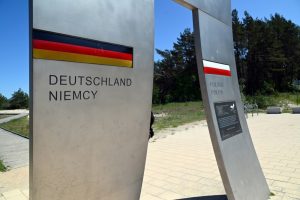










Poland has begun construction of the 10 billion złoty (€2.33 billion) “Cape Pomerania” project to build a new deepwater container port in the northwestern city of Świnoujście near its border with Germany.
The dual-use terminal, which is to be completed at the turn of 2029-2030 and is designed for both civilian and defence use, will be able to handle large ocean-going vessels and is intended to enhance Poland’s logistics infrastructure to serve cargo flows across Central and Eastern Europe.
The previous Law and Justice (PiS) administration, under which the project was actually created, made it clear that it was to enable Poland to rival the German port of Hamburg, which has dominated deepwater cargo traffic in the region of the Baltic Sea. Hamburg is Europe’s third-largest container port after Rotterdam and Antwerp, handling about 7.8 million TEU a year. Marek Gróbarczyk, deputy infrastructure minister in the PiS government, said in 2023 that Świnoujście would become serious competition for Hamburg within six to seven years.
The present centre-left government led by Prime Minister Donald Tusk says the strategic project will boost the country’s maritime sector and position Świnoujście to compete directly with some of Europe’s largest container ports.
Speaking at the launch of construction on July 13, infrastructure minister Dariusz Klimczak hailed Cape Pomerania as “the largest port investment in Poland’s recent history”, saying that it would help the country “compete with Europe’s leading ports”.
Deputy infrastructure minister Arkadiusz Marchewka said the terminal would serve not only Poland but also markets including eastern Germany and the landlocked Czech Republic, Slovakia, Austria and Hungary.
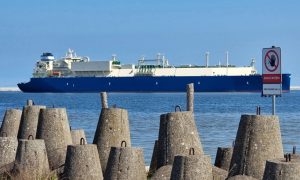
The port will include a 17-metre-deep basin and a 1.3km main quay capable of handling up to three ocean-going container ships at the same time, including two vessels measuring up to 400 metres in length and one of 250 metres.
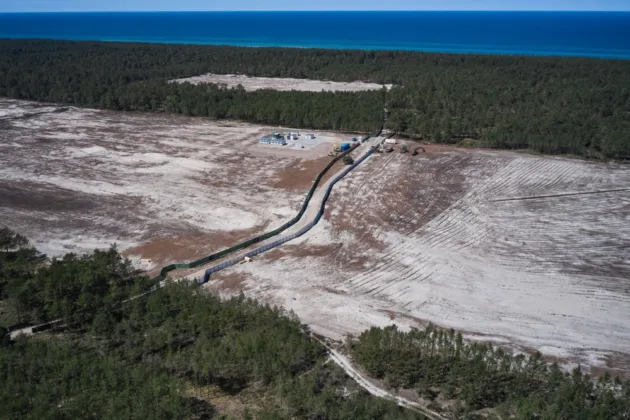
Construction has begun with the building of a technical access road and supporting infrastructure. The work, which will provide access for heavy equipment and construction crews to the offshore site, is expected to take 10 months. The road will run for more than 2.5km and carry power supply and storm drainage lines.
Associated infrastructure work includes deepening the 70km approach channel, building more than 3km of new railway track within a 47-hectare road and rail complex and creating 186 hectares of reclaimed land in the Bay of Pomerania. The port authority, Zarząd Morskich Portów Szczecin i Świnoujście, is responsible for about 1.5 billion złoty (€350 million) of the total, with more than 7 billion złoty (€1.63 billion) earmarked in the state budget for the channel, the basin and landside works. The 2023 contract with a Belgian-Qatari consortium no longer applies and the port is to be built by Polish companies.
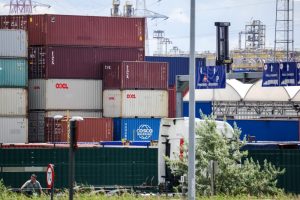
It is expected to have an annual handling capacity of 2 million twenty-foot equivalent units (TEU), the standard measure of container capacity. Polish ports handled a record of about 3.9 million TEU in 2025.
Poland’s largest port, Gdańsk, last year completed its own expansion, increasing its annual capacity by almost 1.5 million TEU to reach 4.5 million TEU. Its Baltic Hub terminal handled 2,767,287 TEU in 2025, a rise of 23 per cent on the previous year.
Despite the fact that the planned port in Świnoujście will use zero-emission cargo-handling technologies and shore power systems to reduce emissions and noise, its construction has been challenged vigorously by environmentalists in both Poland and Germany, who object to the creation of such a large facility within a protected natural area.
On August 4, 2025, the Provincial Administrative Court in Warsaw dismissed legal challenges from the German group Bürgerinitiative Lebensraum Vorpommern, based on the island of Usedom, and the Polish association Zielone Wyspy Świnoujście, which had argued that the port could cause significant environmental damage. The ruling is not final and may still be appealed to the Supreme Administrative Court.
The inauguration of construction of the container port on July 13 was also met with a small protest from Świnoujście residents, who said the port could threaten tourist attractions in the coastal city. Demonstrators carried banners calling for an end to the “concreting of the Baltic Sea”.
The local mayor, Joanna Agatowska, has gone on the record opposing the project as potentially damaging for the area’s tourist industry.
Cape Pomerania is not the only major infrastructural project to be challenged by environmentalists and the Germans.
Environmental groups on both sides of the border challenged the idea of restoring navigability of the river Oder in order to bring back the flow of trade along that waterway, with the environmentalist lobby maintaining that this would be a threat to the natural environment. The current Tusk administration has not progressed any work on that project and in fact attempted to turn parts of the Oder into a protected national park. That legislation was vetoed by President Karol Nawrocki in November 2025.
Objections have also been raised to the building of Poland’s first nuclear power station on the Baltic coast, at Lubiatowo-Kopalino in Pomerania, where the first of three Westinghouse AP1000 reactors is due to enter commercial operation in 2036, and the German authorities have previously raised questions with regard to safety of the project. Cross-border consultations under the Espoo Convention, requested by Germany, Austria, Denmark and Latvia, were concluded in 2023. Germany’s power industry has made no secret of its ambitions to export energy to Poland, a country which still generates just over half of its electricity from coal, 52.7 per cent in 2025 according to the Forum Energii think tank.
Poland’s determination to take its share of the trade in cargo and air traffic is also evidenced by the Centralny Port Komunikacyjny (CPK) project which is going ahead close to Warsaw and which will give the country increased capacity to handle transit passengers and trade.
These ambitions are not music to the ears of Germany and it has discreetly lobbied the Tusk government, one which is seen as being far friendlier to Germany than its PiS predecessor, for Poland to consider joint projects with the Germans rather than pursue its own.
Politically, though, Tusk has found that Polish public opinion supports an ambitious infrastructural agenda which has seen it modernise its road and rail networks and build a canal in the Vistula Spit and a tunnel linking the mainland with Poland’s largest island, of Wolin.
He had, while in opposition, opposed the Vistula Spit canal project as well as the CPK, questioning their economic robustness. But since coming to office he has changed tack and built a narrative of how his government has redesigned the nuclear power plant, central airport and the container port projects so that they could go ahead and be viable.
It would appear that there is now more political consensus with regard to large infrastructural projects from left to right than in areas such as security and foreign affairs.
There are some tensions, though, with regard to infrastructure which relate to the different ways in which Tusk’s ruling Civic Coalition and its predecessor PiS see geopolitics and Polish local development.
PiS, when in office, was keen on projects that built a new north-south dimension in Europe. This was the reason why it set great store in the Three Seas Initiative involving EU states which lie between the Baltic, Black and Adriatic seas. It involves north-south infrastructural initiatives such as the Via Carpatia roadway running north to south across the Three Seas region.
The previous PiS government saw this as important for Poland to build alternative alliances than those with Germany and France, whereas the present government is focused on the Weimar Triangle (France, Germany and Poland) as a way of Poland having a say in EU matters.
The other difference concerns local development. PiS believes in a dispersed model of even development in which more resources are granted to the provinces, whereas Tusk and his party want to concentrate on metropolitan areas as drivers of growth.
With regard to major national projects that have public support, generated during the lifetime of the previous PiS administration, these are going ahead, even if for instance the CPK transport hub (road, air and rail) project has been scaled down and concentrated more on links with metropolitan areas rather than the provinces.
As Poland’s ambition grows so will economic tensions with its western neighbour as interests diverge. There has been evidence of that already within EU institutions, with Poland pressing for increasing competition on the markets whereas Germany wants to protect its companies and infrastructural advantages.