

Ukraine has opened a front against Iran using long-range strike capabilities that European taxpayers have spent more than four years financing, and Tehran has responded by presenting the bill to Brussels.
Ukraine’s Security Service (SBU) said its drones hit several targets in the Caspian Sea on July 25. Among them were the sanctioned cargo ships Port Olya 2 and Begey, a Russian Project 12418 Molniya missile boat and the Filanovsky offshore oil platform.
Ukrainian President Volodymyr Zelensky confirmed the operation, saying his forces had achieved strong results against “vessels used in military cargo shipments involving Iran”.
The SBU said both cargo ships had moved military freight between Iranian and Russian ports and were under United States, British, Canadian and Ukrainian sanctions. Ukrainian military intelligence said the Begey had carried ammunition, artillery shells and body armour, and that its crew switched off its transponder at sea.
Iran told a different story. Its Foreign Ministry said the target was a commercial vessel, that one sailor had been killed and others injured, and it summoned Ukraine’s chargé d’affaires in Tehran to protest at a “hostile and criminal” act.
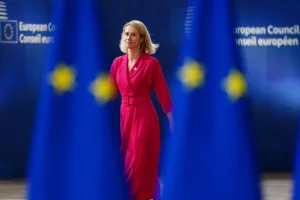
Within hours Iranian Foreign Minister Abbas Araghchi was on the telephone to EU foreign policy chief Kaja Kallas.
According to a readout issued by his ministry, Araghchi demanded a decisive response from the European Union, the United Nations Security Council and the international community, and called for the perpetrators and their backers to be held to account.
He went further on X, writing that the attack had been carried out “at Israel’s behest to drag Europe into its war”. No public evidence was offered for the claim.
Ebrahim Azizi, who chairs the Iranian parliament’s National Security and Foreign Policy Commission, added that “Iran does not let actions go unanswered”. Iranian state-affiliated media noted that Tehran’s ballistic missiles could reach any point in Ukraine.
The demand that Brussels answer for Kyiv’s targeting decisions is awkward, because the EU has spent five months insisting that the Iran conflict belongs to somebody else.
The US and Israel began striking Iran on February 28, killing supreme leader Ali Khamenei. Tehran closed the Strait of Hormuz, energy and fertiliser prices climbed across the continent and Washington asked European governments for warships.
Kallas said there was no appetite among EU foreign ministers for extending the bloc’s naval mission into the Gulf, and stated plainly that “this is not Europe’s war”.
Brussels confined itself to sanctions on Iranian officials over the closure of the strait, adopted on May 22, and to welcoming the memorandum on reopening the waterway signed in June. That agreement broke down in July and American bombing resumed.
Ukraine has now entered the same conflict on its own initiative, without any decision by the European Council.
Europe’s exposure is not rhetorical. Team Europe has provided about €69.3 billion in military aid to Ukraine since 2022, according to European Parliament research drawing on the Kiel Institute’s Ukraine Support Tracker.
European military allocations averaged roughly €2 billion a month between January and April 2026. Bilateral aid attributable specifically to drones reached about €1.6 billion in those four months alone, more than in the whole of 2025.
The €90 billion loan approved on April 23 goes further. Around €60 billion of it is intended to build up Ukraine’s military industry, with the remaining €30 billion covering immediate budgetary needs. Repayment is tied to Russian reparations that may never be paid.
Berlin has been explicit about what the money buys. Germany’s defence ministry said it would support Kyiv in financing “so-called deep strike capabilities” — the category of weapon used in the Caspian.
Zelensky said on July 24 that Ukrainian drones would reach 4,000km next year, with a longer-term goal of 10,000km. Amirabad, the Iranian port the SBU says feeds Russia’s drone supply chain, lies well inside the current range.
NO SAY IN THE TARGETING
European governments fund the capability. They do not choose the targets, and there is no mechanism by which they could.
Zelensky announced a 40-day campaign of deep strikes on June 25, framing it as pressure to force Moscow to end the war. The Caspian operation formed part of that campaign, alongside strikes on a Siberian oil refinery, a fuel depot at Rostov-on-Don and a logistics hub at Yekaterinburg.
Washington has already found the limits of its influence. The Trump administration warned Kyiv against attacking non-Russian vessels in the Black Sea days before the Caspian operation, according to The Wall Street Journal, after Ukrainian drones hit four tankers near Novorossiysk, one chartered by the American oil company Chevron.
Days later Ukrainian drones struck a ship Tehran describes as Iranian and civilian.
Brussels has issued no comparable caution, publicly at least. Its position remains that Iran arms Russia, that Iranian ports on the Caspian have fallen under EU restrictive measures since 2024, and that strikes on Russian military logistics are a matter for Kyiv.
That position is coherent until Iranian missiles land on a country the EU is funding, arming and preparing to admit as a member state. Tehran has said the strike cannot go unanswered. Europe has no vote on what the answer is.