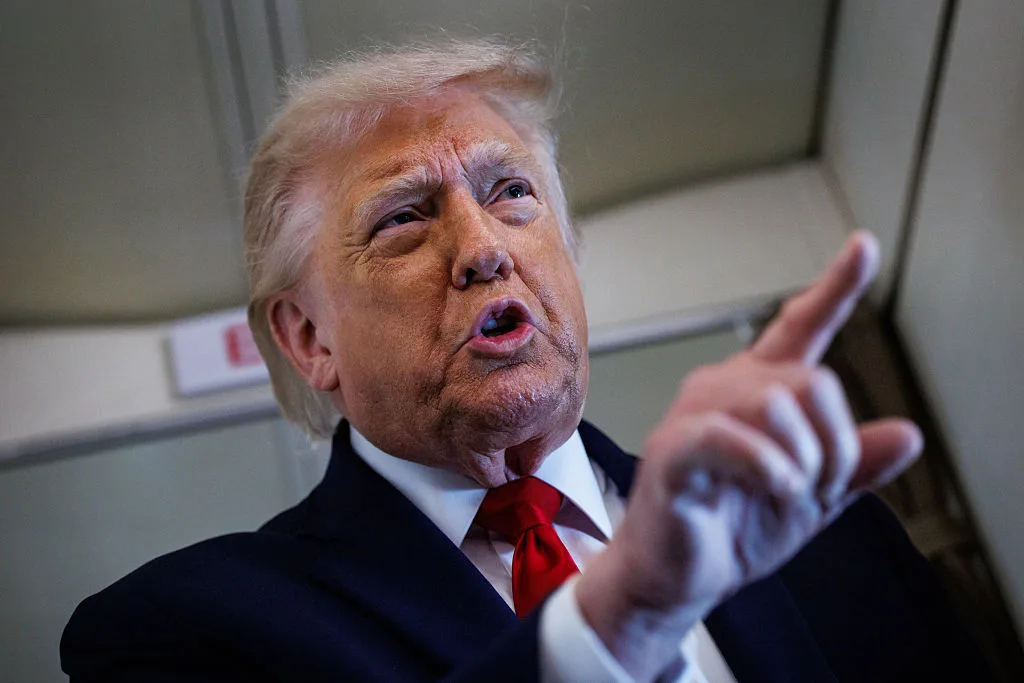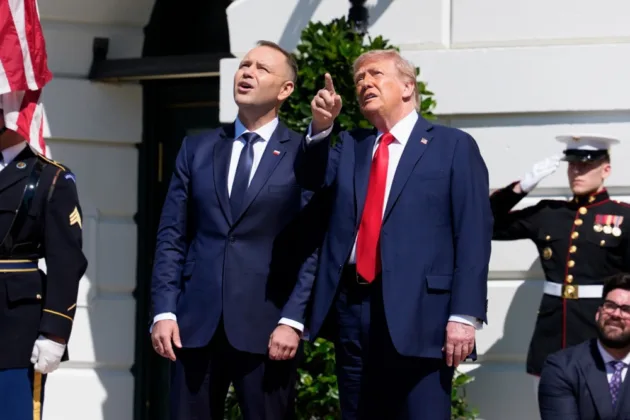







US President Donald Trump has marked the 250th anniversary of US independence with a storm-delayed speech in a near-empty Washington, using the occasion to boast of the US navy “sinking the Spanish fleet to the bottom of Manila Bay” and to liken that 1898 victory to this year’s campaign against Iran.
On the morning of the country’s roundest birthday, the capital woke to temperatures climbing towards 40C (104F) and humidity near 80 per cent, all but deserted, as though it were a summer Thanksgiving. There was no traditional parade along the National Mall this year, and the few early risers crossing the esplanade had travelled in from other parts of the United States.
AT ODDS WITH MADRID
The evening’s most striking passage, at least from a European vantage, concerned Spain. Running through a list of military glories, Trump pointed to a banner he said flew atop the US flagship after the navy “sank the Spanish fleet to the bottom of Manila Bay” in 1898, which he called one of the greatest naval victories in history.
He then drew the comparison he had been building towards, likening it to sinking “the entire Iranian navy, 159 ships” in a single moment. The White House put the number of Iranian vessels destroyed at between 155 and 159, a claim that has not been independently verified.
The jibe at a long-defeated Spanish fleet landed as Trump’s administration has been openly at odds with the current one. Washington’s ambassador to NATO, Matt Whitaker, said the President was unhappy with Spain over its refusal to let US forces use the Rota and Morón bases during the war with Iran, known to the US as Epic Fury, and over Madrid’s resistance to the alliance’s goal of spending 5 per cent of output on defence.
The Spanish Government under Prime Minister Pedro Sánchez has yet to set out a credible path towards that target, Whitaker said. The complaint surfaced shortly before a NATO summit due to open in Ankara on July 7-8, the first since 32 allies agreed at The Hague in 2025 to lift defence budgets towards the new benchmark. Spain also restricted the use of its airspace during the operation.
THE PARTY, EVACUATED
The centrepiece events went ahead, though not without upheaval. A storm forced the evacuation of the National Mall shortly before the start, with the Metropolitan Police and the Secret Service directing spectators towards nearby metro stations and open museums.
The heat wave that had gripped the east coast for days put about 150 million people under alerts. Freedom 250, the Trump administration group organising the celebrations, called off the Independence Day parade planned for the Mall and cut the hours of the Great American State Fair, which opened late. Philadelphia, where the Declaration was signed in 1776, scaled back its main events, as did roughly two dozen towns along the east coast.
The aerial programme was cut short too. The new Air Force One, a refurbished former Qatari Boeing 747 that had entered service only days earlier, passed over at about 7.30pm escorted by four F-22 Raptors, just as the Mall was being cleared. Earlier the crowd had seen the Thunderbirds’ eight F-16s over the capital for the first time in the team’s 73-year history, along with the veteran B-52, the B-1B and the stealth B-2 bombers, F-22 and F-35 fighters and the Blue Angels’ F/A-18s.
The Salute to America 250, set for 7pm, did not begin until about 10.45pm. Trump, who took the stage shortly after 11pm, had promised on July 1 in North Dakota to give “a really long speech … just to show that I can do anything”. In the event he spoke for under 40 minutes. Close to midnight, what organisers called the largest fireworks display in the country’s history, some 850,000 shells over 40 minutes, lit the sky against the lightning.
NOT A HOME CROWD
The elements aside, the politics of the capital did little to help Trump’s Fourth of July in the country’s foremost progressive stronghold. Washington gave him about 6.5 per cent of its vote in 2024, against roughly 90 per cent for Kamala Harris. In neighbouring Maryland, Democratic governor Wes Moore delivered a rival address from Annapolis, while left-wing groups protested at the “politicisation” of the anniversary.
Polling averages put the President’s approval at around 38 per cent, near the lows of his second term, weighed down by the war with Iran and rising energy prices.
That Washington woke emptier than expected owed to the heat, to the politics and to the nature of the city itself. Fewer than half of its residents were born there, and many used the holiday, observed on July 3, to travel, in what forecasters called one of the busiest road weekends of the year.
Though the weather nearly stopped it, Trump marked the anniversary in a Washington without its residents, peopled briefly by patriots faithful to the tradition of celebrating the Fourth in the capital and by MAGA supporters proof against heat, inflation, wars and storms.