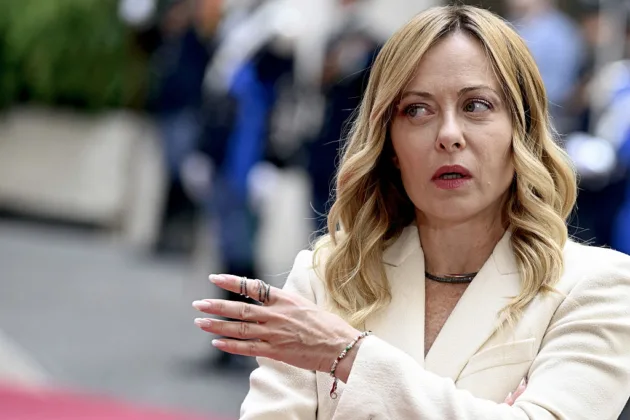






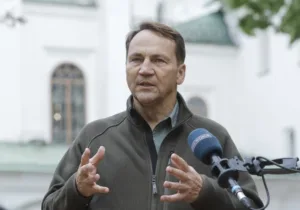

Italian Prime Minister Giorgia Meloni has met UK Conservative leader Kemi Badenoch in Rome on August 24 for an informal meeting. It brought together the two leaders facing growing pressure from political forces further to their right.
The meeting lasted around an hour and took place over coffee at a café in central Rome. Badenoch, who has described Meloni as an inspiration, was in Italy and used the visit to meet the Italian prime minister.
The two discussed the economy, migration and wider political issues. The pair have maintained a political relationship since 2023, when Badenoch was Britain’s business and trade secretary.
Badenoch subsequently praised Meloni’s economic record in a post published on social media after the meeting. “Once upon a time, it was Italy’s economy in the doldrums. Today Italy’s borrowing costs are lower than Britain’s,” she wrote.
She added that “markets and investors have more confidence in Giorgia Meloni’s Italy than in Labour’s Britain”.
The meeting attracted particular attention after The Times reported that Meloni had advised Badenoch against reaching an agreement with Nigel Farage’s Reform UK. According to the newspaper, Meloni told Badenoch that “you’ve got to be yourself” and to “be your own woman and stand your ground”.
The newspaper said she also urged Badenoch not to give in to pressure for a deal with Farage. The report presented the exchange as advice from one conservative leader facing pressure from the right to another.
That interpretation was subsequently challenged. On August 25, sources in Fratelli d’Italia (Brothers of Italy) pushed back against the suggestion that Meloni had expressed hostility towards Farage.
Their statement said Meloni had never suggested that Badenoch should avoid an alliance with Farage and Reform UK. It added that she had “no reason for hostility” towards Farage’s movement, while renewing her regard for Badenoch and the Conservatives.
The statement also said Meloni had not entered, and did not wish to enter, into British party politics. The Times has since removed the claim, and the quotes attributed to Meloni, from its report.
This leaves a distinction between the underlying facts and the more specific account of what Meloni said about Farage. The two leaders met privately and discussed British and Italian politics, but the conversation was not recorded or publicly transcribed, meaning the exact exchange cannot be independently established.
The controversy nevertheless highlights a political parallel between the two leaders. Badenoch is facing the rapid rise of Farage’s Reform UK, which is competing directly with the Conservatives for voters on the right.
A YouGov poll conducted on August 16-17 put Reform on 24 per cent, five points ahead of the Conservatives on 19 per cent. Labour stood at 22 per cent.
Badenoch has so far rejected a formal alliance with Farage. Speaking at the Edinburgh Festival Fringe on August 22, she described a possible Conservative-Reform government as a “monstrous Reform/Conservative hybrid”.
Farage has ruled out an accommodation from his side too. He said deals were a matter of trust and that he did not trust the Conservatives.
The next UK general election is not due until 2029, although an earlier election remains possible. Britain’s first-past-the-post system also means that national polling figures cannot simply be converted into parliamentary seats.
Any Conservative-Reform cooperation could reduce vote-splitting in marginal constituencies. An alliance would not automatically guarantee a parliamentary majority, though, and could also risk alienating voters who distinguish the Conservatives from Reform.
Meloni faces a different but increasingly significant challenge on her right. Her party, Fratelli d’Italia, remains by far the largest political force in Italy.
The centre-right coalition she leads in government is nonetheless having to contend with the rapid rise of Futuro Nazionale (National Future). Former general Roberto Vannacci founded the party in February after leaving the League.
According to a YouTrend poll reported by Reuters on July 24, Futuro Nazionale had risen to 7.6 per cent, while Fratelli d’Italia stood at 26.4 per cent. Reuters reported that the movement was drawing support from parties within Meloni’s governing coalition.
The significance of Vannacci’s rise goes beyond his current share of the vote. The key question is whether Futuro Nazionale will join Meloni’s centre-right coalition ahead of the 2027 general election.
A YouTrend simulation reported by Reuters on July 16 found that a right-wing alliance including Vannacci could secure a parliamentary majority. The centre-left could prevail if Futuro Nazionale ran separately.
“The outcome of the next election will depend not only on the electoral law, but crucially on where Futuro Nazionale positions itself,” YouTrend said. The simulation followed approval by Italy’s lower house of a fully proportional electoral reform, which awards a bonus of 70 seats in the 400-member chamber to any bloc taking more than 42 per cent of the vote.
The latest polling reinforces the risk. An average of polls cited by Reuters on July 24 put the centre-left on 44.3 per cent, compared with 42.2 per cent for Meloni’s coalition.
According to YouTrend, nearly two-thirds of Vannacci’s voters would also favour an electoral pact with the centre-right.
That makes the parallel with Britain relevant. Farage is already a direct electoral competitor to Badenoch, while Vannacci remains much smaller than Meloni.
Yet both leaders face the same broader strategic problem: How to prevent a rival on the right from taking enough votes to weaken the wider conservative camp.