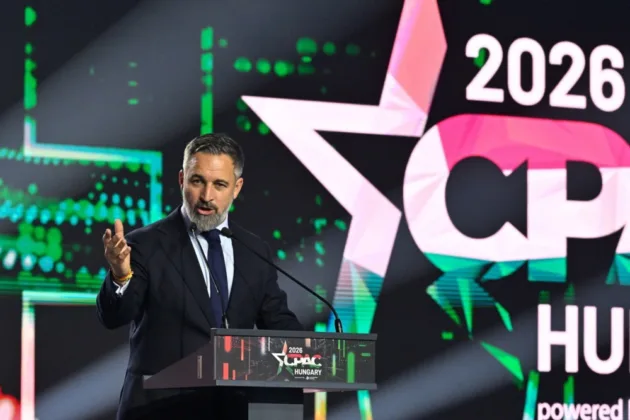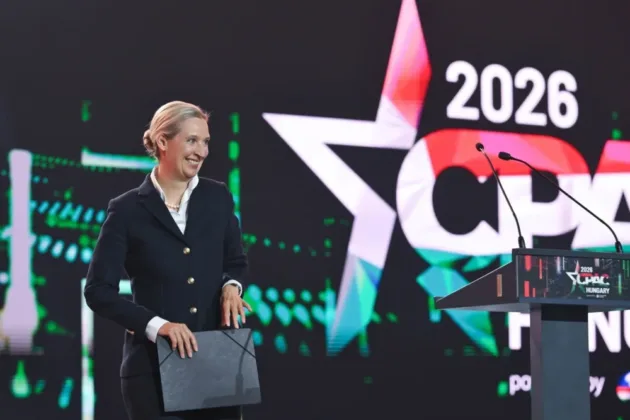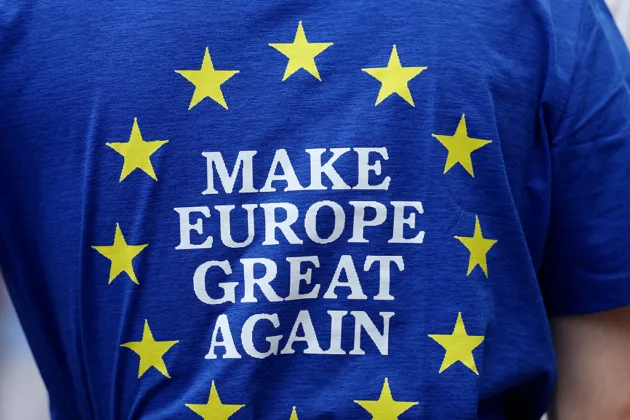



The Conservative Political Action Conference, better known as CPAC, is beginning its first activities in Italy this weekend, marking the country as a potential European hub for the MAGA movement.
A flagship gathering of the US conservative movement, CPAC brings together politicians, activists, donors, influencers and policy organisations, serving as an international platform connecting the American right with conservative forces abroad.
It will begin its activities in Rome this weekend with a preparatory summit bringing together its organisers, Italian and international political figures and other participants, including a closed-door dinner and a press conference. The objective is to hold a first major conference in 2027, after Italy’s next general election, before continuing to organise the conference regularly in the country.
Brussels Signal has spoken exclusively, both on and off the record, with Italian organisers of CPAC, as well as Italian political figures interested in the conference. Their accounts indicate that the arrival of CPAC in Italy has a geopolitical dimension.
Italian Prime Minister Giorgia Meloni, once sceptical of hosting the conference in Italy, has now given the initiative the green light, presenting herself as a figure aiming to bring together different parts of the Western camp at a time of growing political and geopolitical fragmentation. With Hungary having served as CPAC’s main European base under Viktor Orbán, Italy is now being considered as a new platform following his fall from power.
“Meloni initially didn’t want to have CPAC hosted in Italy,” Marcel Kaminstein, one of the main organisers of the Italian edition of CPAC, told Brussels Signal. “She was worried that the conference would give the Italian right an image that was not serious enough. We started discussing it by guaranteeing that it would be done in a more controlled way than the American format, respectful of the Italian societal nuances, bringing in high-level figures from Italy, Europe and the United States. In the end, she was convinced to let us move ahead.”
CPAC was founded in 1974 and has grown from an annual gathering of US conservatives into one of the most important meeting places of the American right. Its activities combine political speeches, policy discussions and networking among politicians, activists, donors, media figures and conservative organisations.
In the United States, the event is also often seen as colourful and highly theatrical, with an exuberant atmosphere and provocative rhetoric — precisely the image Meloni, according to Kaminstein, initially feared could be imported into the Italian political scene.
Its close association with MAGA has developed particularly through Donald Trump, who has repeatedly used CPAC as a major platform and whose movement has become increasingly central to the conference.
Under the leadership of its current chairman, Matt Schlapp, a veteran Republican operative who served as President George W. Bush’s political director, CPAC has expanded well beyond its traditional American base, becoming an international political brand and a vehicle for building relationships between the US conservative movement and its counterparts abroad. It has established a growing network of conferences across Europe.
Hungary was the first major European outpost, with CPAC Budapest launching in 2022 and returning every year since. The conference developed close links with Viktor Orbán’s government and became an important meeting point for American conservatives and European right-wing political forces. Poland followed in 2025, while Britain joined the network this year with its first CPAC conference in London in July.
That relationship changed after Hungary’s 2026 election, with newly elected Prime Minister Péter Magyar distancing itself from Orbán’s network of state-backed conservative organisations. For CPAC, Budapest remains a possible venue, but without the political backing it enjoyed under Orbán. It is against this backdrop that interest in bringing CPAC to Italy has increased.
“Italy is a natural hub for CPAC,” Kaminstein told Brussels Signal. In his view, the country combines a relatively conservative society, the presence of the Vatican and its importance to a significant part of the American right, as well as a conservative government led by a strong political leader such as Meloni.
Kaminstein, 48, was born in Philadelphia to an Italian mother from Rome and an American father of German-Polish-Russian Jewish background. He holds both American and Italian citizenship. He studied at the American University of Rome, and later served as president of the American Club of Rome, and has also worked for several American presidential candidates. His political and professional network has also brought him into contact with Matt Schlapp.
“I had already suggested to him some time ago that CPAC should be held in Italy, but Schlapp’s response was blunt: ‘Meloni doesn’t want it.’”
According to sources close to the Italian government, until last winter Meloni did not want to host CPAC mainly because she feared it could prove counterproductive to her strategy of acting as a bridge between European capitals and the US administration at a time of heightened transatlantic tensions. Her strategy had relied in part on her perceived privileged relationship with Trump, based on her ideological affinity with the MAGA movement. However, hosting CPAC in Italy could have risked making the government appear too closely aligned with MAGA in the eyes of some European partners.
Since then, relations between Trump and Meloni have deteriorated significantly, with Italy declining to fully align itself with some US demands, for example regarding American ambitions over Greenland and the American-Israeli war against Iran. Trump has repeatedly publicly ridiculed Meloni, undermining the perception of their once-privileged relationship.
However, Meloni’s broader foreign policy strategy remains focused on positioning herself as a figure able to bridge different parts of the transatlantic alliance and help keep it united. Against this backdrop, maintaining strong transatlantic ties between conservative movements takes on particular importance.
“The fact that CPAC is coming to Italy challenges the narrative of a break between Italian and American conservatives,” Francesco Giubilei told Brussels Signal, who is helping to organize CPAC in Italy.
Giubilei, 34, is a publisher, writer and one of the emerging public figures of Italy’s conservative right. He chairs the conservative think tank Nazione Futura, previously served as an adviser to Italy’s Culture Minister under the Meloni government, and has participated in numerous CPAC events in the United States and Europe.
He argues that tensions between political leaders do not undermine the ongoing work and cooperation between Italian and American conservatives. “CPAC is an event that began in the Reagan era and has been around for decades. There has been cooperation for many years. The relationships have always been there.”
“Italy can become CPAC’s new main base in Europe now that Hungary has changed government,” he says.
Kaminstein and others are now working to establish an organisation in Italy that can bring CPAC to the country not just once, but on a regular basis over the medium and long term. To do so, Kaminstein is creating a non-profit organisation called COITALIA that will serve as CPAC’s operational arm in the country.
“I’m looking for strategic funding partners and putting together a board of directors. We want to operate over the long term,” Kaminstein says.
As for this weekend’s CPAC initiatives, the information currently available indicates that the three-day programme in Rome will feature a series of high-level gatherings, including a leadership summit bringing together Italian, European and US conservative figures, a gala dinner, a private polo reception and a Vatican-related event, a press conference and a closed-door dinner.
Brussels Signal has obtained an exclusive look at the list of confirmed participants for this weekend’s CPAC initiatives in Rome. Among the first confirmed names is former British Prime Minister Liz Truss, alongside Italian MPs and MEPs from Giorgia Meloni’s Brothers of Italy and Matteo Salvini’s League, as well as senior figures from both parties. The list also includes figures close to Polish President Karol Nawrocki, prominent Italian journalists and political commentators, and Italian, American and British entrepreneurs — some of whom do not appear to have an obvious political affiliation — as well as representatives of Turning Point USA, the organisation founded by the late Charlie Kirk, and organisers of CPAC events in other countries.
Invitations have also been extended to all members of the Italian government, including Prime Minister Meloni, as well as the leaders of the three main governing parties — Brothers of Italy, the League and Forza Italia — although their attendance has yet to be confirmed.