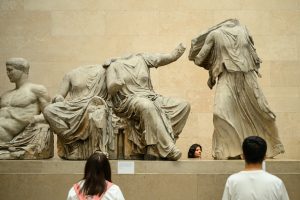



Greek Prime Minister Kyriakos Mitsotakis has rejected any agreement that would oblige Athens to recognise the British Museum’s title to the Parthenon Marbles, also known as the Elgin Marbles.
Mitsotakis said Greece could not accept an arrangement requiring it to acknowledge the museum’s ownership “or a scheme that would mean we ‘borrow’ parts of our own monument”. He urged Britain to find the political will to reunite the sculptures in Athens.
His article came a day after The Daily Telegraph reported that negotiations between Greece and the museum, launched in 2021, had effectively stalled over ownership. No talks were under way and none were expected soon, the paper said, though channels remained open.
A British Museum spokesperson told Greek state news agency AMNA that its position and openness to a deal were unchanged.
The dispute turns on the legal form of any agreement. The museum argues the British Museum Act 1963 bars it from permanently disposing of objects in its collection and allows it only to lend them.
A conventional loan requires the borrower to accept the lender’s ownership. Athens, which maintains the sculptures were removed illegally, regards that as a red line.
The latest flashpoint is the Bayeux Tapestry, on loan to the British Museum from France until July 2027. In August, museum director Nicholas Cullinan told the Financial Times the exchange was “a very compelling example of international partnership” that might offer a path forward on the marbles.
Mitsotakis said he had been surprised by the suggestion. Nobody would consider cutting the tapestry in two and displaying half in each country, he wrote, yet that was what had happened to the Parthenon sculptures.
Greek hopes of a breakthrough had risen in December 2024, when a deal was reported to be close after Mitsotakis met then prime minister Keir Starmer in London. They grew again when Andy Burnham, who as mayor of Greater Manchester had called for the sculptures’ unconditional return, entered Downing Street on July 20.
Burnham has since stepped back. “Ultimately it’s an issue for the British Museum, isn’t it?” he told the Financial Times in August.
In a written parliamentary answer on September 10, the British Government said it had no plans to change the law to allow a permanent transfer. The impasse comes as Burnham seeks closer ties with the European Union ahead of a UK-EU summit expected later this year.
The sculptures were removed from the Acropolis in the early 19th century on the orders of Lord Elgin, then British ambassador to the Ottoman Empire. According to the Greek Culture Ministry, the British Museum holds about 60 per cent of the Parthenon’s surviving sculptural decoration.