





The federal chairman of the Turkish Community in Germany (TGD), Gökay Sofuoğlu, has called on the federal government to lift the residence restriction on asylum seekers in Saxony-Anhalt, arguing that they should not be forced to stay in a state where, he said, they could become targets of right-wing extremists.
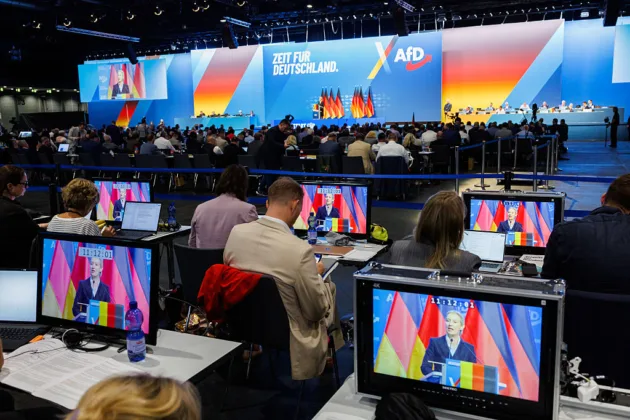
The appeal follows the Alternative for Germany (AfD) victory in the state election on September 6.
The AfD took 43.8 per cent of the vote and 39 of 83 seats in the Magdeburg Landtag, three short of the 42 needed for a majority, despite the state branch being classified as a confirmed right-wing extremist organisation by the state’s domestic intelligence service in 2023, a designation the party rejects as politically motivated.
Turnout was 77.8 per cent, up from 60.3 per cent in 2021.
The Christian Democratic Union (CDU) of minister-president Sven Schulze fell to 17.2 per cent and 15 seats, down from 40. Schulze, who took over from Reiner Haseloff in January, congratulated the AfD on becoming the strongest force in the state.
“People with a migration background in Saxony-Anhalt no longer have time for theoretical security debates,” Sofuoğlu told the German press agency dpa.
Politics must “actively protect them from right-wing extremists”.
Refugees were especially at risk, he said. “We call on the federal government to lift the residence obligation for refugees. Nobody should have to remain in a place where they can become a target of right-wing extremists. We must not wait to react until people have been killed.”
Sofuoğlu also asked democratic parties in the new Magdeburg Landtag and other Länder to fund advice and protection services for victims of anti-Semitic, racist, anti-Muslim and anti-queer violence. He urged them to rule out any dealings with the AfD, saying the “firewall” against the party must not be given a door.
German law restricts asylum applicants’ movement. During the procedure they are generally tied to the district of the reception centre, a rule the Asylum Act describes as a “spatial restriction”.
Recognised refugees who still receive benefits can be required to keep their residence in the Land to which they were assigned, in most cases for three years after recognition under the Residence Act.
Saxony-Anhalt takes about 2.7 per cent of new asylum seekers under the Königstein formula, which sets each Land‘s share according to tax revenue and population. The federal government has not announced a change.
On X the demand was widely mocked as a problem that would solve itself if asylum seekers simply left the state.
Users wrote that they would then go to Berlin or Bavaria, that few locals would object to fewer arrivals, or that the “residence obligation” should apply in countries of origin instead.
Distribution of asylum seekers remains a federal and Land competence. Lifting the rule in one state would shift people and costs to others unless the allocation key were rewritten.
In the Bundestag lobby register, public grants and subsidies to the TGD above €10,000 came to about €4.5 million in 2025. Of that, some €1.3 million came from the family ministry’s “Gemeinsam Schaffen” programme, €1.6 million from “Kultur macht stark” and €630,000 from “Demokratie leben!” projects. The association says it passes part of the money on to other bodies.