

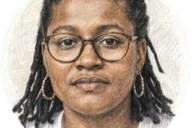
Charlotte Knobloch, former president of the Central Council of Jews in Germany, has called for tougher measures against the Alternative for Germany (AfD), warning that the party is increasingly resembling the Nazi Party before its rise to power.
In an interview with Stern, the 93-year-old said that, while the AfD and the National Socialist German Workers’ Party (NSDAP) should not be equated, comparisons between the two should nevertheless be made.
“[The parties] cannot be equated, but they should be compared,” Knobloch said. She argued that the AfD, like the NSDAP in its early years, has been testing the boundaries of what is politically acceptable while gaining support as its positions become increasingly radical.
“In many areas, I see no difference anymore compared to the NSDAP before it came to power,” she said.
She drew one distinction with the 1930s. “They had made clear from the beginning what they intended, what their politics would look like. Everyone could know that,” she said of the Nazis.
Knobloch, who survived the Holocaust as a child hidden in Franconia, northern Bavaria, contrasted the AfD with previous German right-wing parties including the National Democratic Party of Germany (NPD), now called Die Heimat, the Republicans and the German People’s Union (DVU), absorbed by the NPD in 2011.
“I have experienced many terrible parties: NPD, Republicans, DVU. They came and went. None was as dangerous as the AfD,” she said.
She led the Central Council from 2006 to 2010 and has headed the Jewish Community of Munich and Upper Bavaria since 1985.
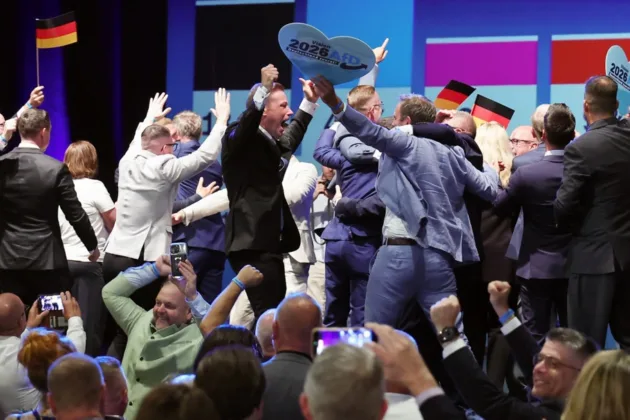
Knobloch’s comments have come as the AfD continues to strengthen its position ahead of two State elections in eastern Germany.
In Saxony-Anhalt, voters are due to go to the polls on September 6, with the party hoping to emerge strong enough to pursue a single-party government. Surveys in August have put the AfD, whose lead candidate is Ulrich Siegmund, at between 41 and 43 per cent, about double the score of the governing Christian Democratic Union (CDU) of minister-president Sven Schulze. An absolute majority in Magdeburg requires 42 of at least 83 seats.
Mecklenburg-Western Pomerania will hold its election two weeks later, on September 20, where the AfD is also leading in opinion polls. Infratest dimap put the party on 36 per cent in July, ahead of the Social Democratic Party (SPD) of State premier Manuela Schwesig on 29 per cent.
The party is currently leading nationwide polls as well. A YouGov survey published on August 18 placed it on 28 per cent, eight points clear of the CDU/CSU.
On February 26 the administrative court in Cologne barred the domestic intelligence service, the Federal Office for the Protection of the Constitution, from describing the AfD as a confirmed right-wing extremist organisation pending a full hearing, finding the evidence submitted did not support the label. The party is handled as a suspected case and denies the charge.
Knobloch said she was particularly concerned by what she sees as insufficient legal consequences for inflammatory statements by AfD politicians.
“Why is it possible to incite hatred against people with impunity today?” she asked, arguing that Germany should consider more forceful responses to political extremism.
Knobloch called for Germany to reconsider the possibility of banning the AfD, while acknowledging that such a move would have little chance of succeeding under current circumstances. “Perhaps one should try it nevertheless,” she said.
“We must resort to radical means ourselves in the fight against these radicals; otherwise, we will not succeed,” she said.
She also suggested that authorities should examine whether individuals could be stripped of their eligibility to hold public office, arguing that “everything that could help” should be attempted. Article 18 of the Basic Law lets the Federal Constitutional Court declare such rights forfeited and withdraw eligibility for office. It has never been applied since 1949.