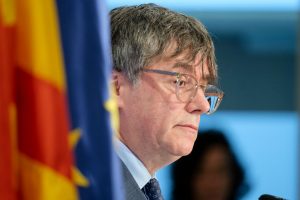




Catalan separatist leader Carles Puigdemont has been cleared to return to Spain after the country’s Constitutional Court ruled that the 2024 amnesty must apply to the embezzlement charges arising from the failed 2017 independence bid.
Within minutes of the ruling on October 6, Supreme Court judge Pablo Llarena lifted the national arrest warrants against Puigdemont and two former ministers, Toni Comín and Lluís Puig.
The warrants had been in force since 2017, meaning Puigdemont can now return without being detained on arrival after nearly nine years in Belgium.
The Constitutional Court voted seven against five to uphold an appeal by former Catalan labour minister Dolors Bassa, overturning the Supreme Court’s refusal to apply the 2024 amnesty to her conviction for misuse of public funds.
Although the case concerned Bassa, the ruling establishes the legal interpretation that applies to the other separatist leaders whose cases involve the same offence.
Llarena’s decision was immediate but technically provisional.
His order removes the warrants “until a new express judicial ruling”, while the Supreme Court awaits the full Constitutional Court judgment before formally applying the amnesty to Puigdemont, Comín and Puig.
The judge nevertheless concluded that the Constitutional Court’s ruling could affect the legal basis for the arrest warrants.
In practical terms, though, the biggest obstacle to Puigdemont’s return has already disappeared.
The former Catalan president fled to Belgium on October 30, 2017, after leading the regional government’s attempt to break Catalonia away from Spain.
The independence referendum of October 1 that year had been declared illegal by Spain’s courts and was followed by a unilateral declaration of independence by the Catalan parliament on October 27.
Madrid subsequently imposed direct rule over the region under Article 155 of the constitution.
Puigdemont was accused of misusing public money to organise the referendum.
The Supreme Court had previously refused to extend the amnesty to the embezzlement offence, arguing that the separatist leaders had obtained a financial benefit by using public funds for their political project rather than spending their own money.
The Constitutional Court has now rejected that interpretation, clearing the principal legal obstacle to applying the amnesty to Puigdemont.
The amnesty law has been in force since June 11, 2024, and the same court upheld its constitutionality in June 2025, while trimming parts of its scope.
Until now, though, the Supreme Court had kept the embezzlement convictions outside it. Puigdemont tried to come home once regardless, appearing briefly in Barcelona on August 8, 2024, before evading the police.
His return comes at an awkward moment for Prime Minister Pedro Sánchez.
Spain is heading for a snap general election on November 29 after Sánchez called the vote on October 5 following a series of parliamentary defeats.
Puigdemont’s Together for Catalonia (Junts) party played a decisive role in blocking the government’s latest housing measures, prompting Sánchez to abandon his attempt to govern until the end of the parliamentary term.
Junts voted with the People’s Party (PP) and Vox on October 2 to throw out two housing decrees, denying the government a majority on what it had presented as its central policy.
Puigdemont’s party was nevertheless instrumental in keeping Sánchez in power in the first place.
In 2023, Sánchez secured another term as prime minister after reaching an agreement with Junts that included the amnesty for those involved in the Catalan independence movement.
The deal allowed Sánchez to form a minority government but made him dependent on the support of a party whose leader remained in exile.
That relationship has since deteriorated.
Junts has increasingly opposed Sánchez’s government, with Puigdemont retaining considerable influence over Spanish politics despite remaining in Belgium.
Sánchez nevertheless defended the amnesty hours after the ruling, arguing that it was intended to resolve the political conflict surrounding Catalonia and improve coexistence.
The opposition PP has taken the opposite view, portraying the amnesty as a political bargain that Sánchez made to secure power and promising to make Puigdemont’s return an issue in the election campaign.
Its leader, Alberto Núñez Feijoo, said the amnesty was a deception and that voters should be the ones to settle it at the ballot box.
Puigdemont’s return is therefore likely to feature prominently in the campaign.
Puigdemont remains a divisive figure across much of Spain, despite retaining a loyal following among supporters of Catalan independence.
Junts has indicated that Puigdemont will address the media from Waterloo, where he has lived since fleeing Spain.
His lawyer, Gonzalo Boye, has said Puigdemont will not rush back before the amnesty has been formally applied, despite the arrest warrant having already been lifted.
Catalan separatist Carles Puigdemont, who is still wanted by the Spanish justice system, has been reinstated as leader of the Together for Catalonia party. https://t.co/lXIYfaIMVw
— Brussels Signal (@brusselssignal) October 28, 2024