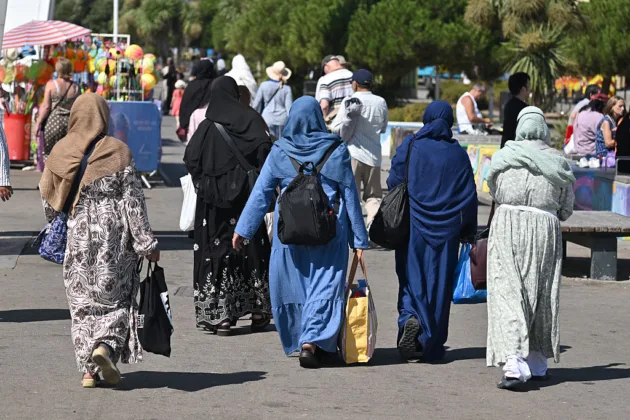






Europe has overtaken every other region of the world as a destination for international migrants, hosting 94 million foreign-born residents in 2024, according to the United Nations International Migrant Stock dataset compiled by its Department of Economic and Social Affairs. Northern America came second, with 61 million.
The continent accounted for close to a third of the 304 million international migrants counted worldwide, a global figure that has roughly doubled since 1990 while still amounting to 3.7 per cent of the world’s population.
The European total has risen by 43 million since 1990, the largest increase of any region over that period. Migrants accounted for 12.6 per cent of the continent’s population in 2024, against 7.1 per cent in 1990.
The two leading destinations have been moving in opposite directions. Northern America has added 34 million migrants since 1990, though its growth has slowed to below 1 per cent a year since 2020, down from 3.8 per cent a year in the 1990s and 2.3 per cent in the following decade.
Europe’s intake accelerated over the same years. The UN attributed part of that to refugee flows caused by the Ukraine war.
The growth is heavily concentrated in a handful of countries. Germany hosted 16.8 million foreign-born residents, more than any country other than the United States, followed by the United Kingdom with 11.8 million, France with 9.2 million, Spain with 8.9 million and Italy with 6.6 million.
Spain has changed fastest. Its foreign-born population stood at 814,000 in 1990 and 6.3 million in 2010, and the increase recorded since 2000, of roughly 6.8 million people, is the largest of any current EU member state.
Measured against population size, the ranking shifts. Foreign-born residents made up 51.2 per cent of the population in Luxembourg, 37 per cent in Malta, 25.5 per cent in Austria, 23.1 per cent in Ireland and 21.4 per cent in Sweden, against 4.5 per cent in Poland and 3.4 per cent in Romania.
The split runs between west and east rather than between large and small member states. The foreign-born share reached 19.8 per cent in Germany and 18.5 per cent in Spain, roughly four times the Polish figure and close to six times the Romanian one.
Only Oceania recorded a higher regional share than Europe, at 21 per cent of residents. Asia hosted 92.2 million migrants, almost as many as Europe in absolute terms, but they amounted to 1.9 per cent of its population.
Much of the movement is internal to the continent. The UN found that 74 per cent of European-born migrants living abroad were in another European country, a pattern it did not record anywhere else at that scale.
The largest flow into Europe from outside came from Northern Africa and Western Asia, at 13 million people, followed by Central and Southern Asia at 10 million.
Poland shows how fast the picture can turn. It hosted 1.13 million foreign-born residents in 1990 and 650,000 in 2010, before climbing to 1.74 million in 2024. Women made up 59.5 per cent of that population, the highest proportion in any EU member state and a direct result of the arrivals from Ukraine, which itself still hosted 5.1 million foreign-born residents, or 13.4 per cent of its population.
Women and girls accounted for 48 per cent of international migrants worldwide, though they were in the majority in France, Spain, Italy and Sweden.
The dataset also shows how much of the recent increase is involuntary. One in six international migrants worldwide had been forcibly displaced across a border, the highest share since the 1950s, when the global refugee series begins. The UN counted 51.7 million refugees, asylum seekers and others in need of international protection by mid-2024, with 18 million of them added since 2010.
The data cover the years before the European Union’s Pact on Migration and Asylum took effect on June 12 and before member states gave final approval to the returns regulation on October 1. Both were presented in Brussels as the instruments that would finally give the bloc control of its external borders.
Seven weeks after the pact entered into application, more than 70,000 people crossed from Morocco during the invasion of the Spanish city of Ceuta on July 30 and 31, the largest such crossing on record. The European Commission said afterwards that the system had held, because almost all those who entered were returned and none reached the mainland.
The pressure has not eased since. Illegal immigration into Spain has continued to climb this year even as the rest of the European Union records sharp falls, leaving the member state with the largest migrant intake of the century also carrying much of the bloc’s current border burden.