
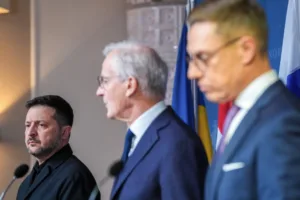

Finnish President Alexander Stubb and Norwegian Prime Minister Jonas Gahr Støre have held a joint telephone call with Russian President Vladimir Putin on October 27 to discuss the war in Ukraine and regional security, marking a notable direct engagement with the Kremlin by Western leaders.
The initiative has nevertheless exposed diplomatic friction among Nordic neighbours, with Danish Prime Minister Mette Frederiksen openly questioning the outreach and cautioning European partners against breaking collective alignment through uncoordinated moves.
According to statements issued by Helsinki and Oslo, the discussion focused on prospective conditions for de-escalation in Ukraine ahead of planned multilateral talks in Abu Dhabi. Both governments said the leaders had also raised security in the Baltic Sea region and the High North.
Both leaders framed the conversation as a pragmatic step informed by their geographic proximity and long shared borders with the Russian Federation. Finland shares a 1,340km frontier with Russia and joined NATO in April 2023, while Norway, a founding member of the alliance, meets Russia in the Arctic.
“The discussion was frank and substantive,” Stubb said.
“We are neighbouring countries to Russia. The outcome of this war will have a direct impact on our and the broader European security. Ending the war requires direct discussions.”
Støre echoed the call for diplomatic off-ramps, pointing to the widening regional fallout: “The war comes with enormous human and material costs. The suffering and destruction will impact generations. In the call we stressed the importance of de-escalation.”
Anticipating unease across European capitals, the Finnish presidency stressed that both leaders “took the call as leaders of their respective countries and did not speak on behalf of Europe as a whole.”
Stubb and Støre also spoke jointly with Ukrainian President Volodymyr Zelensky immediately after the exchange to debrief Kyiv and reaffirm their ongoing military and financial assistance. Norway is the only non-EU country to have pledged support for Ukraine’s financing needs in 2027, while Finland has approved 35 separate packages of assistance.
Zelensky welcomed their focus on pushing Moscow to halt strikes against Ukrainian civilian and energy infrastructure and preparing the ground for upcoming trilateral talks between Ukraine, the US and Russia in Abu Dhabi, expected in November.
The two leaders co-hosted an earlier round in Oslo on October 20, attended by Ukrainian, US, British, German, Italian, European Commission and NATO officials but not by Russia. US envoy Steve Witkoff then travelled to St Petersburg to brief Putin on its outcome. A Russian delegation is expected to join the Abu Dhabi format.
Despite those assurances, the outreach drew swift criticism from Copenhagen.
Speaking to Danish broadcaster TV 2, Prime Minister Mette Frederiksen expressed clear scepticism over the timing and coordination of the conversation.
“I am very sceptical about this Norwegian and Finnish independent initiative. It has not been coordinated with the rest of us,” Frederiksen said, questioning what the bilateral engagement could deliver. “I believe that one should keep Europe together instead of going solo.”
Swedish Prime Minister Ulf Kristersson, speaking on the margins of the Nordic Council session in Helsinki, said he had been given no advance notice and held low expectations of such contacts, adding that Stockholm’s position remained that peace had to be reached on Ukraine’s terms.
The Kremlin’s official readout and reaction followed Moscow’s standard diplomatic playbook, framing the call as validation that direct dialogue is inevitable, while reiterating its core grievances against the West.
The Russian presidency stated that Vladimir Putin used the call to draw direct attention to what he termed the “confrontational policies of EU and NATO member states”, arguing that such an approach was prolonging hostilities.
Putin reportedly reiterated the “root causes” of Moscow’s invasion of Ukraine, holding firm to Russian demands regarding security guarantees, NATO expansion and geopolitical control. Moscow said a just and lasting peace depended on what it called full and unconditional consideration of Russia’s legitimate interests.
The Kremlin indicated that all three leaders agreed to maintain direct lines of contact moving forward.
Norwegian PM @jonasgahrstore and I had a good phone call with @ZelenskyyUa .
We discussed our prior call with President Putin.
Finland and Norway will continue to support Ukraine, and the efforts to find a just and lasting peace.
— Alexander Stubb (@alexstubb) October 27, 2026