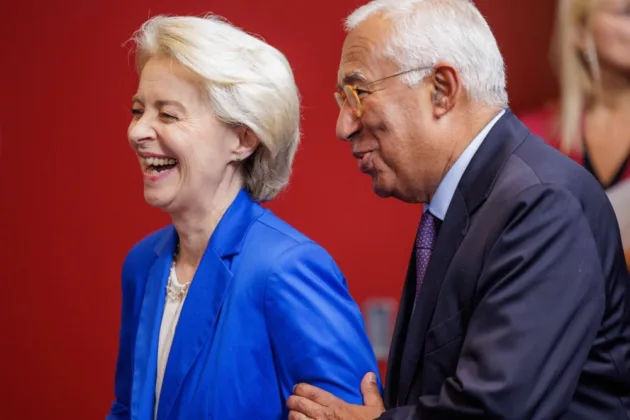
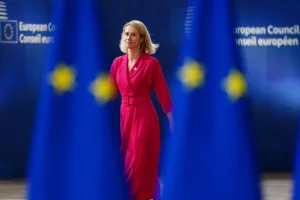
European Council President António Costa has defended his decision to open a diplomatic channel with the Kremlin, after the surprise move blindsided several European Union leaders and overshadowed their summit in Brussels on June 18.
Costa told the 27 he had asked his office to test whether conditions existed for peace talks over Ukraine, a possibility his own team concluded was not currently viable.
His chief of cabinet, Pedro Lourtie, had held several phone calls with a senior aide to Russian President Vladimir Putin, understood to be Yuri Ushakov, although Costa’s office did not confirm the official’s identity.
The contacts were first reported by the Financial Times and Bloomberg, which said the calls were meant to lay the ground for possible talks. An EU official described the exchanges as brief, with nothing discussed on substance.
The disclosure marked a cautious shift after years in which the bloc largely isolated Russia following its full-scale invasion of Ukraine in 2022. Throughout that period Brussels played a supporting role, coordinating sanctions and aid while Washington handled the high-stakes conversations with Moscow.
A CHANNEL OPENED WITHOUT CONSULTATION
The episode laid bare a split over how the EU should deal with Moscow. Costa, who has made the unity of the 27 central to his presidency, ran no broad consultation with national capitals before reaching out.
France and Germany led the pushback. Both argued the timing was wrong and that any contact should run through the E3 format of France, Germany and the United Kingdom, which has been exploring its own line to the Kremlin.
Poland, the Baltic states and the Nordic countries also raised objections, several diplomats said. Estonia, among the bloc’s most hawkish voices on Russia, was prominent among the sceptics, who argued that Moscow had shown no readiness to negotiate seriously.
Multiple officials reported learning of the channel only through media coverage, an embarrassment for a presidency built on coordination. One prime minister is said to have told aides the discussion was pointless while Putin showed no sign of engaging.
SUPPORTERS AND SCEPTICS
Costa found backing elsewhere. Belgium, Slovenia and Austria welcomed the initiative, with Slovakia and Bulgaria also considered favourable.
“Any steps that can lead to a cessation of hostilities and negotiations should be welcomed,” Slovenian Prime Minister Janez Janša said.
His entourage said Costa had acted at the encouragement of Ukraine, which has asked Europeans to take on a bigger role in the peace process, including by talking to Russia.
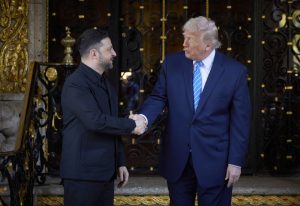
Ukrainian President Volodymyr Zelenskyy, who joined the leaders in Brussels, has pressed the EU to carry more weight in any settlement. “It is important for it to have a strong voice and presence in this process,” he said last month after speaking with Costa.
Dutch Prime Minister Rob Jetten struck a cautious note. “Both Ukraine and Europe have always been very clear that ultimately you will need negotiations to reach a lasting peace deal,” he said, although he stressed that Kyiv must first gain the upper hand on the battlefield.
Italian Prime Minister Giorgia Meloni, sceptical of the E3 club, pushed instead for a single EU envoy chosen by all 27, arguing that a common European voice would carry more weight. The ideal candidate, she suggested, would come from a medium-sized or smaller member state.
A QUESTION OF MANDATE
Summit conclusions endorsed by the 27 stated for the first time that the EU was ready to step up its engagement in the negotiations, provided Moscow committed to a ceasefire.
The contact with Moscow, though, took place days before that text was agreed, raising questions over whether Costa held a mandate or had moved with the backing of only a handful of member states.
His name has circulated for weeks as a possible EU envoy for direct talks with Russia, a role widely seen as carrying considerable political risk. Other names floated have included Finnish President Alexander Stubb and former Italian prime minister Mario Draghi.
The row unfolded as the European Council welcomed a clutch of new faces, among them Hungary’s Péter Magyar, Slovenia’s returning Janša and Latvia’s Andris Kulbergs, reshaping the room in which EU-Russia policy is now argued.
The leaders also agreed to extend the bloc’s sanctions on Russia for a further year, a reminder that pressure on Moscow continues even as some capitals test the ground for dialogue.
Whether the EU can speak to the Kremlin with one voice remains unresolved. Costa has insisted that coordinating the 27 is precisely the job of the Council president, even as the summit showed how far apart those 27 remain.