

A member of parliament for France’s left-wing La France Insoumise (LFI) has proposed to abolish English as the primary mandatory foreign language taught in French schools, demanding it be replaced by Arabic, Wolof and other languages spoken across former colonies to foster cultural and linguistic “créolisation”.
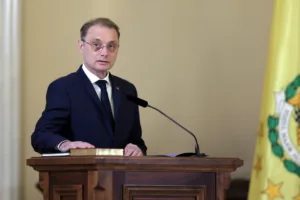
The initiative, put forward by Aurélien Taché, MP for Val-d’Oise, north of Paris, in a wide-ranging policy paper on the future of the French language, outlines an overhaul of national education and linguistic institutions. Taché sat with President Emmanuel Macron’s La République En Marche until 2020 and joined LFI in 2024.
Chief among Taché’s proposals is the removal of English as the default first foreign language (LV1) across public schools, arguing that state curricula should pivot toward non-European tongues, notably Arabic and Wolof, the most widely spoken of Senegal’s national languages, although French remains that country’s sole official language.
On Radio Orient, Taché argued that there weren’t enough teachers of Arabic in France, and that the country reacted negatively in a Pavlovian way against proposals to enhance the offer of Arabic language courses.
The LFI MP has been promoting the idea on the occasion of the release of his book Le français, une langue africaine (French, an African Language), published on October 14, 2026 by Fayard, part of the media group controlled by businessman Vincent Bolloré.
To institutionalise this shift, Taché advocates establishing State-funded maisons de la créolisation (houses of créolisation) across French communes.
These centres would be dedicated to teaching Arabic, West African languages and simplified French orthography, alongside replacing the Académie française, founded in 1635 by Cardinal Richelieu, with a newly constituted “Francophone Academy” that Taché would site in Kinshasa, capital of the Democratic Republic of Congo.
“Sixty-five per cent of French speakers live in Africa,” Taché argued in defending his proposals, asserting that the statistic exposes an unavoidable reality: “Our language, just like our people, is undergoing créolisation. A new Francophonie is emerging.”
L’arabe est la 2e langue la plus parlée en France, mais seuls 222 professeurs l’enseignent !
Dans mon livre, je propose d’en finir avec le tout-anglais, notamment imposé en LV1, pour donner toute leur place à l’arabe, au chinois, à l’espagnol et aux autres langues.… pic.twitter.com/CC0WE8RxoK
— Aurélien Taché (@Aurelientache) October 20, 2026
Critics on the French Right and centre were swift to condemn Taché’s blueprint, describing it as an open capitulation to linguistic balkanisation.
Opponents argue that stripping French children of standard English, the global lingua franca of commerce and science, whilst State-sponsoring regional African languages in the name of decolonisation, would further isolate vulnerable pupils, weaken France’s international competitiveness and actively dismantle the Republic’s secular assimilation model.
Conservative Atlantico founder Jean-Sébastien Ferjou said on X: “Paternalism in all its glory: In essence, as Africans are idiots, simplify their language and make ourselves accessible by forcing the mix of French with local languages. As if entire generations of Africans had not been able to speak perfect French.”
The concept of créolisation, developed by the Martinican writer Édouard Glissant to describe cultures meeting and fusing into a new common identity, has been elevated by LFI founder Jean-Luc Mélenchon into the bedrock of the party’s electoral doctrine.
Mélenchon wrote in 2021 that the French population “is and will be mixed”, adding that the country was creolising at that very moment. He has urged the French to welcome the process rather than mourn it and presents créolisation as the answer to, rather than a version of, the “great replacement” thesis advanced by the Right.
The strategy has paid electoral dividends for the left-wing coalition. By leaning heavily into post-colonial grievances, multiculturalism and explicit appeals to diaspora communities, LFI has established an electoral stranglehold across France’s heavily migrant-populated suburban belts (banlieues), where the party routinely secures upwards of 60 to 70 per cent of the local vote.
Vidéo délirante où Aurélien Taché nous explique que comme beaucoup d'africains parlent français, il faut donc le simplifier et faire apprendre l'arabe et le wolof aux français dans des "maisons de la créolisation "???? Je ne sais même plus quoi dire tellement le niveau de pompage… pic.twitter.com/mG2Js2OKLk
— Nathanaël Benedict Pignalet 🇨🇵 🐘👑 (@NBPignalet) October 15, 2026